Posted in Uncategorized

Budget Friendly Ways to Build Your Cross-Stitch Stash

There are so many different ways to build your collection these days, that this list is just the tip of the iceberg for how to go about it.

1.      Borrowing cross-stitch pattern books

Your local library can be a fantastic resource for finding patterns that may be of interest for you. Your membership is free, and you have hundreds of thousands – if not millions – of resources at your finger-tips! If your library doesn’t have what you want on the shelf, they can place a request upon your behalf to other libraries and the item you need can be brought in. The only cost to you may be over-due fees, photocopying or printing fees.

2.      Buying things only on sale

Sales are becoming a regular occurrence for a variety of businesses and craft businesses are no exception – Mid-year sales, end of financial year sales, click frenzy sales and black Friday sales just to name a few!

Regardless of whether the items are on sale or not, I really enjoy browsing the Fox Collection’s website and seeing what items they have on sale.

3.      Receiving donations from other crafters

When I purchase a pattern or kit I have the best of intentions – usually I have someone in mind for the finished product. For example, I have a variety of baby themed samplers that I have never touched but bought them thinking that I would stitch them for family and friends. My family and friends have had children since I bought the samplers, but I’ve not gotten around to stitching anything for them. Resulting in me being more than happy to give away the patterns to any willing stitcher wanting to take them on.

4.      Purchasing partly completed projects

This option can be the best of both worlds – depending on what you’re interests are and what’s available. However, you will need to be patient. I did a search on the Internet in December 2018 and found that there is a limited market for people selling partially completed projects.

5.      Free downloads/ Free patterns

Type in ‘free cross-stitch patterns’ into your preferred search engine and you are bound to come up with millions of different websites and images enabling you to access free patterns that you can print off or save to your computer. Below is a list of some of my favourite sites:

6.      Swap meets/Swap parties

If this isn’t a ‘thing’ already, it should be! Not only is it a great excuse to catch up with like-minded people, but you get to add patterns and kits to your collection that you may not have otherwise been able to do and you get to pass on patterns and kits that you no longer want or need.

If you’re unable to physically catch up with like-minded people, there are a variety of groups online that encourage the buying, swapping and selling of patterns and kits. An example, is the Buy, sell and swap cross-stitch Facebook public group.

7.      Design your own charts

There are a lot of tutorials on the Internet that can show you how to design your own patterns. Depending on your learning style and how much time you have, there are YouTube clips such as Peacock and Fig’s 10 minute clip on creating your own pattern. They also have a clip on designing your own pattern using Macstitch and Winstitch software. Scribble also shows us how to use stencils on graph paper.

Peacock and Fig’s clip on Making your own cross stitch pattern – 24 December 2015

I used the phrase ‘designing your own cross stitch patterns’ to come across this sample of clips. You can use any variation of this phrase and words to come across similar results.

In summary, there are so many different ways that you can build your collection for little to no money. I’ve recently purchased and downloaded software that will enable me to convert my own photos to cross-stitch patterns – something that will keep me entertained for a long time! I’ve also found myself going through my stash of leftover threads from completed kits when I’ve run out of a colour I really need and the timing doesn’t allow me to go to the physical shop and purchase what I need.e

If you have any other ways in which you’ve built up your collection, I would love to hear about them!

Related Posts and websites

Posted in Uncategorized

My First Cross Stitch Country Quilt

Years in the making

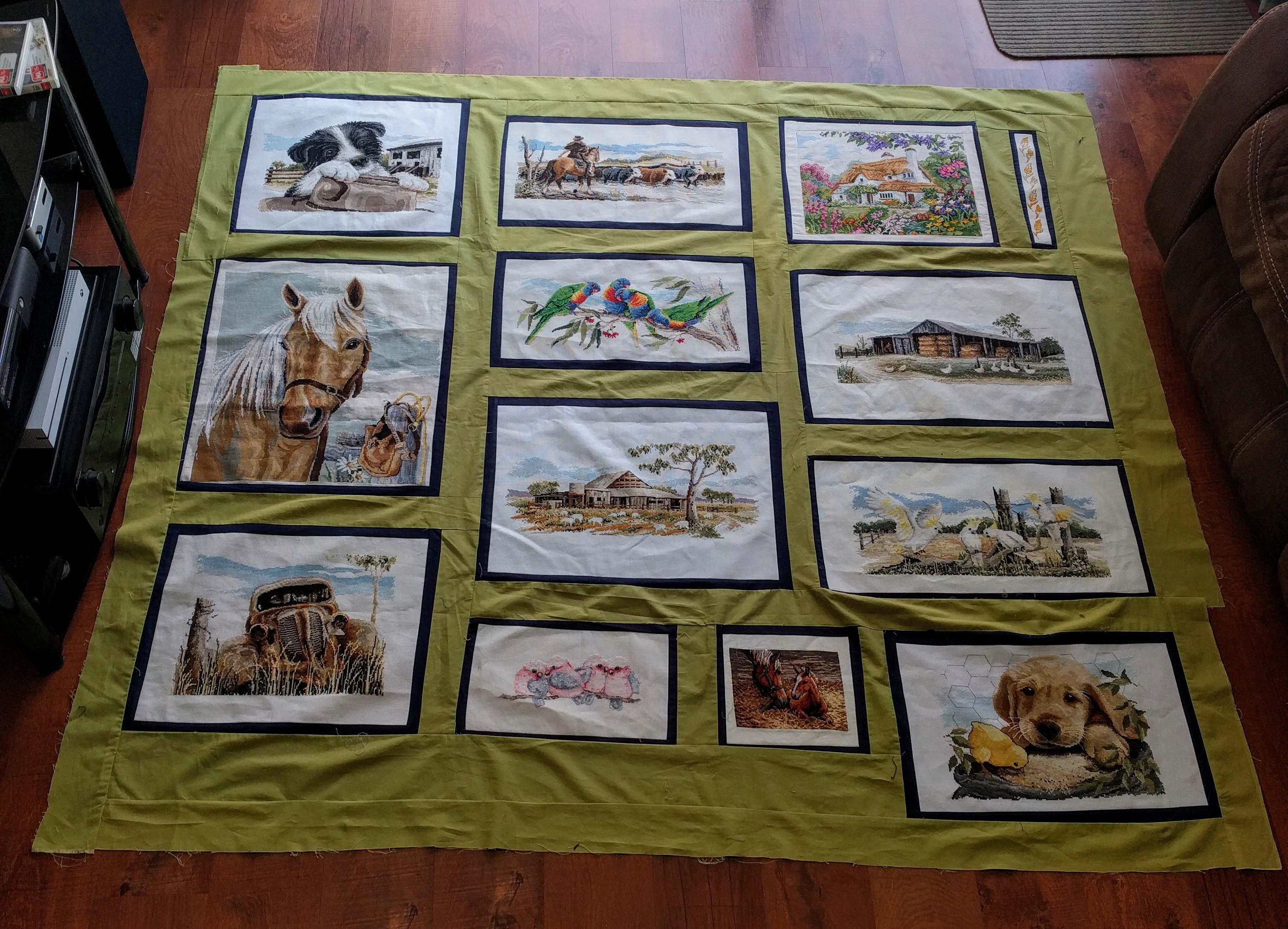
This quilt has been years in the making. Each picture has taken me an average of 3 months to complete, whilst working full-time and studying part time (for 6 years) and other projects in between. The pictures that make up this quilt are mostly Country Threads. The cottage and cat at the fish pond are from two different cross stitch magazines I’ve had for years. The mare and foal are a Dimensions Gold Collection kit (aka Dimensions Good Morning (Horse and Foal)).

Representations

Each picture represents an element of my family’s farm. Growing up we always had two dogs, two cats, many horses, many cows and bulls, chooks (aka chickens), ducks, geese and briefly, a flock of sheep. We’ve also had wild foxes, wombats, cockatoos (that love eating the oats and grass seeds in the round bales of hay), lorikeets, rosellas, galahs, crows, rabbits, hares, the odd echidna and once a pelican! On the farm, we also have a shearing shed that we’ve never used as an actual shearing shed. Instead, it has been a fantastic place for us to store our horse-riding gear, cattle drenching equipment, a place for chooks and ducks to hatch and raise their young, places for the cats to snooze (sleep) and catch mice and rabbits, a place to store square bales of hay, a place for the horses to shelter from the weather and mend from illness or injury. The shearing shed has also been a place for us to store bits and pieces we have wanted to store from the weather.

The creative process

For years I’ve known that I’ve wanted to make a quilt out of these pictures, but I’ve never had a firm idea of how it would look, how big it would be and how many pictures it would exactly it would have. As the pictures progressed and accumulated, I started thinking about the farm on a broader scale and the common colours they involve. Which is how I decided upon the blue and green shades you see in the pictures.

Image shows how the navy blue and lime green looks as the border and connecting pieces for the cross stitch pictures.
Choosing the colours for quilting fabric.

The closer I got to finishing the pictures and being ready to assemble the quilt, Pinterest became my best friend for all quilt related things – to the point that I created a board on Pinterest! I also decided that I would back/line the cross-stitch pictures with calico before I attached the navy blue and green borders. Below is how I attached the pictures to the calico and I made the most of the huge floor space at my parents space.

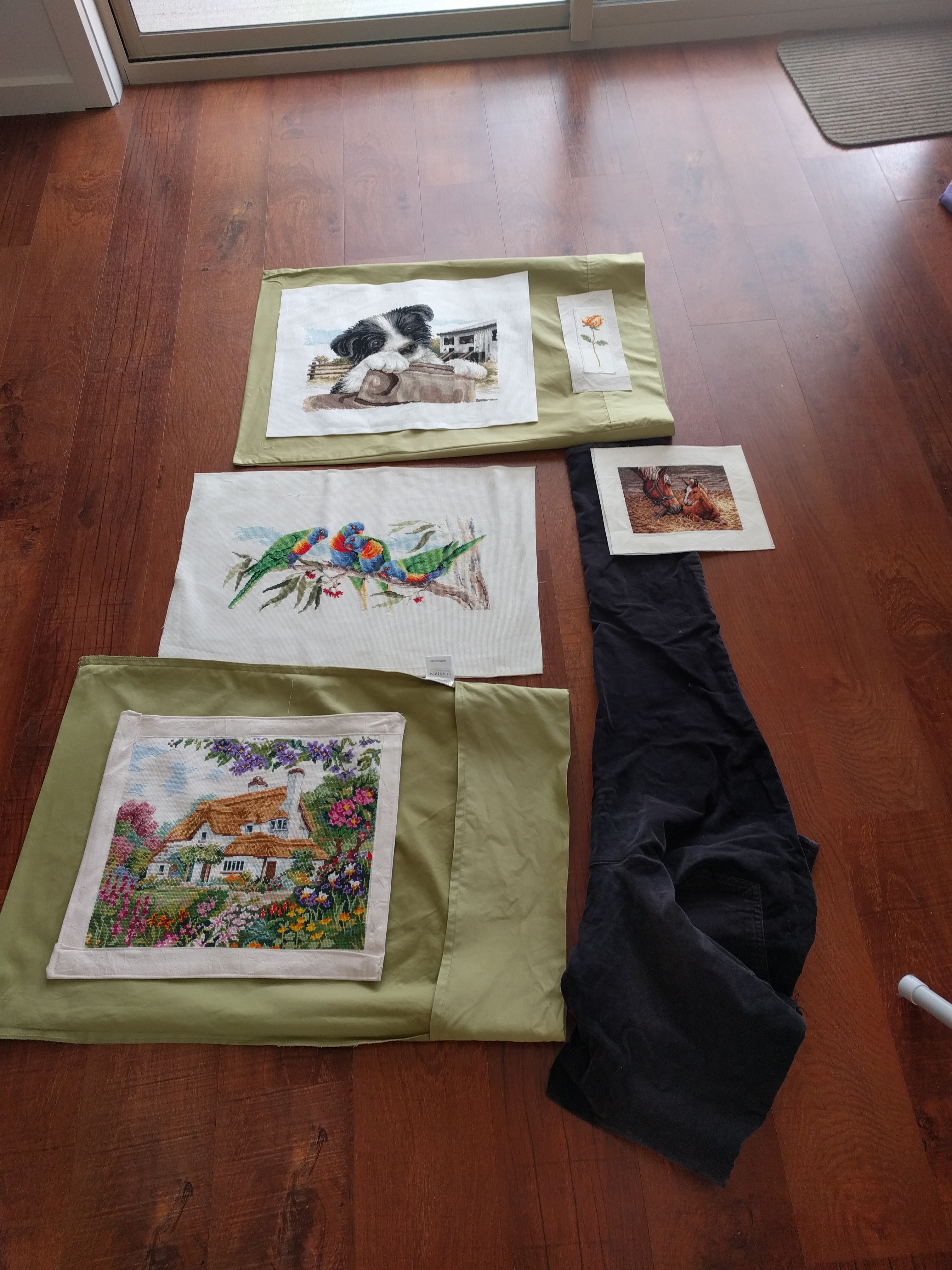
Five metres worth of calico flat on the floor with cross stitch pictures pinned to it for me to cut out and sew.
Cross stitch pictures pinned to calico.

Layout options

Once I had the cross stitch pictures lined with calico and the pictures had the navy blue borders, I had a lot of fun and stress with trying to figure out how it should be set out. The images below are just a few of the ways I had the pictures set out before I decided on the final setting…

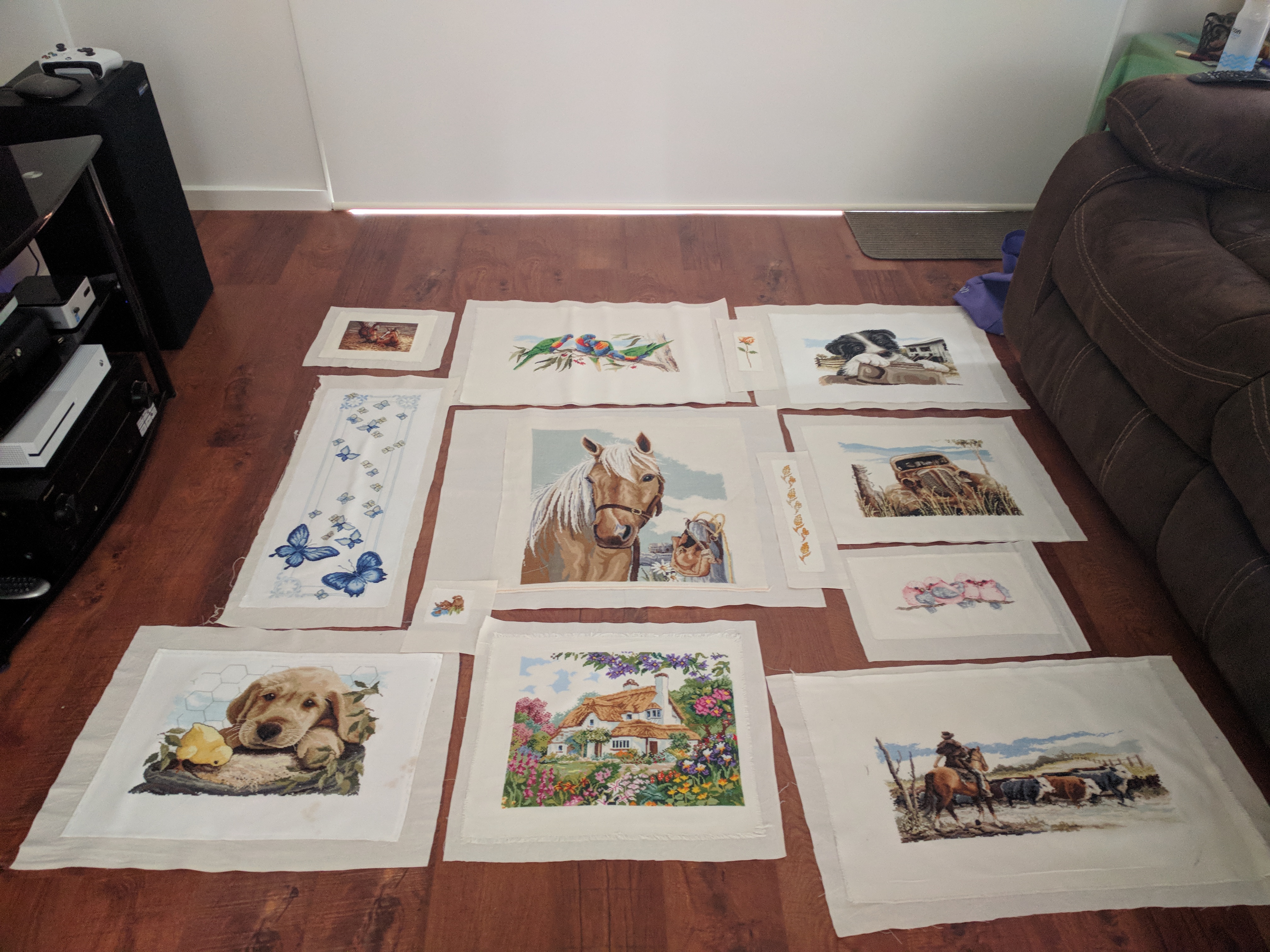
Quilt lay out option 1. Row 1 - left to right: Mare and foal, lorikeets, rose and border collie. Row 2 - left to right: Butterflies, small cat, Palamino horse, wheat, rusty old car and galahs. Row 3 - left to right: Labrador puppy with chick, English cottage, droving cattle across a creek.
Quilt layout option 1.
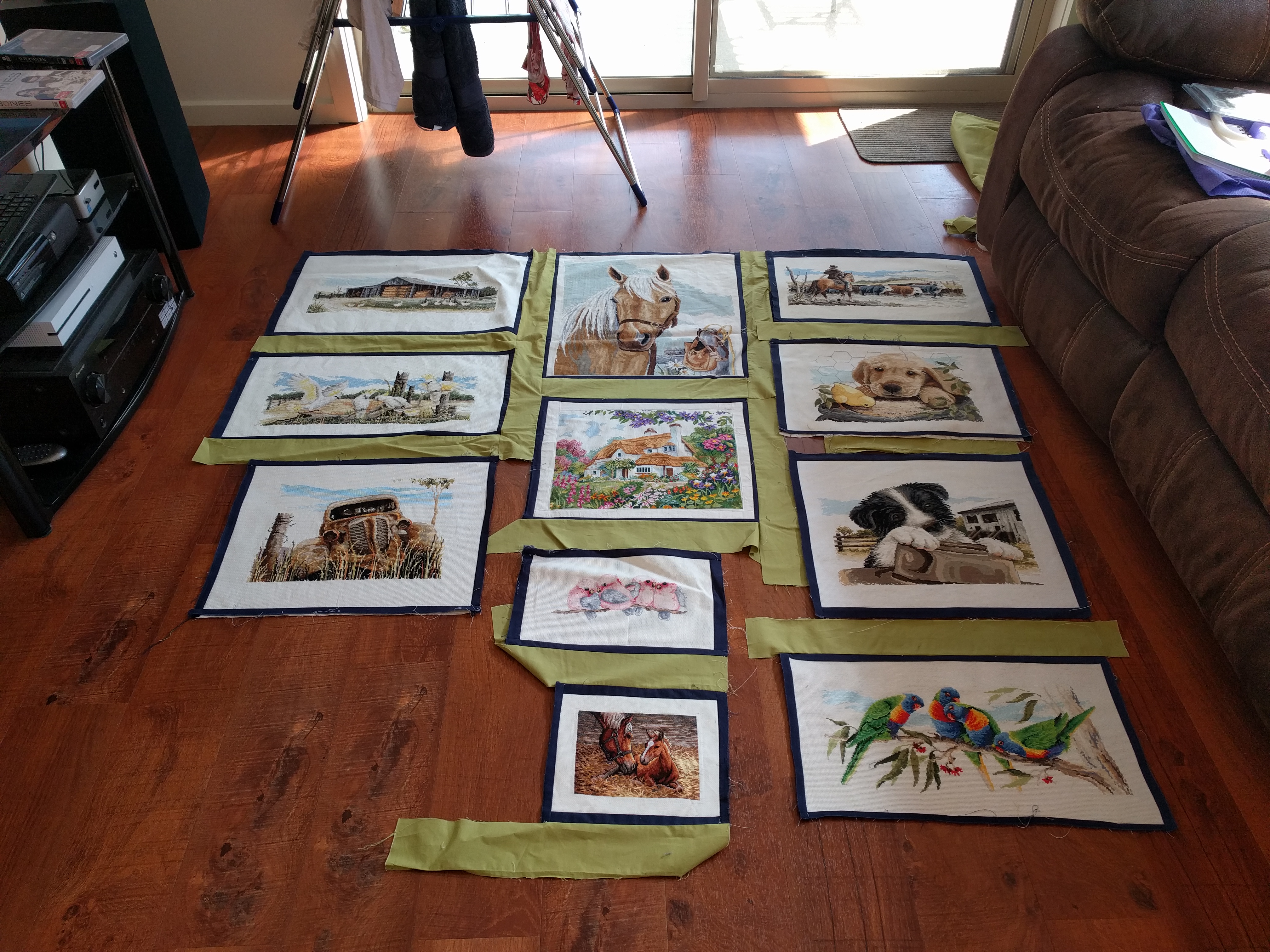
Quilt layout option 2. Row 1 - left to right: Hay shed, palamino horse, droving cattle across a creek. Row 2 - left to right: cockatoos, English cottage, labrador puppy with chick.
Row 3 - left to right: Rusty car, galahs, border collie.
Row 4 - left to right: mare and foal, Lorikeets.
Layout option 2
Layout option 3
Layout option 3

Once I was happy with the layout, joining it all together with the green fabric proved to be harder than I thought it would be – mostly because I wasn’t following an official pattern and I didn’t have any specific measurements in mind. All I knew was that I wanted it to be as square as possible in the end.

Things I have learnt to date about this quilt.

To date, this quilt has taught me a lot about myself and as much as it may frustrate me, I can make decisions on the fly. Other things I have learnt include:

  • Patience when I’m frogging something (a cross stitch term I’ve recently learnt that refers to un-picking something – aka ‘ribbit’ like the sound a frog makes);
  • The amount of thread I’ll go through for the sewing machine because of the amount of frogging and because I’m not following a set pattern;
  • How heavy the quilt becomes the more it comes together;
  • Best intentions with sewing straight (including having pre-determined guidelines to follow) doesn’t always mean that I will sew straight!
  • Perfection. In quilting I’ve found the need for it is more important than ever – especially if I want things to be square and line up just so;
  • Where there’s a will there’s a way. I accept that this quilt will not be as perfect or as flat or as straight or as square as I want it to be. However, I have found that there are alternate ways to achieve what I want.

Where to from here?

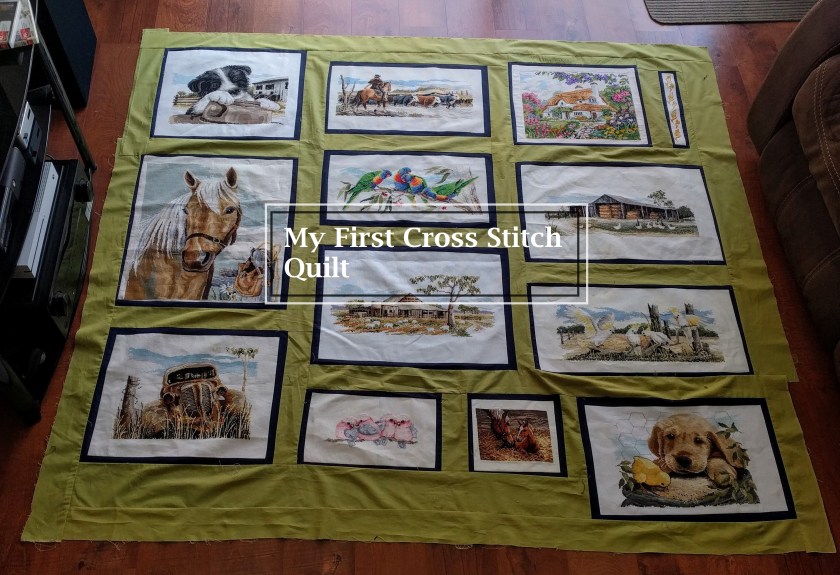
Quilt progress as of 3rd February 2019.

Now that the quilt is reasonably square, I can now measure it up for batting that I aim to purchase soon. Meanwhile, I have purchased additional navy blue quilting fabric that I will sew over the top of the existing navy blue borders around each cross stitch picture. My aim is to have the borders as even as possible whilst trying to flatten out the quilt as much as I can. In the image above, I’ve tried to flatten it out as much as I can with no avail. To try and ensure that the borders don’t slip as I’m sewing them, my aim is to use double sided tape to hold the fabric in place. My additional aim is to sew the borders on whilst the batting is attached, to reduce any potential movement that the batting may do over time.

Once I’m happy with the borders and the batting, I’ll attach the back of the quilt and the trim/final border and it should then be finished!

Posted in Uncategorized

5 Ways to get your stitching mojo back

Like writers’ block, there are times when I really don’t feel like stitching. The reasons may vary from feeling tired due to family and work pressures to feeling uninspired with the options I have in my collection. Stitcher’s block is totally normal and these are 5 ways to overcome the block.

1.      Have a break.

Having a break from cross-stitch could be just what you need. Do something other than cross-stitch for as long as you want or need. Whether it be learning a new crafty skill or returning to a crafty project you’ve set aside for some time. Alternatively, it could be going out for a long walk or heading down to the shops and treat yourself to a coffee or drink of your choice.

My break from cross-stitch can vary from a few days to a few weeks. During that time, I’ll be playing video games on a range of consoles, writing, scrapbooking or colouring in. I know when my mojo starts returning when I start looking at the patterns and kits in my collection or browsing websites to see what else is out there.

2.      Browse the Internet

Browsing the Net can be a way of seeing what other patterns are out there and what other people have done and are working on. Apps like Pinterest, and Instagram or sites like Etsy not only show a variety of patterns available, but ways in which the finished pieces can be completed (other than framing).

I looooove browsing Pinterest. I have used that site to find motivation for running, inspiration for quilt designs, cheer my boyfriend up with funny and cute dog and puppy pictures, go ‘ooh and aaah’ over amazing landscape photos and cheer myself up with cute and funny cat, kitten, foal and horse pictures.

Other sites I love visiting include:

3.      Join a club, group or forum

Cross-stitching can be as isolating or social as you want it to be. Online or face-to-face groups, clubs or forums can be a great way to catch up with like minded people. Face-to-face clubs, groups or forums include the Embroiders Guild and stitching sessions that your local craft store may hold. 

Alternatively, if you conduct a search on your preferred search engine or social media platform for an embroidery club or forum, you will find that there’s a lot out there. Facebook is one of my preferred platforms and I’m part of the Australian Cross-stitching group. I love seeing what other members post. Whether it be their WIP’s or finishes or questions about cross-stitch, all of it is motivating and inspiring and many of the designs are absolutely beautiful.

4. Attend a craft fair

As introverted as I am and as stressed I feel at times by attending events with large crowds, there’s something about attending a craft fair that I love. It may be something to do with being curious about the changing trends in quilting, cross-stitch, paper crafts etc. or seeing what new products are available to us. I really love attending the annual Canberra Quilt and Craft Fair in August when I can and setting myself a budget and whether or not I can stick to it! Other challenges I’ve set for myself is to find patterns or kits that I think loved ones would like and others that I would like to stitch for myself.

5.      Flosstube channels on YouTube

This is a recent find and I wish I had come across Flosstube sooner. Typing in ‘cross stitch’ to YouTube led me to Flosstube and I’m hooked! In a nut shell, Flosstube is the video version of blogs and face-to-face cross stitch catch ups. Anyone can post clips to YouTube using the Flosstube hashtag (#) and talk about anything and everything cross stitch. I love finding out what Kitten Stitcher and Stitching Jules are up to with in their cross stitch worlds. For me, it’s the way they present to camera and chat away. Check out their clips and you will see what I mean!

How do you get your stitching mojo back? Have you tried any of these ways? Were any of them useful?