Have you ever experienced the Fear of Missing Out (FOMO)? What influences your decisions for choosing one cross-stitch pattern or project over another?
I will be one of the first people to put my hand up and admit that I regularly suffer from FOMO and it drives me and my loved ones up the wall! My indecision ranges from which chocolate bar to have through trying to decide what meal to have or which cross stitch pattern to stitch next. When I’m trying to make a decision, I consider things from all angles and perspectives – including whether or not I’ll regret my purchase and feel that I’ve missed out on something.
A Psychology Todayarticle (published 23rd April 2018) by Nick Hobson Ph. D. discussed the fear of missing out and two studies scientists conducted to try and understand how FOMO works and if it’s isolated to certain social situations. What I took out of the article is that the FOMO has a lot to do with confidence within ourselves to make decisions that are right for ourselves, being happy with those decisions (regardless of the outcome) and living in the moment.
Ellen explains FOMO on her show on 5 March 2016
It’s important to note that dealing with FOMO and getting over the FOMO is a work in progress. Something that I’m working on daily. When I’m trying to decide on which pattern to stitch next or which one to purchase, I remind myself of the budget I’ve allocated myself and ask myself:
Who am I stitching this for?
Why do I want to purchase the pattern/kit?
When do I need to complete the project by?
Can I realistically complete the project in
time?
Do I have all of the tools for the project?
What about you? Have you ever experienced FOMO or remorse regarding your craft? How have you handled it?
Have you ever considered that this craft could have a good side, bad side or even ugly side?
The Good…
With cross stitch, the various sides of this craft can range from the amazing creativity we all get to share in with the range of patterns available to us to stitch. Through to the accessories that help us with our craft and the amazing and wonderful people we get to meet and share our passion with and learn from.
Thankfully I’ve never accidentally sat on a needle pointing
the wrong way or stepped on one for that matter. However, I have misplaced many needles throughout my time and
wishing I had a way to find them. Knowing that magnets would help me, but not
knowing how exactly they would help! It has only been within the last 6 months
or so that I’ve come across needle minders – also known as needle nannies. So
for my birthday in 2018, I asked for a Big
Eyed Cat needle minder by Stitchnmad on Etsy and I absolutely love it! I’m also thinking that I need
more needle minders to go with the various WIP’s I have!
What I also didn’t realise about needle minders is how easy
it may be to make them! That said, I love the variety and options currently
available and knowing that if I fall on hard times, that I could make them
myself.
Meanwhile, I’ve recently come across a variety of YouTube
clips on cross-stitch involving the technique called ‘parking’.
I’m still playing around with this technique and currently I’m finding that it
will be more useful for solid projects rather than ones I’m currently working
on that have many spaces.
That said, I’ve loved my stitch and bitch sessions with one
of my best mates who has since moved interstate. Prior to her move, we would
catch up once a week and alternate as to who’s place we would catch up at (we
lived within a 15 to 30-minute drive away from each other – a short distance
considering we lived in the country!). This time would enable us to catch up on
what’s been happening in each other’s lives and share tips, tricks and other
stitch related topics with each other. This would range from the way we would
start or finish off stitches through to the use of light – lamps to light up
the front or back of the projects we’re working on, depending on how dark the
fabric was. We would also grumble about our threads knotting up and learning
how to count or getting our eyes checked because we had miscounted the number
of stitches we needed to do or confusing the thread colour and associated
symbol.
Update – As of the end of 2018, my bestie and her husband moved back to Canberra and we’re going to be starting up our stitch n’ bitch sessions again! What’s even more awesome is that she’s living a short 10 to 15 minutes-drive away and we don’t need to worry about country roads!!
The Bad…
The bad side we experience can be associated with the mistakes we make and whether or not we can laugh about them and learn from them. Such mistakes can range from having dirty fingers whilst stitching, resulting in our projects getting dirty. Through to knotty threads, running out of fabric resulting in not being able to finish a project.
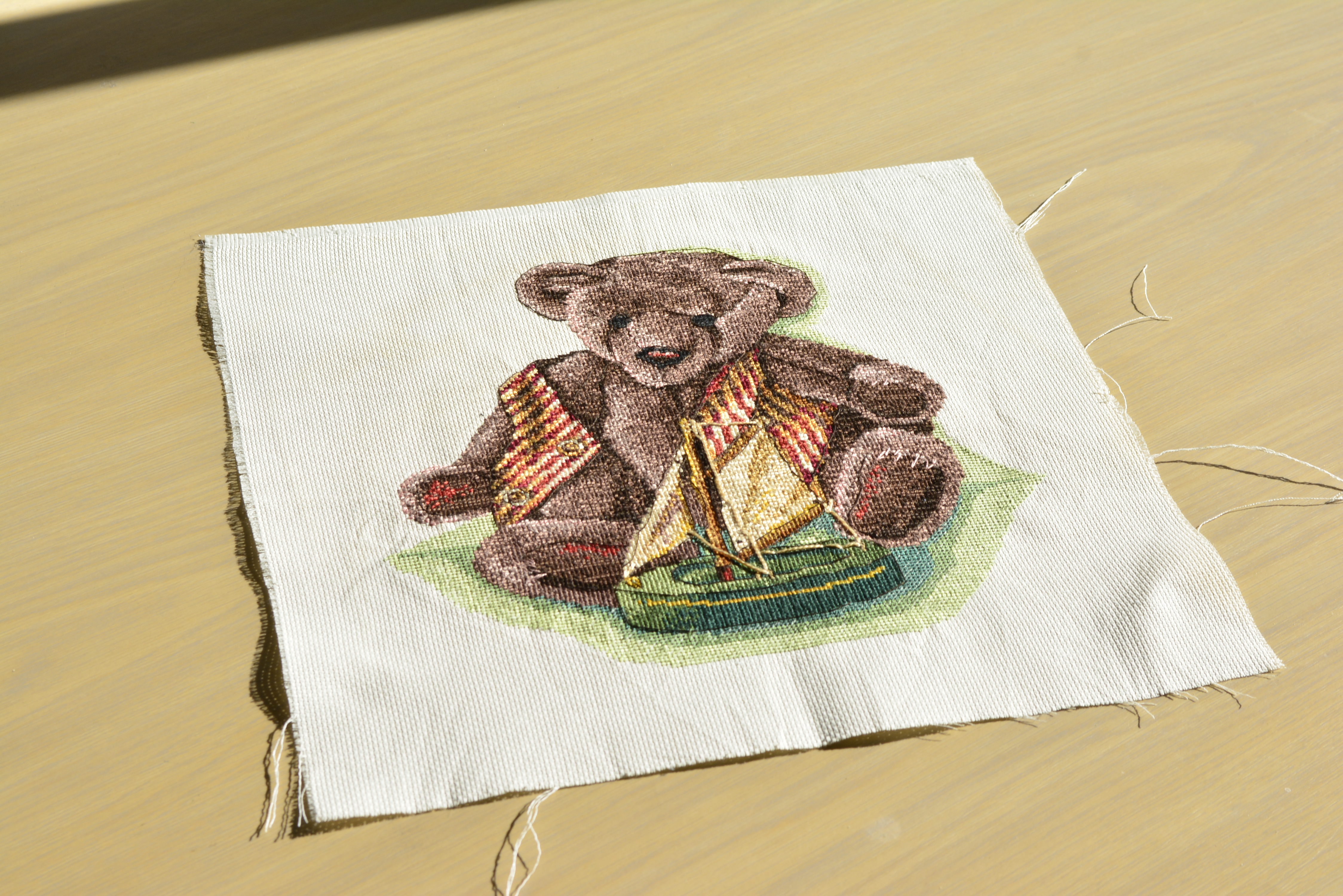
When I got back into cross-stitch after a long hiatus, I had completely forgotten about the importance of starting in the centre of fabric and pattern and making sure that all of my crosses are going in the same direction. I don’t remember any details of when I first got into cross-stitch or what the finished piece looked like, but I do have my first completed piece from when I seriously got back into cross-stitch and it may as well have been my first!
Teddy Bear with Train – not exactly centre and dirty fabric
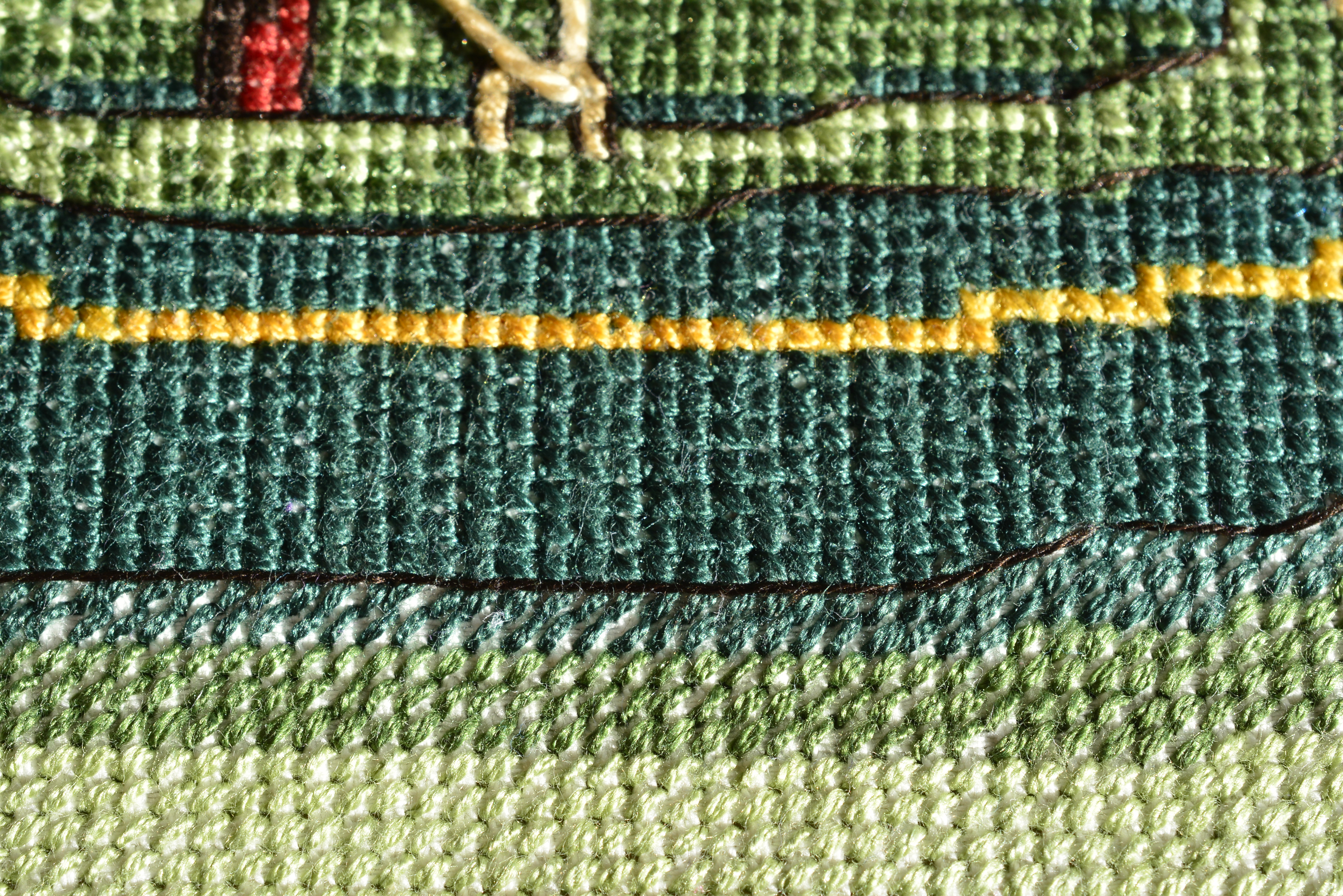
Meanwhile, from a distance, the dark brown bear seems fine. He’s well centred on the fabric. The half stitches are all pointing in the one direction and the backstitch provides definition to key areas of the piece. A closer look at the piece shows a more troubled picture with many novice mistakes. My crosses are uneven and stitched haphazardly. If memory serves me well, I’d stitched the lines alternating in direction because I thought it was easier and saving time. E.g. line one going right to left and line two going left to right. Then there’s the problem with the backstitch. Because I was in a rush to get the piece completed (I was super keen to start the next one), I didn’t take as much time and care to do a good job. One thing that the dark bear doesn’t tell you is that when I finished him, there was a significant amount of fabric below him.
Bear with Boat – From a distance it looks okay… Close up of Bear with Boat – not all of the crosses are going in the same direction
What you may also notice with the bear below is how dirty the fabric is. Another huge mistake! What I’ve learnt over time and what many of you may know is that it’s a sin for a stitcher to stitch with dirty hands and to leave their fabric dirty when it’s finished. Why? Aesthetically, it looks grubby, messy, unprofessional. Technically, the grub, grime and muck can attract bugs, mites and other nasty critters that can feed off it and eventually ruin the picture. Additionally, there’s the risk of the piece growing mould or remaining stained for the rest of its life because I’ve not washed it soon enough and ensured it’s dried and stored properly.
Maths, numbers and I have never really gotten along. In the
world of cross-stitch, this means that I have trouble calculating how much
fabric I need for a project – especially if I’m choosing to stitch a project on
a different count of fabric to what the artist recommends. For example, the
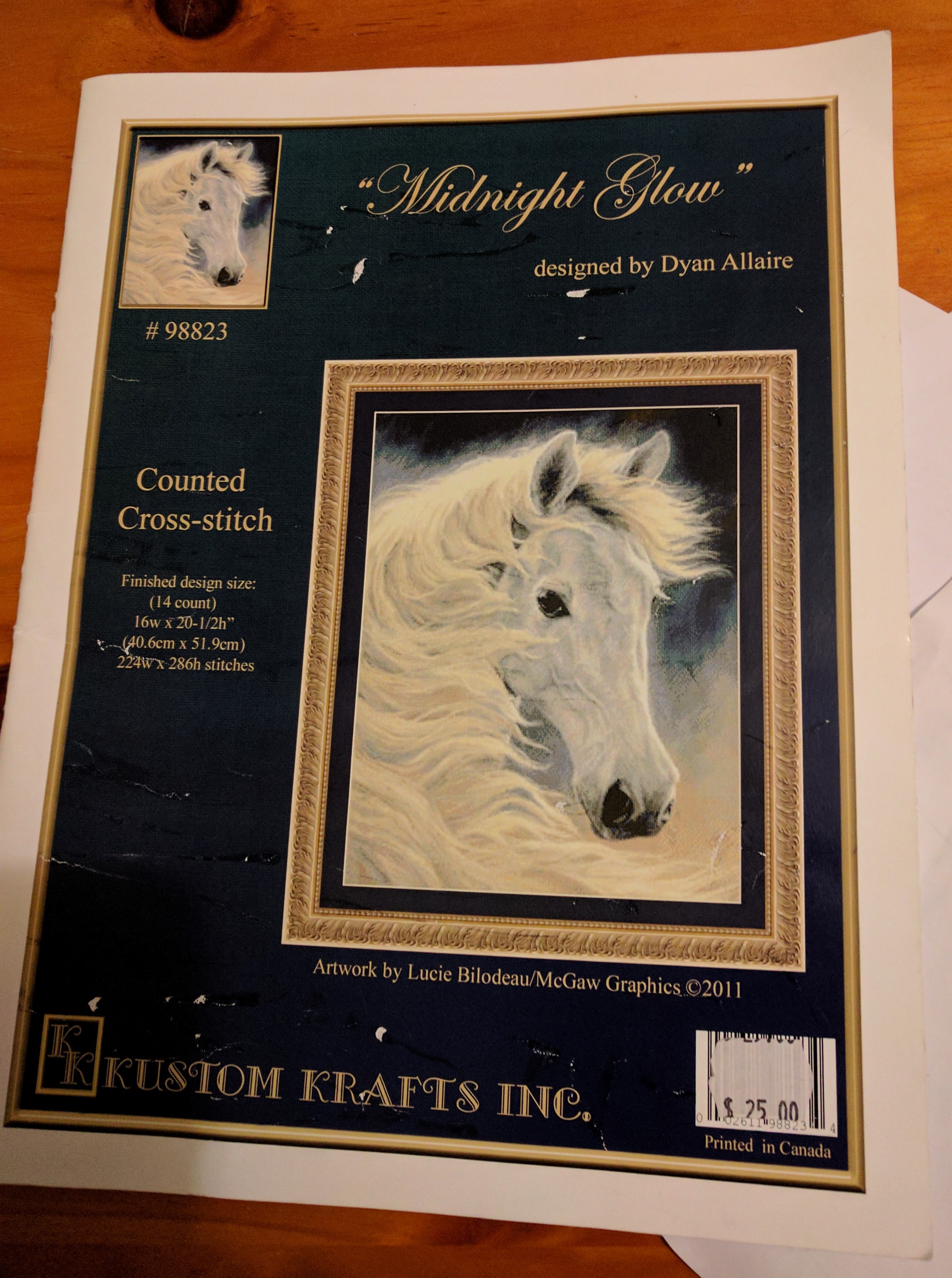
image of the white horse as shown below, is the best example of when I have
gotten the measurements really wrong.
Midnight Glow pattern designed by Dyan Allaire, published by Kustom KraftsThe above pattern is how Midnight Glow should look when finished!
Which means that I’m going to need to be really creative with the way that I finish off this picture. I had initially thought that I would frame it. But I’m starting to think that I could incorporate it into a scrapbook page.
I’m yet to meet a stitcher who loves it when their threads
get knotted up while they’re stitching. For me, it’s inevitable for my thread
to knot at least once during my time stitching a project. Depending on the size
of the knot, I’ll try to pull it through the fabric and continue stitching or
pull the thread either side of the knot to ‘undo’ the knot. Unfortunately, this
doesn’t always work out for me and my stitches end up being pulled too tight or
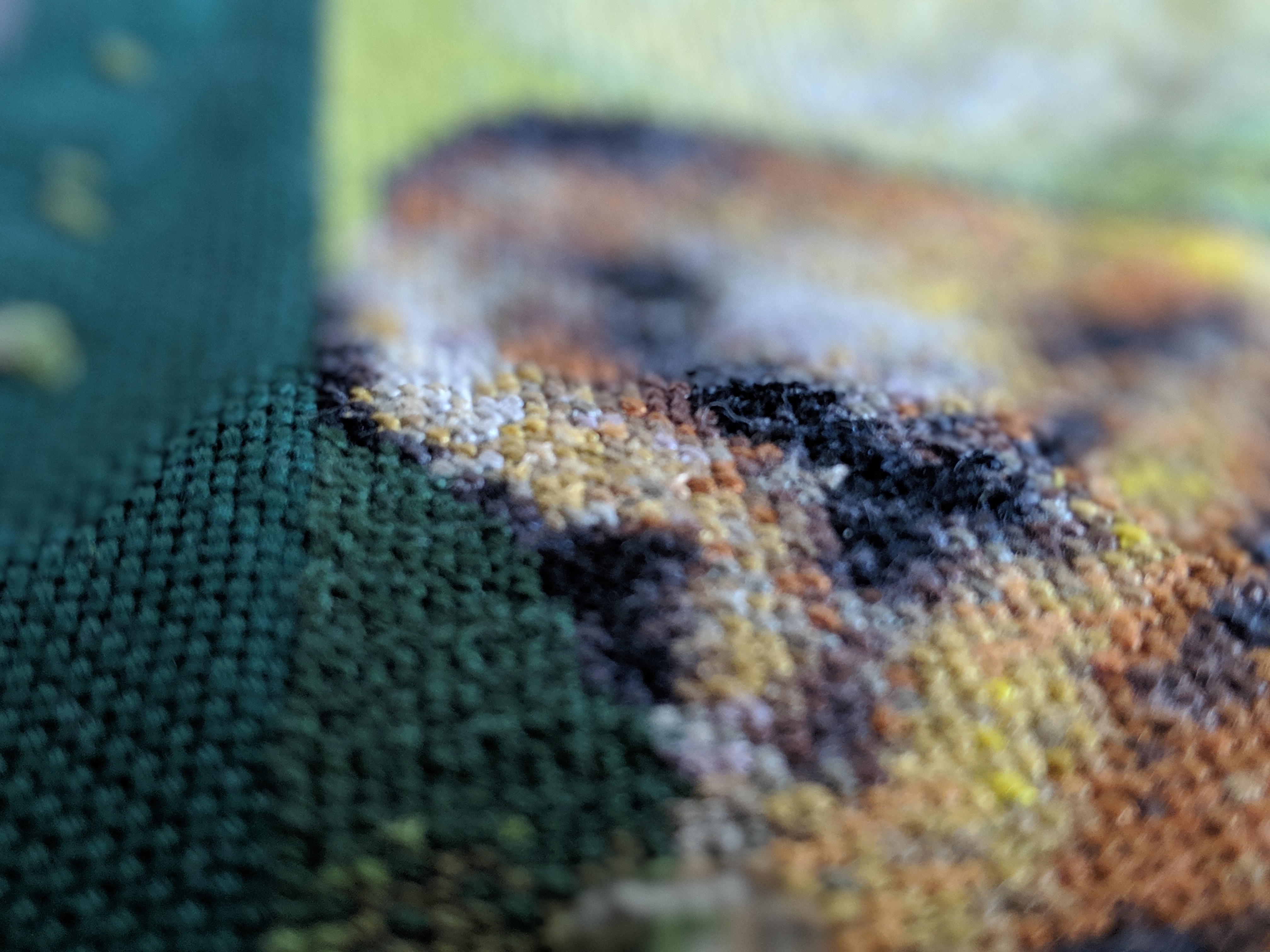
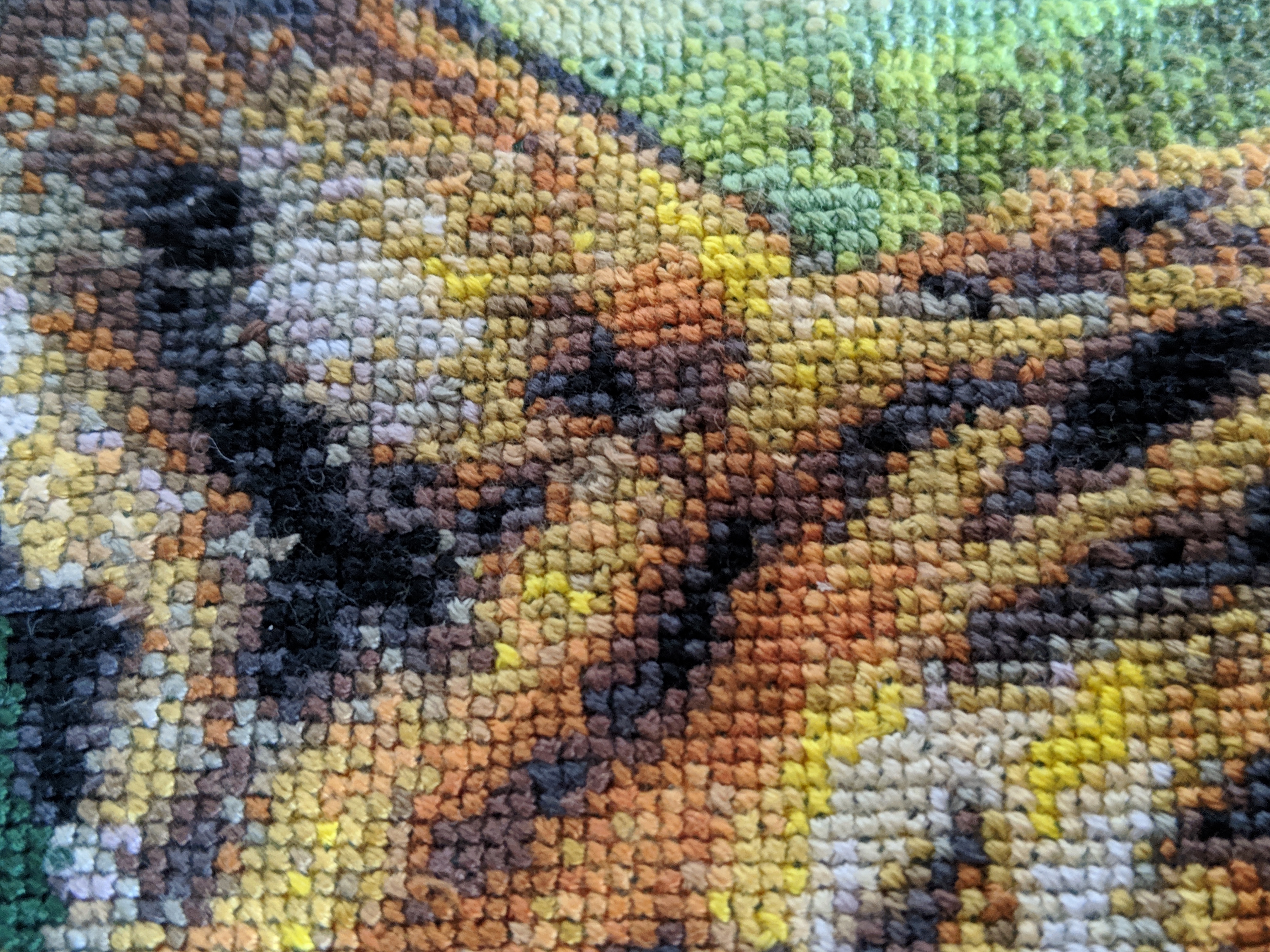
the knot remains and it ends up on the front side of the picture. An example of
this is the Kustom Kraft Tiger picture I started stitching ages ago shown below:
Left ear of tiger – some lumpy stitching
The Ugly…
Unfortunately ugly things happen in cross stitch and being part of the cross stitch community makes life easier to deal with when the ugly things happen like the following things…
Breaking a daylight light bulb that’s no longer being made
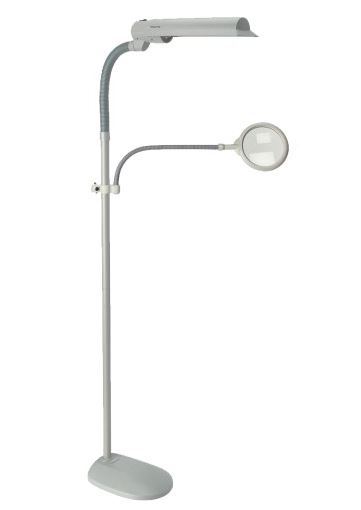
Many years ago for a birthday present, I received an Over The Top (OTT) daylight lamp that had a magnifier attached to it, like the one below:
Since the OTT was first purchased, the manufacturers have changed the way the light bulb fits within the socket. So any new bulbs I go to purchase, wont fit the existing socket and I’m left with the conundrum of what to do with a perfectly good stand with a magnifier and possibly purchasing another lamp.
Losing half a pattern that is now out of print
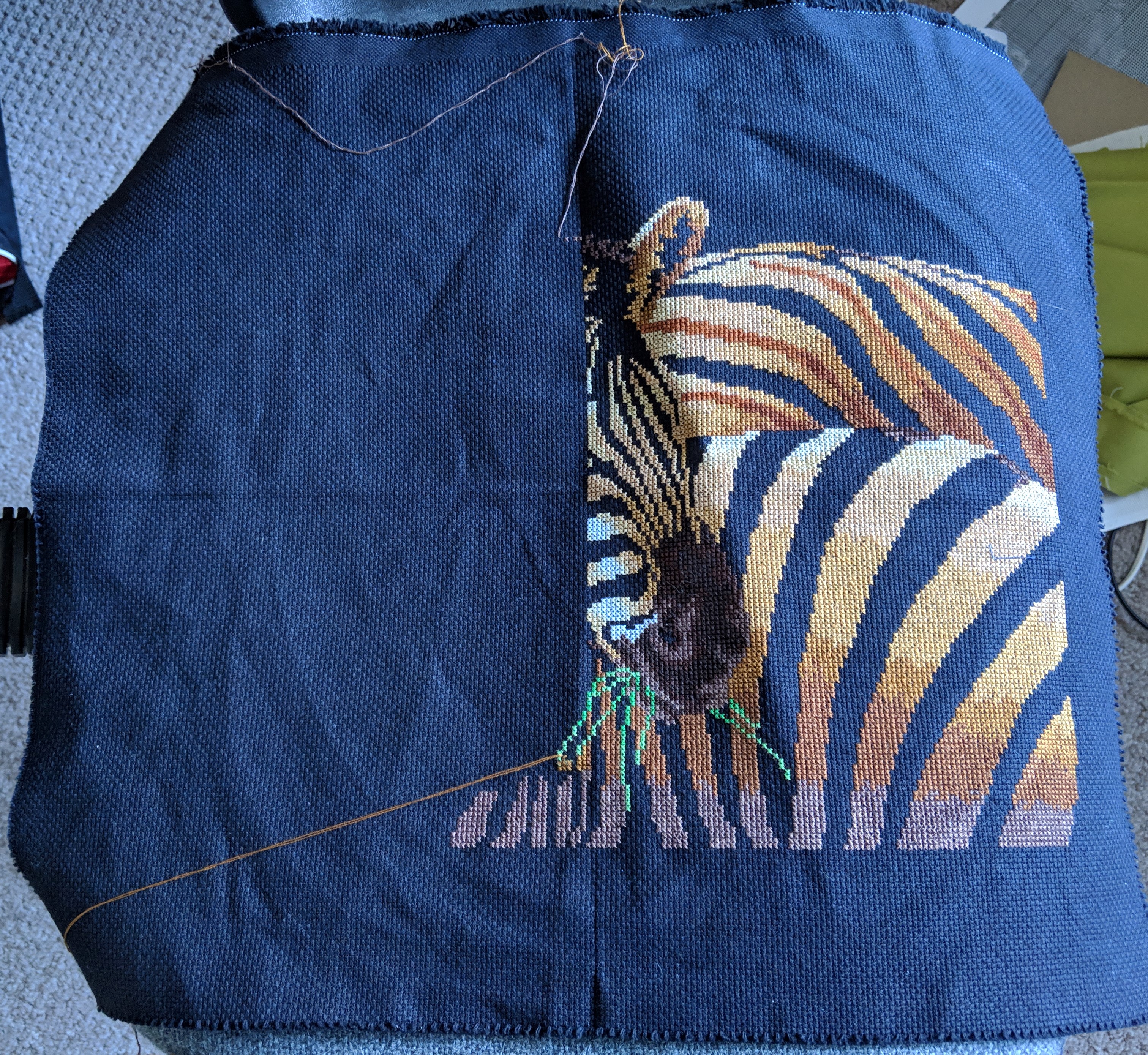
One of the joys of cross stitching is having the option to switch between a variety of projects. One of those projects for me is the Zebra Grande by Elsa Williams. Due to the way the pattern has been produced, it’s split in half and I’ve been clever enough to lose the second half of the pattern!
Zebra Grande by Elsa Williams – what the finished product should look like.
Half finished Zebra
I have made attempts to try and stitch the second half of the Zebras using the colour photo of the finished product, but it’s not the same. A portion of the Zebras are cut off by the matting and framing, so I’m making some guesses which could wildly through out the finished piece.
Lasting thoughts
What have been your experiences with the good, bad and ugly of cross stitch? How have you handled them?
During the first year that my boyfriend and I were living together, we became acutely aware of the collections we have and the amount of space they took up. Me and my craft and he and his fishing. At times I would comment in amazement on another package arriving for him, containing more squidgies (aka hard and soft plastic lures) to become part of his collection. Whilst he would occasionally comment on how long I spend in a craft store and how many threads, patterns and fabric I’ve purchased. My boyfriend is amazingly patient! I’m not sure what he would do without his phone to keep him entertained whilst waiting for me to finish up in the craft store and I love him to bits for it!
My boyfriend and I also have a running joke about me leaving my stuff all over the place (not just craft stuff) and how he has displaced it since we moved in together (we’ve been living together for about 7, nearly 8 years!). My man does a fantastic job of keeping his gear to the office and garage and I have my craft room…which can then creep into the living room or lounge room – depending on where I happen to be hanging out at the time – and a little bit in the office. But only because my filing cabinet is there and I’m yet to move it from the office to the craft room. And I’ve had my craft room for about 2 years.
So…my craft room and my
collections. Thinking about it now, it’s somewhat out-dated. I have my
favourite magazines and books that were purchased several years ago [insert
picture of bookshelf in craft room]. Many of the patterns that are in the
filing cabinet were purchased over the last 10 years – the most recent
purchases being about 2 years ago [insert pictures of filing cabinet]. Majority
of my purchases have been fabric and re-stocking my threads as I need them.
I have recently purchased what I
thought were some kits, but they’ve arrived without the patterns! I had made
the assumption upon purchasing them that the kits contained the patterns, but
alas I have the fabric and thread and I need to purchase the patterns
separately ☹ Alternatively, I could repurpose the fabric and
thread ‘kits’ for other projects. The question will be which projects?
I’ve tried to keep myself
restrained and not purchase too much, as I tell myself that I can’t purchase
anything until I have completed however many other projects I want to do or am
in the middle of. It is with this in mind, that I think I’ve hindered myself in
the process. You see, when I’m taking a break from some of the bigger, intense
projects, I enjoy stitching birthday and Christmas cards to give to friends and
family and friends. The part where I end up stitching myself up (pun intended)
is when I go to choose a pattern for them. I end up reverting to the same old
ones I’ve stitched time and time again and I feel myself getting bored because
I’ve stitched a similar pattern before but for a different family member or
friend.
The other reason why I’ve tried
to restrain myself from a lot of purchases, is that I want to convert a lot of
my photos [see my Pinterest boards] into cross stitch patterns. My intention to
start entering them into a variety of craft competitions such as the Sydney
Royal Show, the Ekka
and Canberra Royal Show and see how things go.
Where my stitching obsession
kicks in is the amount of time I spend working on my craft and/or thinking
about it. I stitch every day if I can. The only times when I’m not stitching is
when I’m super tired from a long day and I know that if I try to do some
stitching, I’ll more than likely have to unpick it the next time I pick up the
project because I’ve mis-counted or used the wrong colour or something along
those lines.
What about you? What does your cross-stitch addiction look like? Have any family members or friends try to tell you that you have too many threads, patterns, kits or accessories? Also, how often do you talk about your addiction? Are you supported by family and friends who feed your addiction through gift vouchers and similar things?
Many articles and blog posts have been written about the importance of mindfulness and taking time out for your self and your mental well-being. Colouring books for adults has become very popular in recent years as well as the resurgence of journaling. In my teenage years, I went through a bout of depression after seeing the movie “Saving Private Ryan”. For an unknown reason at the time, I found writing and colouring books to be therapeutic. I even remember asking my mum to buy some more colouring books as I had already finished off the kids colouring books that we had around the house (from when my siblings and I were younger) and I needed something a bit more challenging.
As I’ve gotten older and I’ve gotten back into cross-stitch, I’ve found cross stitch to be just as thereputic as colouring in and journaling. When I’m stitching on my own, I’m able to focus solely on the task at hand and have some music, tv or flosstube playing in the background. On the days when I’ve let life get to me and I’m stuck in my head (i.e. I’m unable to vocalise the mood I’m in or I know I’m in a bad mood and it’s best for me to not talk too much), I use cross-stitch as a way to focus my attention on something positive and methodical. Additionally, when my family and friends ask why I do cross-stitch, my regular reply is ‘it’s one of the few things I can do where I’m allowed to get angry and annoyed at myself and I can’t get fired for it!’
Subversive cross-stitch quote – Author of quote unknown
What I hadn’t expected or anticipated was the number of people who have written about cross stitch and embroidery being thereputic! I have known for some time that other forms of creative arts such as writing, painting, sculpting etc. have enormously positive affects for people who need a way to channel the energy they have and express their thoughts and feelings. Susan Luckman (Professor of cultural studies), Kate Dwyer and Robin Shreeves (freelance writer) are just three of the many people who have written about the positive affects of cross stitch and embroidery as ways for people to reduce their anxiety and stress levels.
Which may be why subversive cross stitch like the above image, has become so popular and given cross stitch a new lease on life. As it has given people an alternative way to express themselves and communicate their thoughts and feelings that they may not have otherwise had words for.
So how has cross-stitch and the creative arts helped you? Have you been able to help someone through cross-stitch? Alternatively, do you have a favourite saying or quote? Have you put it into stitches? I would love to hear about your experiences!
I have a love hate relationship with running. I love the excited feeling I get before a run – especially if I’m competing in an event – and the exhausted feeling or feeling of achievement after an event. It’s just the actual act of running I’m not always fond of – especially when various parts of my body are whinging or I’m just not feeling it and I end up walking more than I do running.
My reason for talking about running, is that I’ve come across a few articles over the years about the different types of runners in the community, and it got me thinking about those types could relate or be converted to our world of stitching.
In terms of running, I’m a little bit of everything. I have about 3 different apps going during my run, plus the fit bit on my wrist. I need to listen to music if I’m running on my own. If I’m running with others, I really don’t like talking to others unless it’s before or after the event. I’m competitive and will compare my times from previous events for the same course with current times and use that as my motivator to do better next time. I’m also a fair-weather runner and I will use the weather as an excuse to not go for a run if I’m really not feeling it. My stubborn determination has also gotten in the way of this logic and the reasoning that I paid to participate in the event (even though under any other circumstances I wouldn’t run in 20 to 40-kilometre winds with rain) because it’s for a good cause. Usually it’s the Mother’s Day Classic that has this kind of weather and I’ve inevitable caught a cold as a result!
So with no further delay, I present to you, my version of ‘What Type of Stitcher are You?’:
As a social stitcher, your energy and enthusiasm comes from stitching in a group environment. At times you can stitch alone, but feel lonely and drained as a result. By stitching in a group, you’re able to laugh, share your triumphs and struggles with life and your projects. Because stitching and enjoy other people’s company is what it’s all about.
Trend setter
Are you breaking all the rules and setting up new ones? Are you getting the rest of us to rethink the meaning of being a stitcher? So many questions with so many more answers! Being a trend setter means that your finger (or needle) is on the pulse of the stitching world. You know what patterns, threads, fabrics, accessories and kits have us begging for more and trends that have us chomping at the bit to try. Which may include an unconventional way of expressing yourself through cross-stitch. An amazing example is Severija Incirauskaite-Kriauneviciene’s embroidery like the image below:
Image from online magazine dontpaniconline.com. Artwork by Sevrija Incirauskaite-Kriauneviciene
“Introverts unite…alone at our own homes”. Stitching-wise, being a lone wolf means that you’re happy to be where you’re most comfortable – regardless of what your family, friends and the stitching community may expect of you. You have no need to follow trends or try to keep up with Jones’s. You just do what feels right to you and stitch whatever patterns you want (which really is what all of us do anyway 😊).
One project at a time
You find it easier to stitch one project at a time rather than having multiple projects on the go at the same time. By working on one project at a time, you are able to focus all of your attention and resources on it and it’s a project that you absolutely love! For some of you it may be a Heaven and Earth Designs (aka HAED) or a similarly full coverage piece that will take you years to complete, but it will look absolutely amazing when you’ve finished it. For others, you may have a lot of things happening in your life and you’re unable to spend as much time as you want on cross-stitch.
So many projects. So little time.
You have many projects on the go and at times you feel like you don’t have enough time in the day to stitch all of the projects you want. What doesn’t help is that you are regularly searching the internet and attending craft fairs that have even more projects that you fall in love with and must have then and there! With so many projects you’re working on, you may then find yourself searching the internet for a variety of suggestions on how to manage all of your projects and have a rotation schedule.
Cross Stitch Planning and Organization by Stitchin’ Mommy, published on 14 May 2018 on YouTube.
As an overachiever, you have a number of projects on the go and you get them all completed within the time frame you have assigned yourself and you have gone above and beyond to make them look Ah-may-zing! You may also find yourself staying up quite late or getting up super early to finish off that project or page that has been your ‘bug-bear’. You have more than likely timed how long it takes you to stitch in an hour and you try to better it each time.
The Accessoriser
In order for you to get comfortable and commence your cross-stitch, you need to have your needleminder, support gloves, stitching stand, special scissors, scissor-minder (I’m not sure if they exist, but I’m sure they do!), hoops, spare scissors, highlighters, pencils, erasers, pattern – physical and digital versions… Have I missed anything? Oh! Lighting – natural light through the window as well as your over the top light and magnifier glass and regular glasses. You’re regularly on the hunt for any other accessories that may help you with your stitching, whether it be to make it more comfortable for your or stitch quicker.
Embroidery toolbox by Milsey – published on YouTube on 18 June 2017
Your local library can be a fantastic resource for finding
patterns that may be of interest for you. Your membership is free, and you have
hundreds of thousands – if not millions – of resources at your finger-tips! If
your library doesn’t have what you want on the shelf, they can place a request
upon your behalf to other libraries and the item you need can be brought in. The
only cost to you may be over-due fees, photocopying or printing fees.
Sales are becoming a regular occurrence for a variety of
businesses and craft businesses are no exception – Mid-year sales, end of
financial year sales, click frenzy sales and black Friday sales just to name a
few!
Regardless of whether the items are on sale or not, I really
enjoy browsing the Fox Collection’s
website and seeing what items they have on sale.
When I purchase a pattern or kit I have the best of
intentions – usually I have someone in mind for the finished product. For
example, I have a variety of baby themed samplers that I have never touched but
bought them thinking that I would stitch them for family and friends. My family
and friends have had children since I bought the samplers, but I’ve not gotten
around to stitching anything for them. Resulting in me being more than happy to
give away the patterns to any willing stitcher wanting to take them on.
This option can be the best of both worlds – depending on
what you’re interests are and what’s available. However, you will need to be
patient. I did a search on the Internet
in December 2018 and found that there is a limited market for people selling
partially completed projects.
Type in ‘free cross-stitch patterns’ into your preferred search engine and you are bound to come up with millions of different websites and images enabling you to access free patterns that you can print off or save to your computer. Below is a list of some of my favourite sites:
If this isn’t a ‘thing’ already, it should be! Not only is
it a great excuse to catch up with like-minded people, but you get to add
patterns and kits to your collection that you may not have otherwise been able
to do and you get to pass on patterns and kits that you no longer want or need.
If you’re unable to physically catch up with like-minded
people, there are a variety of groups online that encourage the buying,
swapping and selling of patterns and kits. An example, is the Buy,
sell and swap cross-stitch Facebook public group.
There are a lot of tutorials on the Internet that can show you how to design your own patterns. Depending on your learning style and how much time you have, there are YouTube clips such as Peacock and Fig’s 10 minute clip on creating your own pattern. They also have a clip on designing your own pattern using Macstitch and Winstitch software. Scribble also shows us how to use stencils on graph paper.
Peacock and Fig’s clip on Making your own cross stitch pattern – 24 December 2015
I used the phrase ‘designing your own cross stitch patterns’ to come across this sample of clips. You can use any variation of this phrase and words to come across similar results.
In summary, there are so many different ways that you can build your collection for little to no money. I’ve recently purchased and downloaded software that will enable me to convert my own photos to cross-stitch patterns – something that will keep me entertained for a long time! I’ve also found myself going through my stash of leftover threads from completed kits when I’ve run out of a colour I really need and the timing doesn’t allow me to go to the physical shop and purchase what I need.e
If you have any other ways in which you’ve built up your collection, I would love to hear about them!
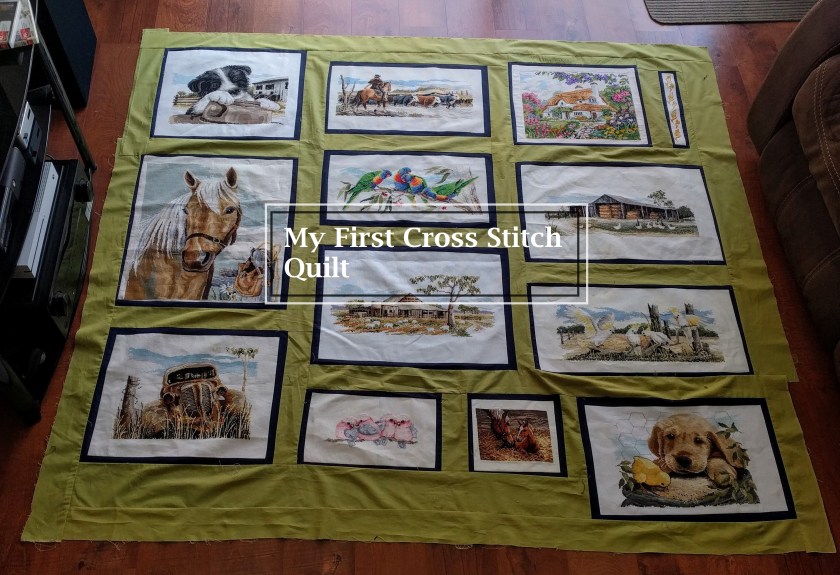
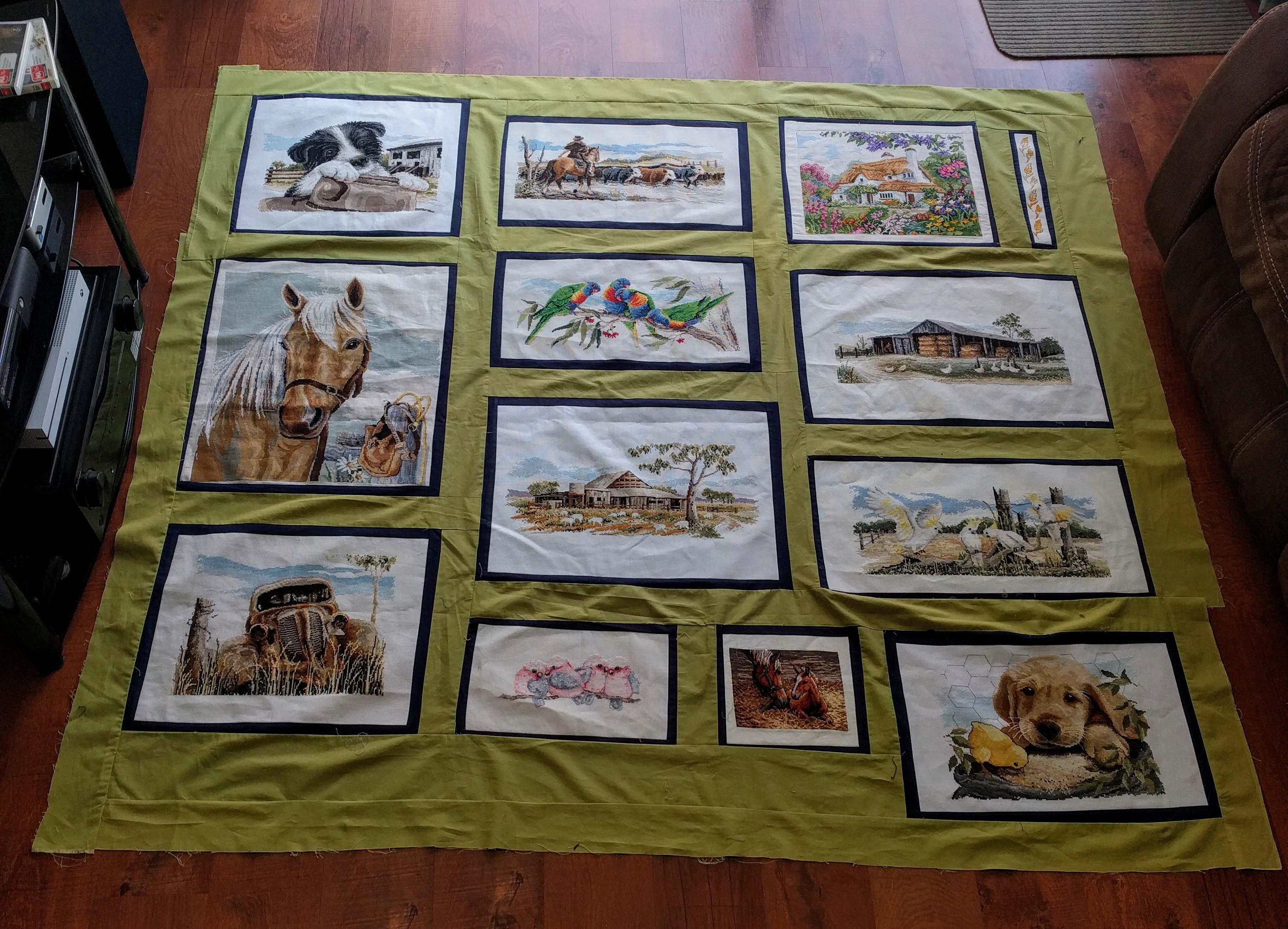
This quilt has been years in the making. Each picture has taken me an average of 3 months to complete, whilst working full-time and studying part time (for 6 years) and other projects in between. The pictures that make up this quilt are mostly Country Threads. The cottage and cat at the fish pond are from two different cross stitch magazines I’ve had for years. The mare and foal are a Dimensions Gold Collection kit (aka Dimensions Good Morning (Horse and Foal)).
Representations
Each picture represents an element of my family’s farm. Growing up we always had two dogs, two cats, many horses, many cows and bulls, chooks (aka chickens), ducks, geese and briefly, a flock of sheep. We’ve also had wild foxes, wombats, cockatoos (that love eating the oats and grass seeds in the round bales of hay), lorikeets, rosellas, galahs, crows, rabbits, hares, the odd echidna and once a pelican! On the farm, we also have a shearing shed that we’ve never used as an actual shearing shed. Instead, it has been a fantastic place for us to store our horse-riding gear, cattle drenching equipment, a place for chooks and ducks to hatch and raise their young, places for the cats to snooze (sleep) and catch mice and rabbits, a place to store square bales of hay, a place for the horses to shelter from the weather and mend from illness or injury. The shearing shed has also been a place for us to store bits and pieces we have wanted to store from the weather.
The creative process
For years I’ve known that I’ve wanted to make a quilt out of these pictures, but I’ve never had a firm idea of how it would look, how big it would be and how many pictures it would exactly it would have. As the pictures progressed and accumulated, I started thinking about the farm on a broader scale and the common colours they involve. Which is how I decided upon the blue and green shades you see in the pictures.
Choosing the colours for quilting fabric.
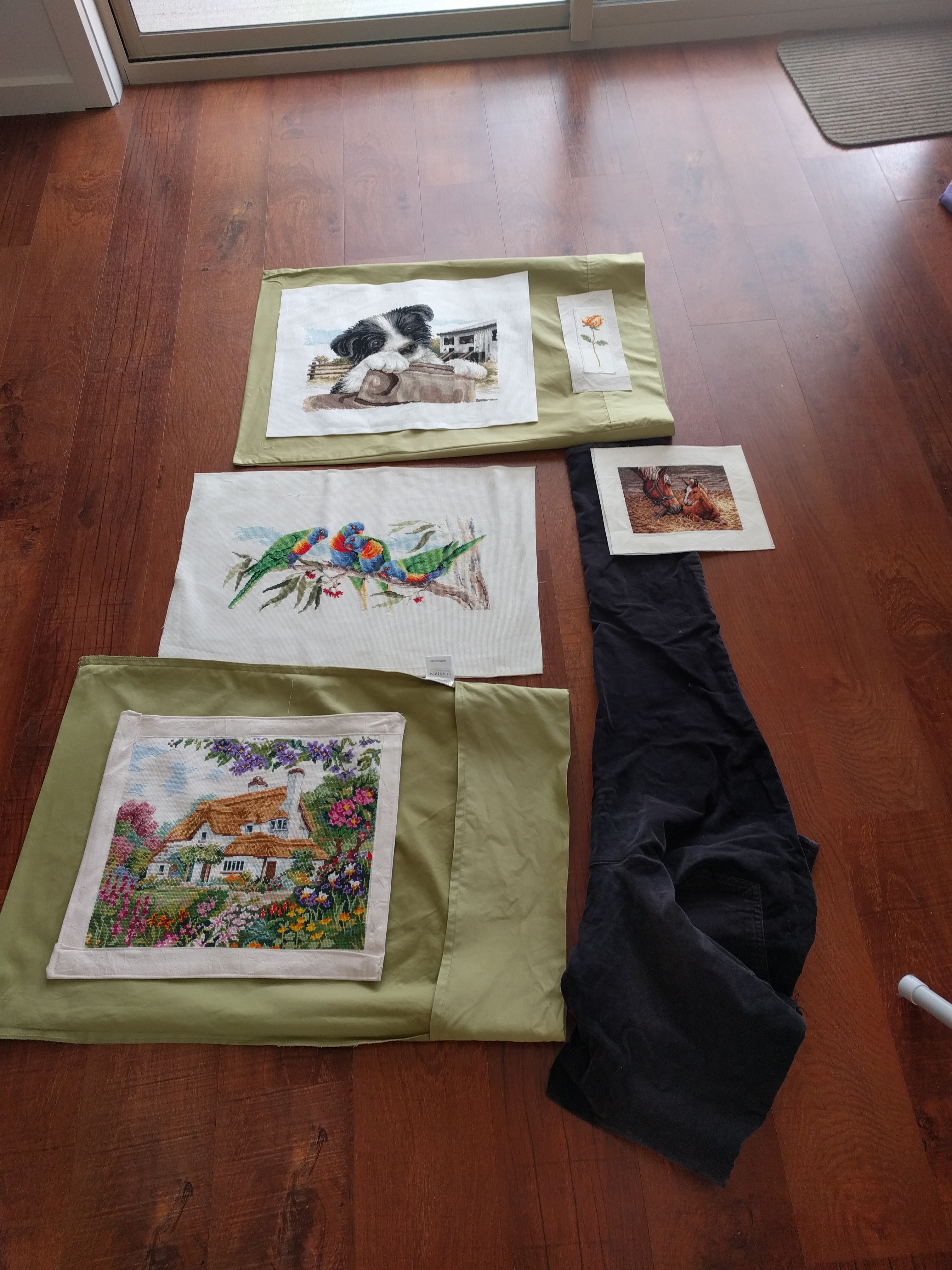
The closer I got to finishing the pictures and being ready to assemble the quilt, Pinterest became my best friend for all quilt related things – to the point that I created a board on Pinterest! I also decided that I would back/line the cross-stitch pictures with calico before I attached the navy blue and green borders. Below is how I attached the pictures to the calico and I made the most of the huge floor space at my parents space.
Cross stitch pictures pinned to calico.
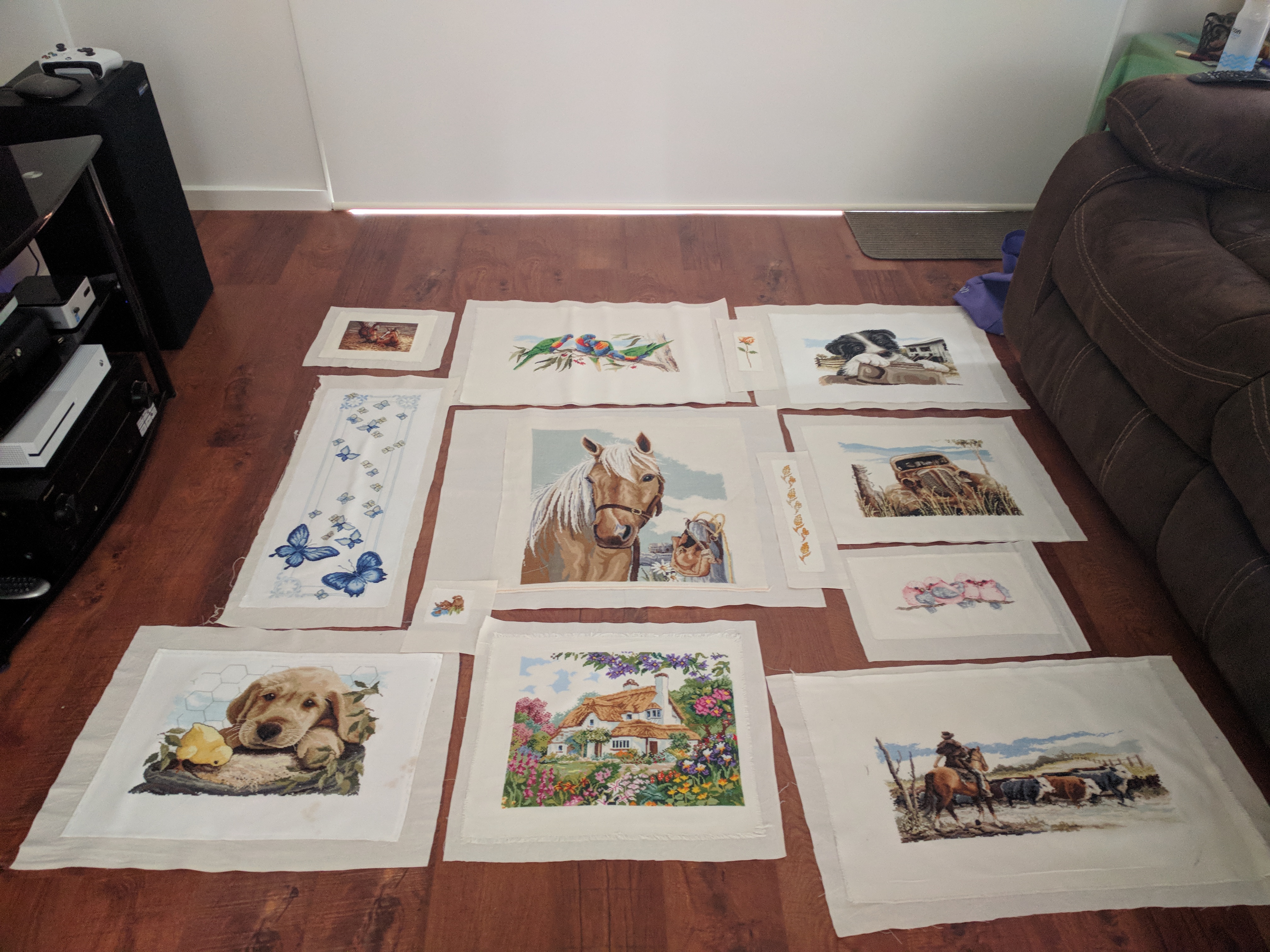
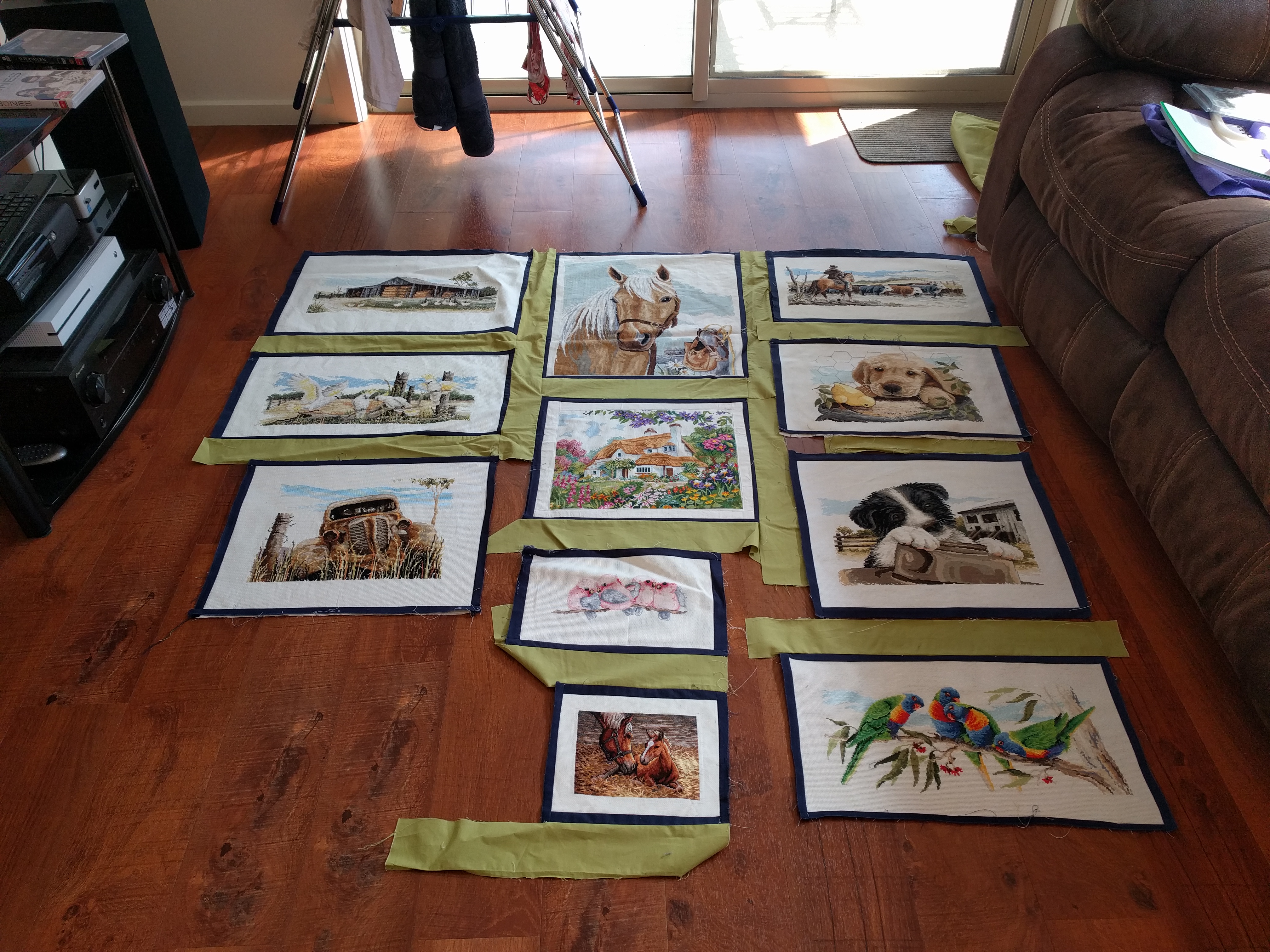
Layout options
Once I had the cross stitch pictures lined with calico and the pictures had the navy blue borders, I had a lot of fun and stress with trying to figure out how it should be set out. The images below are just a few of the ways I had the pictures set out before I decided on the final setting…
Once I was happy with the layout, joining it all together with the green fabric proved to be harder than I thought it would be – mostly because I wasn’t following an official pattern and I didn’t have any specific measurements in mind. All I knew was that I wanted it to be as square as possible in the end.
Things I have learnt to date about this quilt.
To date, this quilt has taught me a lot about myself and as much as it may frustrate me, I can make decisions on the fly. Other things I have learnt include:
Patience when I’m frogging something (a cross stitch term I’ve recently learnt that refers to un-picking something – aka ‘ribbit’ like the sound a frog makes);
The amount of thread I’ll go through for the sewing machine because of the amount of frogging and because I’m not following a set pattern;
How heavy the quilt becomes the more it comes together;
Best intentions with sewing straight (including having pre-determined guidelines to follow) doesn’t always mean that I will sew straight!
Perfection. In quilting I’ve found the need for it is more important than ever – especially if I want things to be square and line up just so;
Where there’s a will there’s a way. I accept that this quilt will not be as perfect or as flat or as straight or as square as I want it to be. However, I have found that there are alternate ways to achieve what I want.
Where to from here?
Quilt progress as of 3rd February 2019.
Now that the quilt is reasonably square, I can now measure it up for batting that I aim to purchase soon. Meanwhile, I have purchased additional navy blue quilting fabric that I will sew over the top of the existing navy blue borders around each cross stitch picture. My aim is to have the borders as even as possible whilst trying to flatten out the quilt as much as I can. In the image above, I’ve tried to flatten it out as much as I can with no avail. To try and ensure that the borders don’t slip as I’m sewing them, my aim is to use double sided tape to hold the fabric in place. My additional aim is to sew the borders on whilst the batting is attached, to reduce any potential movement that the batting may do over time.
Once I’m happy with the borders and the batting, I’ll attach the back of the quilt and the trim/final border and it should then be finished!
Like writers’ block, there are times when I really don’t feel like stitching. The reasons may vary from feeling tired due to family and work pressures to feeling uninspired with the options I have in my collection. Stitcher’s block is totally normal and these are 5 ways to overcome the block.
Having a break from cross-stitch could be just what you need. Do something other than cross-stitch for as long as you want or need. Whether it be learning a new crafty skill or returning to a crafty project you’ve set aside for some time. Alternatively, it could be going out for a long walk or heading down to the shops and treat yourself to a coffee or drink of your choice.
My break from cross-stitch can vary from a few days to a few weeks. During that time, I’ll be playing video games on a range of consoles, writing, scrapbooking or colouring in. I know when my mojo starts returning when I start looking at the patterns and kits in my collection or browsing websites to see what else is out there.
Browsing the Net can be a way of seeing what other patterns are out there and what other people have done and are working on. Apps like Pinterest, and Instagram or sites like Etsy not only show a variety of patterns available, but ways in which the finished pieces can be completed (other than framing).
I looooove browsing Pinterest. I have used that site to find motivation for running, inspiration for quilt designs, cheer my boyfriend up with funny and cute dog and puppy pictures, go ‘ooh and aaah’ over amazing landscape photos and cheer myself up with cute and funny cat, kitten, foal and horse pictures.
Cross-stitching can be as isolating or social as you want it to be. Online or face-to-face groups, clubs or forums can be a great way to catch up with like minded people. Face-to-face clubs, groups or forums include the Embroiders Guild and stitching sessions that your local craft store may hold.
Alternatively, if you conduct a search on your preferred search engine or social media platform for an embroidery club or forum, you will find that there’s a lot out there. Facebook is one of my preferred platforms and I’m part of the Australian Cross-stitching group. I love seeing what other members post. Whether it be their WIP’s or finishes or questions about cross-stitch, all of it is motivating and inspiring and many of the designs are absolutely beautiful.
As introverted as I am and as stressed I feel at times by attending events with large crowds, there’s something about attending a craft fair that I love. It may be something to do with being curious about the changing trends in quilting, cross-stitch, paper crafts etc. or seeing what new products are available to us. I really love attending the annualCanberra Quilt and Craft Fairin August when I can and setting myself a budget and whether or not I can stick to it! Other challenges I’ve set for myself is to find patterns or kits that I think loved ones would like and others that I would like to stitch for myself.
5. Flosstube channels on YouTube
This is a recent find and I wish I had come across Flosstube sooner. Typing in ‘cross stitch’ to YouTube led me to Flosstube and I’m hooked! In a nut shell, Flosstube is the video version of blogs and face-to-face cross stitch catch ups. Anyone can post clips to YouTube using the Flosstube hashtag (#) and talk about anything and everything cross stitch. I love finding out whatKitten StitcherandStitching Julesare up to with in their cross stitch worlds. For me, it’s the way they present to camera and chat away. Check out their clips and you will see what I mean!
How do you get your stitching mojo back? Have you tried any of these ways? Were any of them useful?



















 The XStitching Runner