Posted in Uncategorized

How do you teach someone to cross stitch? Part 2 – Learning styles and abilities

Hi Everyone

The way we learn is unique to us and when we find someone who can explain things or show us things in a way that clicks for us, makes them a very special person! It can also say a lot about the teacher. Their ability to ask the right questions, observe your body language and properly hear what you are telling them, to then adjust their way of communicating with you. Resulting in you feeling supported and (hopefully) confident in your abilities to have successfully learnt the intended lesson or perform a specific task.

Learning styles

There are many different ways in which we learn. Sometimes it depends on what we’re that will determine the best way in which we can put it into practice. Sometimes it depends on how our teacher presents the material to us that we need to learn that can make the world of difference. The YouTube clip below shows how this can be true for both sides of the coin via the use of scenes from popular or famous movies through the decades…

‘Learning Styles’ – uploaded to YouTube on 10 November 2010 – shows the main learning styles via popular movies.

In support of the above YouTube clip, the website Learning-styles-online.com (viewed on 29 July 2018) suggests that there are 7 different ways in which people prefer to learn.

Visual learning means that you or your student prefers to use pictures/ diagrams and videos that assist you with understanding how to do something. Additionally, you or your student may find it easier to have someone sit with you and show you how to thread the needle and make the crosses on the fabric – regardless of which fabric it is. Furthermore, you or your student may find the use of colours and patterns to assist with the learning of a new task. Click here for further information.
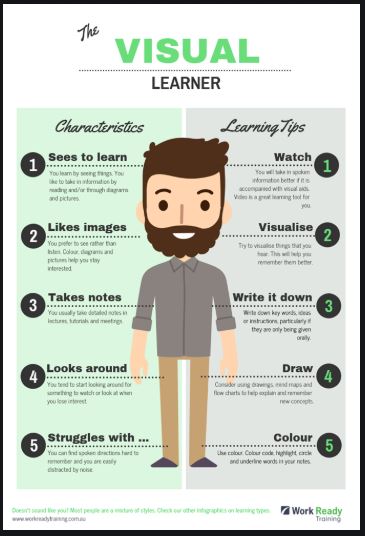
Image from the Work Ready Training website – originally posted on 18 September 2018

Logical learning means that you or your student uses logic, reasoning and systems, to understand how and why cross-stitch works to then put it into practice. From a teaching perspective, explaining why we do cross stitch may assist your student with understanding the logic of cross stitch. This may also relate to the pattern they choose to stitch. Click here for further information.

Verbal learning means that you or your student finds it easier to listen to someone talk or reading a set of instructions (words only). Learning-styles-online.com suggests that you or your student read the instructions to yourself out-loud. By doing so in a dramatic and varied way, it may make the instructions sound more interesting and you or your student may pick up on the keywords that will assist with achieving the desired outcome. Click here for further information.

Physical or tactile learning means that you or your student needs to get your hands dirty to learn. Learning-styles-online.com uses the example of pulling apart an engine and putting it back together without the assistance of instructions to learn how the engine works. From a cross stitch perspective, you and your student can sit together and go through the motions of cross stitch. Click here for further information.

Image from the Work Ready Training website – originally posted on 2 October 2018

Aural learning is about the use of sounds and music to enable you or your student to connect to what you’re learning, because it enables you (or your student) to visualise the way something moves or the actions you need to take to complete a movement. Alternatively, the music in the background can assist with triggering memories the next time the sounds or music are heard, resulting in your or your student being able to remember the process of cross stitch until it becomes second nature. Click here for further information.

Social learning means that you or your student enjoys studying in group environments or being around other people whilst learning, because it enables you to bounce ideas off others and increase your understanding of the topic at hand. Which is where stitch ‘n’ bitch sessions can be a perfect way for your or your student/s to learn cross stitch, because you’re able to bounce off each other and share different tips and tricks you’ve learnt along the way and see how others stitch as well. Click here for further information.

Social learning image from the ATD website article on ‘how to be a catalyst for social learning’

Solitary or one-on-one learning means that you or your student finds it easier to learn on your own because there are less distractions. Which also means that stitching at home in silence (or softened background noises) may be your preference or your student’s preference. Click here for further information.

What about learning disabilities?

This is a little different to the learning styles that we have just looked at and learning disabilities can have a major impact on the way in which you teach someone to cross stitch. In the YouTube clip below titled ‘Common Learning Disabilities’, Dr Audrey Huebner from the Mayo Clinic, briefly talks about the common learning disabilities and what they mean.

‘Common Learning Disabilities’ by Dr Audrey Huebner from the Mayo Clinic – uploaded on 14 April 2017

It’s important that we talk about learning disabilities because it will (hopefully) help you and your student be more comfortable around each other and both of you will be able to communicate in a way that works for both of you. On a personal note, I always have and always will struggle with maths and doing some calculations in my head. At times when I’m doing cross stitch, I’ll joke about how I need to go back to school and learn how to count because I’ve stitched either too many or not enough crosses. I’ll also joke about how I need to get my eyes checked because as I get tireder as the day progresses, I make more mistakes. The eye sight thing and making mistakes can happen to anyone and everyone. However, I absolutely acknowledge that people who have legitimate eye sight problems will need some extra help with the way they see a cross stitch pattern and fabric – just a hint for what the next post will be about!

If you are teaching someone with a learning disability, the following clip by the CreativeMentalist may help you with providing praise and feedback to your student. Additionally, your student may find comfort and reassurance in hearing and seeing what she has to say.

‘8 Things kids with learning disabilities need to hear’ by CreativeMentalist – uploaded on 2 January 2015

Another clip that may be of interest and use for you as a teacher is ‘Students with Disabilities: Special Education Categories’ by Teachings in Education. The presenter briefly goes through the 14 different categories by defining what they are and provides some tips on what teachers can do to help their students learn a task or concept.

‘Students with Disabilities: Special Education Categories’ by Teachings in Education – Uploaded to YouTube on 7 April 2018

I hope that this post has given you some food for thought and that you consider some of the different ways in which may approach the way you do your cross stitch. In part 3, we’ll take a look at physical abilities and disabilities and some tools of the trade that may help you and your students.

Until next time, happy stitching!

Related links:

Posted in How To, Tips and Tricks, Uncategorized

How do you teach someone to cross stitch? Part 1 – Who is your student?

Hi Everyone

Have you ever been approached by family, friends, friends of friends or colleagues and asked if you could teach them how to cross stitch?

I’ve been contemplating this question for some time now and wondered what the best approach would be. Many years ago I would have just jumped straight into it with whomever my student would be. Not really considering their preferred learning style, choice of pattern and materials, their age and abilities, let alone my teaching style!

This series is going to cover all of these things and more in case you are approached and asked to teach someone to cross stitch. So without further adieu…

Why age matters

How old we are and our life experiences can make the world of difference in how we learn new things and sometimes, how long it takes us to learn those new things.

For example, the blog post by the TEFL Academy (posted on 16 January 2017) titled ‘6 Differences between teaching adults and young learners’ talks about the importance of using different approaches based upon the age of your student. Based upon the blog post by the TEFL Academy, you will need to consider the following things if you are teaching adults or children and adolescents:

Adults Children and teenagers
Are autonomous and independent and prefer to work things out for themselves, with minimal direction. You will need to be in charge and provide the young learner with clear instructions on what they need to do with their needle and thread and fabric.
You may find that you and your adult learner can spend a lot more time on the cross stitch project due to extended attention spans. Your young learner may have a genuine interest in cross stitch, but will need a bit of variety to keep them interested. This is where the choice of pattern is crucial. Starting off on a small picture that the young learner is interested in will make the difference.
Keeping things fun is still important for your adult learner. This is where stitch ‘n’ bitch sessions may be more applicable. Having a relaxed environment where there is minimal pressure may help your learner with being anxious about learning something new. Keep it as fun as possible for your young learner – especially for your very young learners. Their key interest is play and having fun. How you do that is up to you!
Finding the motivation for why your person wants to cross stitch is important. It’s just like you needing to find the motivation to stitch a project. This may be closely linked with keeping it fun and having a design or project that they really want to stitch. Finding the motivation for why your person wants to cross stitch is important. It’s just like you needing to find the motivation to stitch a project. This may be closely linked with keeping it fun and having a design or project that they really want to stitch.
Depending on the type of relationship you have with your adult learner, having some ground rules may still be necessary to ensure you both are on the same page. Each person is different. Use your judgement on this one.   Discipline. How you approach this may vary from person to person. For example, setting up some ground rules may help for some people. The challenge will be following through on the consequences should any of those ground rules be broken. E.g. running with scissors, poking others with needles and scissors = no stitching for x amount of time.
Life experience will play a very large part with your adult learner and it can have an enormous impact on their motivation for wanting to learn how to do cross stitch. It will be worth having a chat with your learner to find out why they want to learn cross stitch. Also, you may find that you learn something from your learner while you’re teaching them! The TEFL Academy recognises the enthusiasm and curiosity that young people bring to learning. It will be worth keeping this in mind and trying to enhance their enthusiasm and curiosity while teaching them cross stitch. For example, linking story telling with cross stitch may be one way of keeping it fun and piquing their curiosity!

What about gender?

In this day and age, gender shouldn’t matter – anyone can do cross stitch – what does matter, is the way gender can influence the way you teach your student and how your student learns.

If your student considers themselves to be male, they may initially feel embarrassed about learning how to cross stitch, even though they have a strong interest in it. All because cross stitch and embroidery has historically have been considered something women and girls have done – even though some of the most famous fashion designers are men – e.g. Karl Largerfeld, Hugo Boss, Pierre Cardin, Giorgio Armani and Tommy Hilfiger to name a few. To put this into context, the flosstube video below is the first one from Shaun/ Sean who has wanted to do cross stitch for a long time, but has felt embarrassed and fearful about taking it up, because of the perceptions around who does cross stitch.

Flosstube clip by Sean/Shaun – uploaded to YouTube on 30 January 2019

So what I’m trying to say here is that some of your male students may need some extra praise and encouragement to help them feel comfortable with doing cross stitch. The patterns they stitch may help a lot too. The same may be for your female students and other students who are part of the LGBTQI community who are really interested in cross stitch, but feel uncomfortable about taking up the craft because of some old perceptions about our craft.

So what do you think so far? Have you already taught someone to cross stitch? Has their age and gender had an impact on how you have taught them?

Until next time, happy stitching!

Posted in Uncategorized

Creative Flair – when it’s in your genes, there’s no escaping!

Hi Everyone

As I’m writing this post, I’ve just gotten back from spending some awesome time with my sister and her family. Yesterday (26 October) my nephew turned 5 and today was a great time to catch up with my nephew, my sister and her family and celebrate 5 years of my nephew being with us!

One of the really cool things with spending time with my nephew, is that he’s really into art and being crafty! At the moment he’s really into water colour painting and drawing and experimenting with colours. This area of art isn’t my strong point, so I found it really fun to experiment with my nephew and have fun working with kid logic. For example, we had fun figuring out what would happen if we mixed a dark blue with bright yellow and how much of each colour we used to make the final colour. We also found that the paint brush would be very thirsty for some colours and not so much for other colours.

As I’m reflecting on today, many things are coming to mind. I’m remember what it was like to have that kid wonder of ‘what if’ and not worrying about the result, because we don’t know what it will be and therefore we have no expectations. When I was in late primary school, we had the friendship bracelets.

It became so much of a craze that I remember making a number of them and selling them at school for about $0.50c (50 cents) to about $1 to $2 depending on the complexity of the design. I remember spending many nights in front of the t.v. with one end of the bracelet pinned to my pant leg or the bean bag and I’d be madly tying the knots in preparation for the next day. Below are a couple of the bracelets I’ve held onto. They’re quite simple in comparison with some of the others I’ve made and sold.

Rainbow friendship bracelets. Diagonal design going from left to right. This image shows a close up of the design to show the darker and lighter reds, blues, greens and an orange and yellow and darker and lighter purple and pink.
Rainbow Friendship Bracelet made out of DMC cotton
This overhead shot shows two friendship bracelets that show the front and back of the bracelets. Both are rainbow diagonal going from left to right.
Overhead view of the rainbow friendship bracelets

It’s also important to note that with the selling of these bracelets, I had a limited market because I went to a small country school. When I graduated, there were a total of 74 students in the entire school and 8 people in my year. So my market was pretty small and there was someone else making the bracelets as well. Mine were better though!

In high school I was very much into writing and wanted to do something with that. I did a fair bit of cooking and craft classes to get my creative fix and did a bit of cross stitch at home. It was also at high school that I was introduced to quilting and photography. It was pretty cool developing the film in photography and learning how the whole process worked. I also knew early on that with photography, that if I had to do portraiture and tell people how to pose in photos, that I didn’t want to take it any further. I really don’t like telling people what to do and how to look to get a particular result. There’s also the pressure of getting the picture taken in a quick and short period of time and to that’s too much pressure.

I digress! I can’t help but wonder what things my nephew will be interested in and how everyone in his life can help to influence him in a positive way. I’m curious about whether he’ll stick with painting or progress onto other forms like pastels, charcoal and pencils. Or move onto mediums like pottery, origami, woodwork, metalwork and photography.

The really cool thing has been seeing that the creative flair remaining strong in my immediate and extended family. My grandparents on both sides of my family were creative with their photography, knitting, painting, gardening and music. I remember my grand father on Dad’s side, bringing out the piano accordion or mandolin on Christmas Eve and would play us some tunes. Sometimes he would sing as well. There was a few times there where he had tried to teach some of my cousins and I how to play the mandolin . My fingers were too small at the time and they haven’t grown much since!

Many of my aunts are creative with their painting and gardening and one of my uncles has taught himself to play the guitar. One of my cousins is/has been in a number of different bands and has performed on stage with his band. Another cousin of mine is creative with her hairdressing and make-up artistry. Meanwhile, my sister and her fiance are creative in their own rights with their talents in music (drums and possibly guitar), pottery, drawing and photography.

So my nephew has no escape from this strong creative flair and I can’t wait to see what comes of it!