Posted in Uncategorized

How do you teach someone to cross stitch? Part 2 – Learning styles and abilities

Hi Everyone

The way we learn is unique to us and when we find someone who can explain things or show us things in a way that clicks for us, makes them a very special person! It can also say a lot about the teacher. Their ability to ask the right questions, observe your body language and properly hear what you are telling them, to then adjust their way of communicating with you. Resulting in you feeling supported and (hopefully) confident in your abilities to have successfully learnt the intended lesson or perform a specific task.

Learning styles

There are many different ways in which we learn. Sometimes it depends on what we’re that will determine the best way in which we can put it into practice. Sometimes it depends on how our teacher presents the material to us that we need to learn that can make the world of difference. The YouTube clip below shows how this can be true for both sides of the coin via the use of scenes from popular or famous movies through the decades…

‘Learning Styles’ – uploaded to YouTube on 10 November 2010 – shows the main learning styles via popular movies.

In support of the above YouTube clip, the website Learning-styles-online.com (viewed on 29 July 2018) suggests that there are 7 different ways in which people prefer to learn.

Visual learning means that you or your student prefers to use pictures/ diagrams and videos that assist you with understanding how to do something. Additionally, you or your student may find it easier to have someone sit with you and show you how to thread the needle and make the crosses on the fabric – regardless of which fabric it is. Furthermore, you or your student may find the use of colours and patterns to assist with the learning of a new task. Click here for further information.
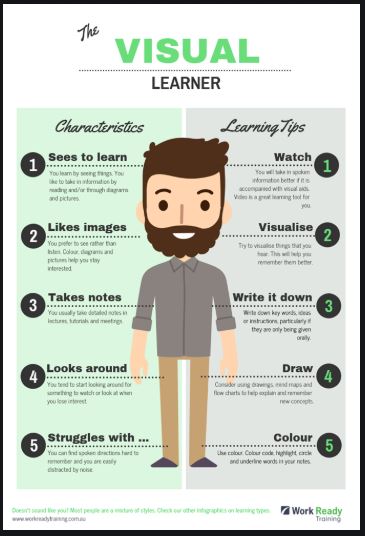
Image from the Work Ready Training website – originally posted on 18 September 2018

Logical learning means that you or your student uses logic, reasoning and systems, to understand how and why cross-stitch works to then put it into practice. From a teaching perspective, explaining why we do cross stitch may assist your student with understanding the logic of cross stitch. This may also relate to the pattern they choose to stitch. Click here for further information.

Verbal learning means that you or your student finds it easier to listen to someone talk or reading a set of instructions (words only). Learning-styles-online.com suggests that you or your student read the instructions to yourself out-loud. By doing so in a dramatic and varied way, it may make the instructions sound more interesting and you or your student may pick up on the keywords that will assist with achieving the desired outcome. Click here for further information.

Physical or tactile learning means that you or your student needs to get your hands dirty to learn. Learning-styles-online.com uses the example of pulling apart an engine and putting it back together without the assistance of instructions to learn how the engine works. From a cross stitch perspective, you and your student can sit together and go through the motions of cross stitch. Click here for further information.

Image from the Work Ready Training website – originally posted on 2 October 2018

Aural learning is about the use of sounds and music to enable you or your student to connect to what you’re learning, because it enables you (or your student) to visualise the way something moves or the actions you need to take to complete a movement. Alternatively, the music in the background can assist with triggering memories the next time the sounds or music are heard, resulting in your or your student being able to remember the process of cross stitch until it becomes second nature. Click here for further information.

Social learning means that you or your student enjoys studying in group environments or being around other people whilst learning, because it enables you to bounce ideas off others and increase your understanding of the topic at hand. Which is where stitch ‘n’ bitch sessions can be a perfect way for your or your student/s to learn cross stitch, because you’re able to bounce off each other and share different tips and tricks you’ve learnt along the way and see how others stitch as well. Click here for further information.

Social learning image from the ATD website article on ‘how to be a catalyst for social learning’

Solitary or one-on-one learning means that you or your student finds it easier to learn on your own because there are less distractions. Which also means that stitching at home in silence (or softened background noises) may be your preference or your student’s preference. Click here for further information.

What about learning disabilities?

This is a little different to the learning styles that we have just looked at and learning disabilities can have a major impact on the way in which you teach someone to cross stitch. In the YouTube clip below titled ‘Common Learning Disabilities’, Dr Audrey Huebner from the Mayo Clinic, briefly talks about the common learning disabilities and what they mean.

‘Common Learning Disabilities’ by Dr Audrey Huebner from the Mayo Clinic – uploaded on 14 April 2017

It’s important that we talk about learning disabilities because it will (hopefully) help you and your student be more comfortable around each other and both of you will be able to communicate in a way that works for both of you. On a personal note, I always have and always will struggle with maths and doing some calculations in my head. At times when I’m doing cross stitch, I’ll joke about how I need to go back to school and learn how to count because I’ve stitched either too many or not enough crosses. I’ll also joke about how I need to get my eyes checked because as I get tireder as the day progresses, I make more mistakes. The eye sight thing and making mistakes can happen to anyone and everyone. However, I absolutely acknowledge that people who have legitimate eye sight problems will need some extra help with the way they see a cross stitch pattern and fabric – just a hint for what the next post will be about!

If you are teaching someone with a learning disability, the following clip by the CreativeMentalist may help you with providing praise and feedback to your student. Additionally, your student may find comfort and reassurance in hearing and seeing what she has to say.

‘8 Things kids with learning disabilities need to hear’ by CreativeMentalist – uploaded on 2 January 2015

Another clip that may be of interest and use for you as a teacher is ‘Students with Disabilities: Special Education Categories’ by Teachings in Education. The presenter briefly goes through the 14 different categories by defining what they are and provides some tips on what teachers can do to help their students learn a task or concept.

‘Students with Disabilities: Special Education Categories’ by Teachings in Education – Uploaded to YouTube on 7 April 2018

I hope that this post has given you some food for thought and that you consider some of the different ways in which may approach the way you do your cross stitch. In part 3, we’ll take a look at physical abilities and disabilities and some tools of the trade that may help you and your students.

Until next time, happy stitching!

Related links:

Posted in How To, Tips and Tricks, Uncategorized

How do you teach someone to cross stitch? Part 1 – Who is your student?

Hi Everyone

Have you ever been approached by family, friends, friends of friends or colleagues and asked if you could teach them how to cross stitch?

I’ve been contemplating this question for some time now and wondered what the best approach would be. Many years ago I would have just jumped straight into it with whomever my student would be. Not really considering their preferred learning style, choice of pattern and materials, their age and abilities, let alone my teaching style!

This series is going to cover all of these things and more in case you are approached and asked to teach someone to cross stitch. So without further adieu…

Why age matters

How old we are and our life experiences can make the world of difference in how we learn new things and sometimes, how long it takes us to learn those new things.

For example, the blog post by the TEFL Academy (posted on 16 January 2017) titled ‘6 Differences between teaching adults and young learners’ talks about the importance of using different approaches based upon the age of your student. Based upon the blog post by the TEFL Academy, you will need to consider the following things if you are teaching adults or children and adolescents:

Adults Children and teenagers
Are autonomous and independent and prefer to work things out for themselves, with minimal direction. You will need to be in charge and provide the young learner with clear instructions on what they need to do with their needle and thread and fabric.
You may find that you and your adult learner can spend a lot more time on the cross stitch project due to extended attention spans. Your young learner may have a genuine interest in cross stitch, but will need a bit of variety to keep them interested. This is where the choice of pattern is crucial. Starting off on a small picture that the young learner is interested in will make the difference.
Keeping things fun is still important for your adult learner. This is where stitch ‘n’ bitch sessions may be more applicable. Having a relaxed environment where there is minimal pressure may help your learner with being anxious about learning something new. Keep it as fun as possible for your young learner – especially for your very young learners. Their key interest is play and having fun. How you do that is up to you!
Finding the motivation for why your person wants to cross stitch is important. It’s just like you needing to find the motivation to stitch a project. This may be closely linked with keeping it fun and having a design or project that they really want to stitch. Finding the motivation for why your person wants to cross stitch is important. It’s just like you needing to find the motivation to stitch a project. This may be closely linked with keeping it fun and having a design or project that they really want to stitch.
Depending on the type of relationship you have with your adult learner, having some ground rules may still be necessary to ensure you both are on the same page. Each person is different. Use your judgement on this one.   Discipline. How you approach this may vary from person to person. For example, setting up some ground rules may help for some people. The challenge will be following through on the consequences should any of those ground rules be broken. E.g. running with scissors, poking others with needles and scissors = no stitching for x amount of time.
Life experience will play a very large part with your adult learner and it can have an enormous impact on their motivation for wanting to learn how to do cross stitch. It will be worth having a chat with your learner to find out why they want to learn cross stitch. Also, you may find that you learn something from your learner while you’re teaching them! The TEFL Academy recognises the enthusiasm and curiosity that young people bring to learning. It will be worth keeping this in mind and trying to enhance their enthusiasm and curiosity while teaching them cross stitch. For example, linking story telling with cross stitch may be one way of keeping it fun and piquing their curiosity!

What about gender?

In this day and age, gender shouldn’t matter – anyone can do cross stitch – what does matter, is the way gender can influence the way you teach your student and how your student learns.

If your student considers themselves to be male, they may initially feel embarrassed about learning how to cross stitch, even though they have a strong interest in it. All because cross stitch and embroidery has historically have been considered something women and girls have done – even though some of the most famous fashion designers are men – e.g. Karl Largerfeld, Hugo Boss, Pierre Cardin, Giorgio Armani and Tommy Hilfiger to name a few. To put this into context, the flosstube video below is the first one from Shaun/ Sean who has wanted to do cross stitch for a long time, but has felt embarrassed and fearful about taking it up, because of the perceptions around who does cross stitch.

Flosstube clip by Sean/Shaun – uploaded to YouTube on 30 January 2019

So what I’m trying to say here is that some of your male students may need some extra praise and encouragement to help them feel comfortable with doing cross stitch. The patterns they stitch may help a lot too. The same may be for your female students and other students who are part of the LGBTQI community who are really interested in cross stitch, but feel uncomfortable about taking up the craft because of some old perceptions about our craft.

So what do you think so far? Have you already taught someone to cross stitch? Has their age and gender had an impact on how you have taught them?

Until next time, happy stitching!

Posted in Uncategorized

Creative Flair – when it’s in your genes, there’s no escaping!

Hi Everyone

As I’m writing this post, I’ve just gotten back from spending some awesome time with my sister and her family. Yesterday (26 October) my nephew turned 5 and today was a great time to catch up with my nephew, my sister and her family and celebrate 5 years of my nephew being with us!

One of the really cool things with spending time with my nephew, is that he’s really into art and being crafty! At the moment he’s really into water colour painting and drawing and experimenting with colours. This area of art isn’t my strong point, so I found it really fun to experiment with my nephew and have fun working with kid logic. For example, we had fun figuring out what would happen if we mixed a dark blue with bright yellow and how much of each colour we used to make the final colour. We also found that the paint brush would be very thirsty for some colours and not so much for other colours.

As I’m reflecting on today, many things are coming to mind. I’m remember what it was like to have that kid wonder of ‘what if’ and not worrying about the result, because we don’t know what it will be and therefore we have no expectations. When I was in late primary school, we had the friendship bracelets.

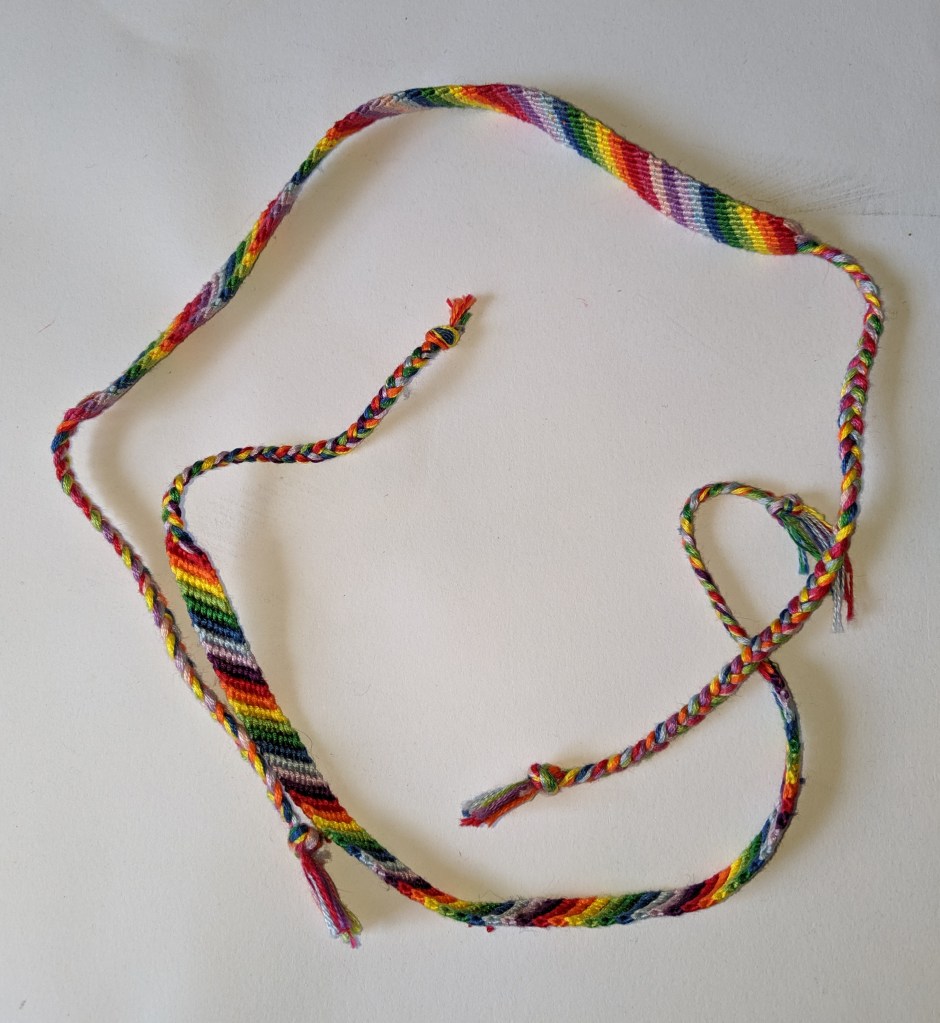
It became so much of a craze that I remember making a number of them and selling them at school for about $0.50c (50 cents) to about $1 to $2 depending on the complexity of the design. I remember spending many nights in front of the t.v. with one end of the bracelet pinned to my pant leg or the bean bag and I’d be madly tying the knots in preparation for the next day. Below are a couple of the bracelets I’ve held onto. They’re quite simple in comparison with some of the others I’ve made and sold.

Rainbow friendship bracelets. Diagonal design going from left to right. This image shows a close up of the design to show the darker and lighter reds, blues, greens and an orange and yellow and darker and lighter purple and pink.
Rainbow Friendship Bracelet made out of DMC cotton
This overhead shot shows two friendship bracelets that show the front and back of the bracelets. Both are rainbow diagonal going from left to right.
Overhead view of the rainbow friendship bracelets

It’s also important to note that with the selling of these bracelets, I had a limited market because I went to a small country school. When I graduated, there were a total of 74 students in the entire school and 8 people in my year. So my market was pretty small and there was someone else making the bracelets as well. Mine were better though!

In high school I was very much into writing and wanted to do something with that. I did a fair bit of cooking and craft classes to get my creative fix and did a bit of cross stitch at home. It was also at high school that I was introduced to quilting and photography. It was pretty cool developing the film in photography and learning how the whole process worked. I also knew early on that with photography, that if I had to do portraiture and tell people how to pose in photos, that I didn’t want to take it any further. I really don’t like telling people what to do and how to look to get a particular result. There’s also the pressure of getting the picture taken in a quick and short period of time and to that’s too much pressure.

I digress! I can’t help but wonder what things my nephew will be interested in and how everyone in his life can help to influence him in a positive way. I’m curious about whether he’ll stick with painting or progress onto other forms like pastels, charcoal and pencils. Or move onto mediums like pottery, origami, woodwork, metalwork and photography.

The really cool thing has been seeing that the creative flair remaining strong in my immediate and extended family. My grandparents on both sides of my family were creative with their photography, knitting, painting, gardening and music. I remember my grand father on Dad’s side, bringing out the piano accordion or mandolin on Christmas Eve and would play us some tunes. Sometimes he would sing as well. There was a few times there where he had tried to teach some of my cousins and I how to play the mandolin . My fingers were too small at the time and they haven’t grown much since!

Many of my aunts are creative with their painting and gardening and one of my uncles has taught himself to play the guitar. One of my cousins is/has been in a number of different bands and has performed on stage with his band. Another cousin of mine is creative with her hairdressing and make-up artistry. Meanwhile, my sister and her fiance are creative in their own rights with their talents in music (drums and possibly guitar), pottery, drawing and photography.

So my nephew has no escape from this strong creative flair and I can’t wait to see what comes of it!

Posted in Uncategorized

Halloween Cross Stitch – Admiring from a distance

Hi Everyone

As an Aussie, Halloween has never been a big part of my life. I love horror and thriller movies, tv shows and novels. I’m facinated by ghost stories and urban legends. All of which has sometimes caused me to be a little scared a times, when I’ve needed to drive home late at night, the fog’s starting to roll in and I think to myself that this would be a great start to a ‘Supernatural’ episode!

Meanwhile, over the last few months when I’ve been watching Flosstube, a lot of Halloween themed cross stitch has caught my – especially some of the designs that the Sunshine Stitchers have shown as part of their WIP’s and finishes. In their latest episode (shown below), checkout the framed Halloween projects in the background.

Sunshine Stitchers – Episode #50 – 29 September 2019

Another flosstuber who’s caught my eye for Halloween things is Javagirlstitches – episode 15:

The awesome thing with flosstube is that everyone who shows us the projects they’re working on, also talks about where they got their patterns from and fabrics. I love this because I’ve started doing some searches on the Internet and it’s going to get me into a world of pain soon. All because I’ll want to buy all of the things and then want to stitch all of the things when they arrive in the mail and I’ve already got enough on the go! Or have I?!

The patterns that have caught my eye include (but not limited to):

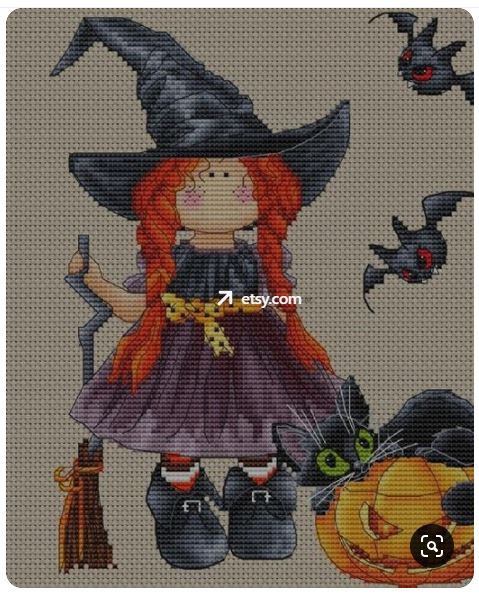
The Cottage Needle’s petite cross stitch of ‘The Classical Sorceress Witch’ (loosely translated from the French title on The Cottage Needle’s etsy store. Les PETiTES CROiX De LUCIE Le Sorciere Classical Witch):

The Cottage Needle’s ‘Classic Sorceress Witch’ – image captured from Pinterest – pattern available from The Cottage Needle’s etsy site.

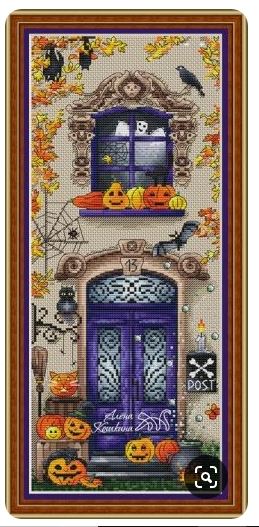
‘Halloween Balcony’ cross stitch pattern by Alena Koshkina, which is available from the Mybobbin Crafts Online store:

Image from Pinterest

I love the colours that Alena has chosen for this pattern and the colour of fabric just makes everything pop!

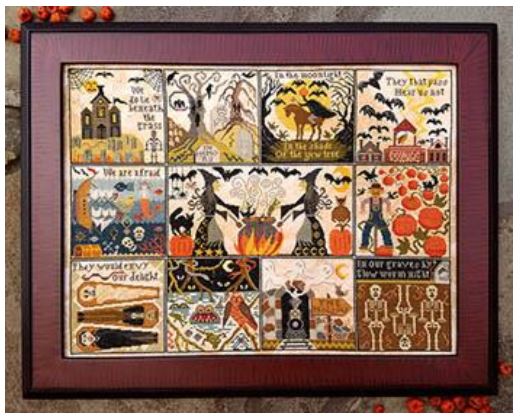
“Halloween at Hawk Run Hollow” by Carriage House Samplings, which is available from the Everything Cross Stitch website:

Image from the Everything Cross Stitch website.

“Halloween Night” by Alena Koshkina which is also available from the Mybobbin Crafts Online store:

Image from the Mybobbins Crafts Online Store

‘Sleepy Hollow’ by Glendon Place and it’s available from Sandra’s Stitch Stash. I saw this pattern as part of Gary’s (from the Sunshine Stitchers) WIP parade. He’s done a fantastic job on it!

Image from Sandra’s Stitch Stash

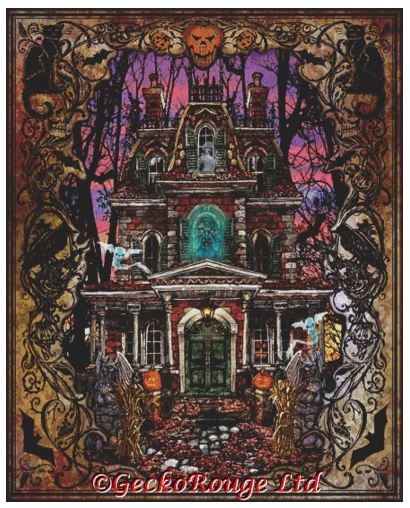
Last, but not least is ‘Fright Night’ by Lewis T Johnson and sold by Geko Rouge. My jaw dropped and my eyes widened when I saw this one! Just wow! The detail!

Image from Geko Rouge website

The awesome thing with all of this, is that this is just a sample – a tiny sample – of what’s out there! As I was scrolling through Pinterest and the different website I visited to put this post together, I came across more and more images and projects that I wanted to add to the list to share with you, let alone add to my collection!

Honourable mentions should go to Heaven and Earth Designs, 123Stitch and Hands On Designs. All three websites have some amazing Halloween themed pieces to work on.

Until next time, happy stitching!

Posted in Uncategorized

Cross Stitch, Footy Finals and Blogging

Hi Everyone

It’s been a big week. I’ve successfully completed my first full week at my new job, finished my second week of three days at the gym and I’m exhausted. I’ve been really tired and slept through the majority of the night, but my quality of sleep hasn’t been great. I know that a lot of it’s to do with not drinking enough water, I’ve been taking on bucket loads of information and my muscles are sore (a good sore though!).

In the lead up to this weekend, conversations and news items on the tv have grabbed my attention about footy finals and I’ve been mulling over in my mind, what I want to write about this week for this blog post – both of which I’ll talk about a little later.

Cross Stitch

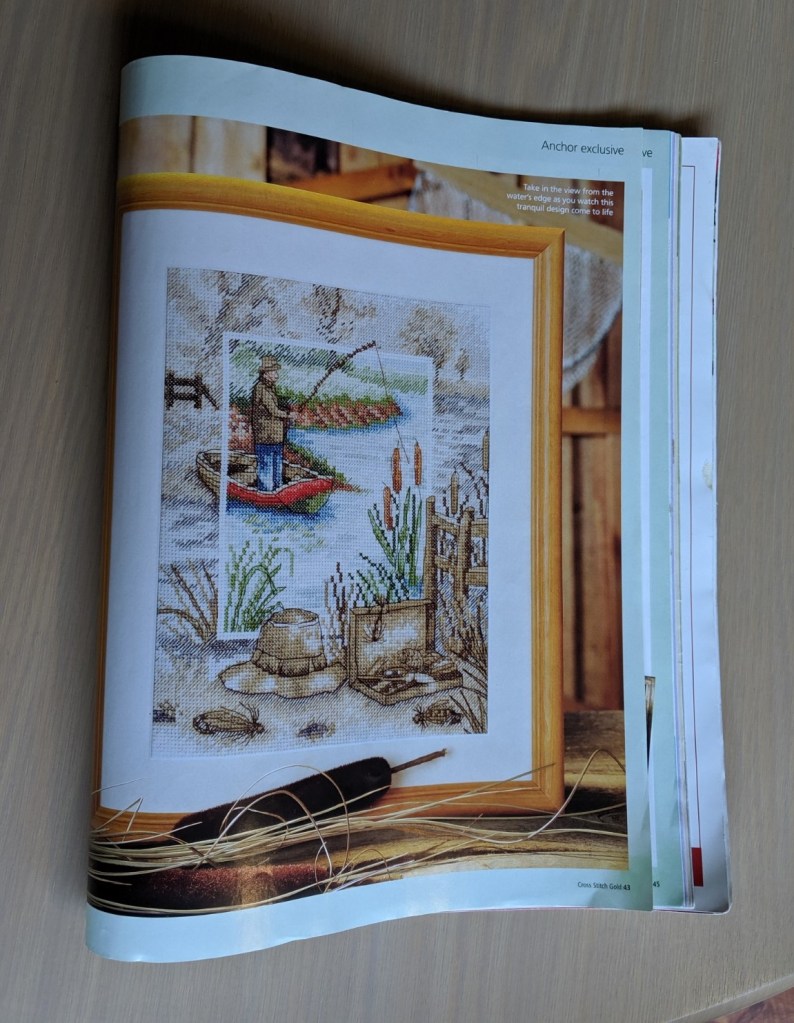
For all of this week I’ve been able to get some cross stitch done and I’ve managed to stick to one project! I’m still working on the fishing project and I really should have taken a progress shot last week, so that you could see how much more I’ve done. However, the picture below shows what I have been able to do over the last few months – most of which has been done over the last few weeks…

‘Fishing on the River’ / ‘Out Fishing’ – Designed by Collette Bispham – my progress so far

The strands of floss you see to the left and right of the WIP are for when I get to the next stages of the pattern. Also, in an earlier post, I had called this pattern ‘Fishing on the River’. I had used this name based upon sub-heading the Cross Stitch Gold magazine had used. Meanwhile, I’ve found that it’s been called ‘Out Fishing’ on the pages of the actual pattern and its details. As a result of this, I’m gong to call this project the fishing project just to keep it simple. Also, it’s the only fishing project I’m working on at the moment.

The other important thing to note with this project, is that I’ve chosen to use a brown Aida, rather than the recommended cream Aida. It is still 14 count though. I decided to use the brown Aida because I had the right amount for the pattern and enough excess for framing (or whatever I choose to do for the finish). Also, I thought that it would give the project an interesting finish because of the brown border the finished project has.

Now that I’ve taken the fishing project out of the hoop and ironed it to show you the progress, I’m itching to start a new project or move onto an existing project. I’m still umming and arrring about a new Christmas project. A lot of this is due to the patterns and fabric for the projects are in my stitching corner (I’m currently residing in my lounge room on the chase part of the couch), and I can see them every time I sit down to work on the fishing project or any other one I choose to work on. What’s holding me back at the moment, is figuring out which threads I use – DMC or Anchor threads. The patterns have listings for both brands and I have no doubt that I have all of the called for threads. Two things that are holding me back on starting a new project are:

  1. It’s another new project. I have so many other projects at the moment. Do I really need another one? Also, if I do start a new project, which one should I start? Should it be a small, easy one that I can finish in about a week and finish as a card? Or should it be one that will take a few months (at least) to finish?
  2. Where and how am I going to store the project if start a new one? Many of the YouTube clips I’ve watched over recent months have talked about and shown us their project bag collections and new additions to that collection. I don’t have anything like that at the moment and I’m starting to think that I need to have some. I do have a couple of Lincraft bags I use as travel bags for my WIPs and I’m currently using them for existing projects that I’m actively working on.

I’m also leaning towards going back to my mini mushroom project.

Mini Mushroom WIP – image taken back around the end of June 2019

I’ve stitched a lot more since the above image was taken. I’ve really enjoyed seeing it come to life so far because it’s one of my own designs and like any project, I love seeing it come to life.

Additionally, I had a reminder come up on my IT devices about finishing and sending off a finished project to the framer’s, to then enter it in the 2020 Sydney Royal Easter Show. I haven’t finished my intended project for this show, but the reminders about the framing, reminded me of the plan/s I have for my stitching and what I want to achieve with it. I will achieve and complete those plans. It will just be on a slightly different timeline to what I had initially intended for them!

Footy Finals

It’s also the AFL (Australian Football League) Grand Final this weekend and NRL (National Rugby League) semi-final. I’m not a regular follower of the NRL, but I’m mentioning it now because the Canberra Raiders have made it to the Grand Final – 25 years in the making! So for the next 7 days at least, there are going to be a whole heap of local businesses getting behind the team with Raiders paraphernalia, green decorations and green food. It would be so good if the Raiders won because it’s been so long between drinks and if I had to support an NRL team, why not my home team?!

Meanwhile, today (Saturday 28 September 2019) is the AFL Grand Final and it’s going to be HUGE! We have Richmond Tigers versus the Greater Western Sydney (GWS) Giants. The Tigers have been part of the AFL for over 100 years whilst the Giants have only been around for 8 years and this is their first grand final. The Tigers have a number of flags under their belt – most recently, a couple of years ago. So, I’m really hoping that Giants win because they’re such a young team.

Update – The Tigers won. Their experience meant that they completely thrashed the Giants – 114 to 25. That said, it was a history making game in so many ways. What I hadn’t realised until the commentators said it, 100 years ago, the Tigers were in their first grand final, now 100 years later, the Giants were in their first grand final.

Blogging Mojo

I feel like I’m loosing my blogging mojo. Or at least, I think I need to re-adjust the direction I move with my blog. This may assist with me practising what I’m preaching with regards to promoting cross stitch and the designers who are having such a huge influence on the direction that cross stitch is going.

Alternatively, I’m thinking that I could have posts a lot like everyone else’s, and have weekly or monthly updates and have WIP (work in progress) parades, finishes, full finishes (e.g. framed, cards etc.) and starts. The challenge I’m working through with this, is the fear I have of being over-looked or my posts being considered ‘yawn-fests’ because I’m talking about very similar things to everyone else. The slight positive is that I’ll be stitching things a little different to everyone else!

Your help is needed

Any feedback you can provide on what you want to see and read about cross stitch would be great! Do you want to know about what others are doing? What I’m stitching?

Until next time, happy stitching!

Posted in Uncategorized

Cross Stitch Xmas Ornaments and Bucket Loads of Cross Stitch

Hi Everyone

What is it with Murphy’s Law that as soon as I properly relax on a holiday, that I then get sick? The upside to spending a week and a half on the couch and binge watching Netflix, is that I have been able to get a bucket load of cross stitch done!

Moonlit Waters Fairy Progress…

The deal/rule I have with myself at the moment, is that I’m not allowed to move onto another project until I’ve completed a page. This rule applies to the larger projects I’m working on and it drives me a bit batty when I start getting an itch to start a new project. So, as a result of this rule and getting sick, I was able to finish a page on the Moonlit Fairy project (see below) and start some work on some Christmas ornaments and Christmas related projects.

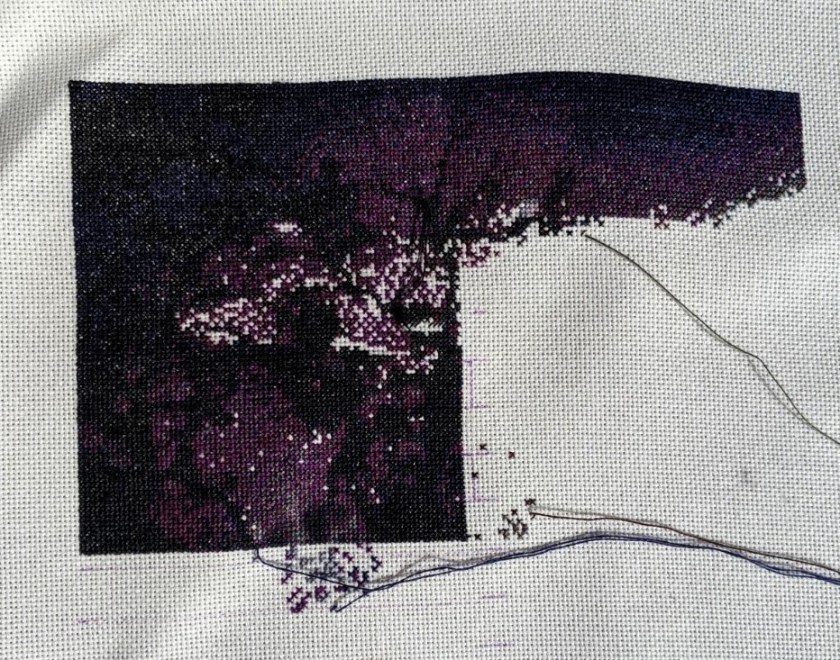
Progress of Moonlit Waters from earlier this year.
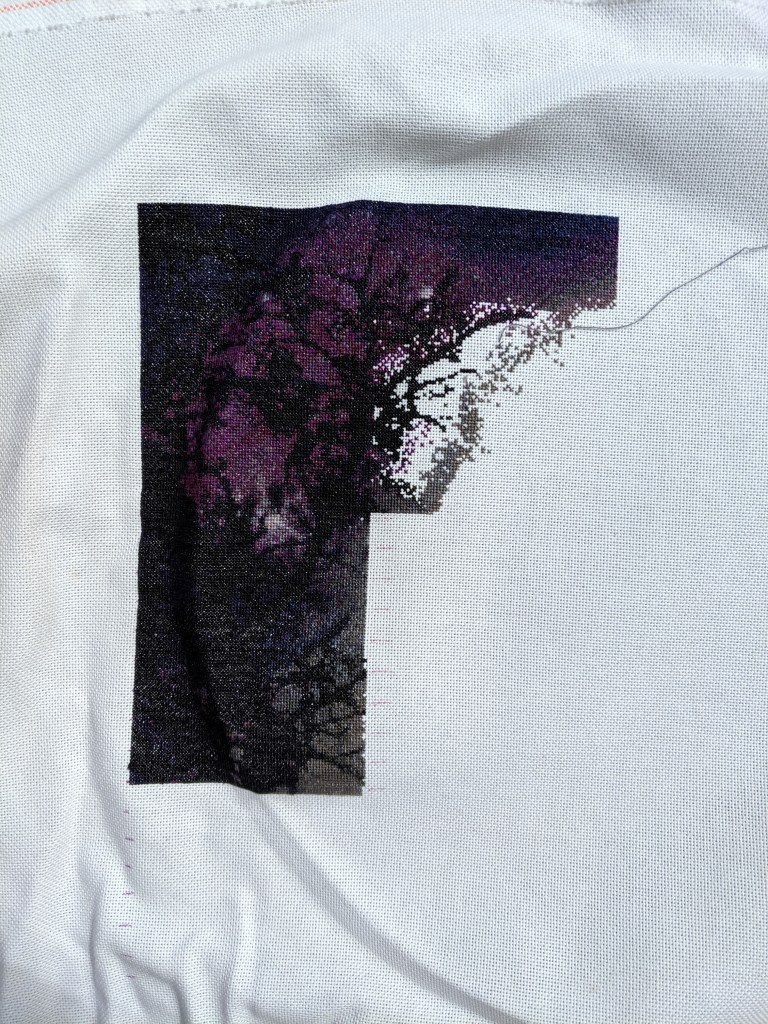
Progress as of 22 September 2019

Christmas Ornaments…

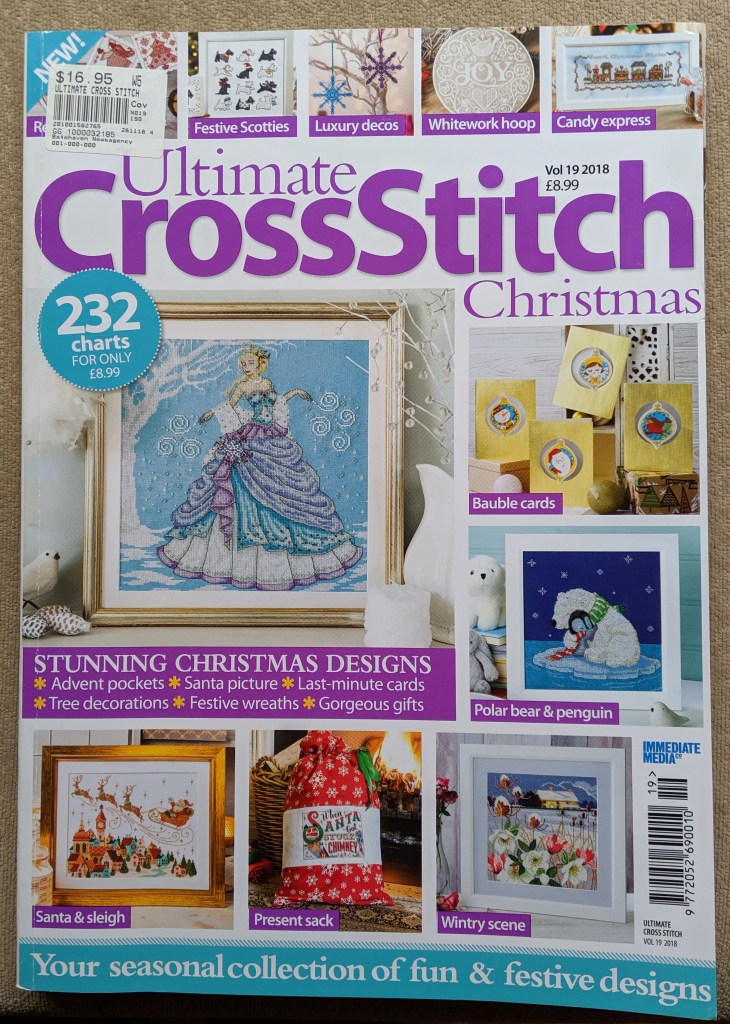
The Christmas ornament I completed last night (20 September 2019) was Snowflakes from Ultimate CrossStitch Christmas Volume 19 2018. I bought it during my Christmas holidays at the coast and I want to stitch all the things in this issue.

Ultimate Cross Stitch Christmas Volume 19 2018 magazine cover

One of the things I really enjoyed with this project, was stitching on plastic canvas. All of the projects I’ve worked on in the past have been on Aida or Evenweave, so it was a nice change to work on something different. The main challenge I had with working on the plastic canvas, was it being clear plastic and getting my bearings with where I needed to put my next stitch.

I decided to stitch two snowflakes in two different colours – purple and blue and I had contemplated using ModPodge glue to stick them together or double sided tape. My concern however, was that neither would hold very well and I didn’t want there to be much of a gap between the two snowflakes. I could have made the joining of the snowflakes extra decorative with the use of metallic threads for the seam and beads. But I wanted it to be seamless and the focus to be on the snowflake and the clear edge around it, which triggered my light bulb moment. My boyfriend is an avid fisherman and has a variety of fishing lines that I may be able to use to join the snowflakes together!

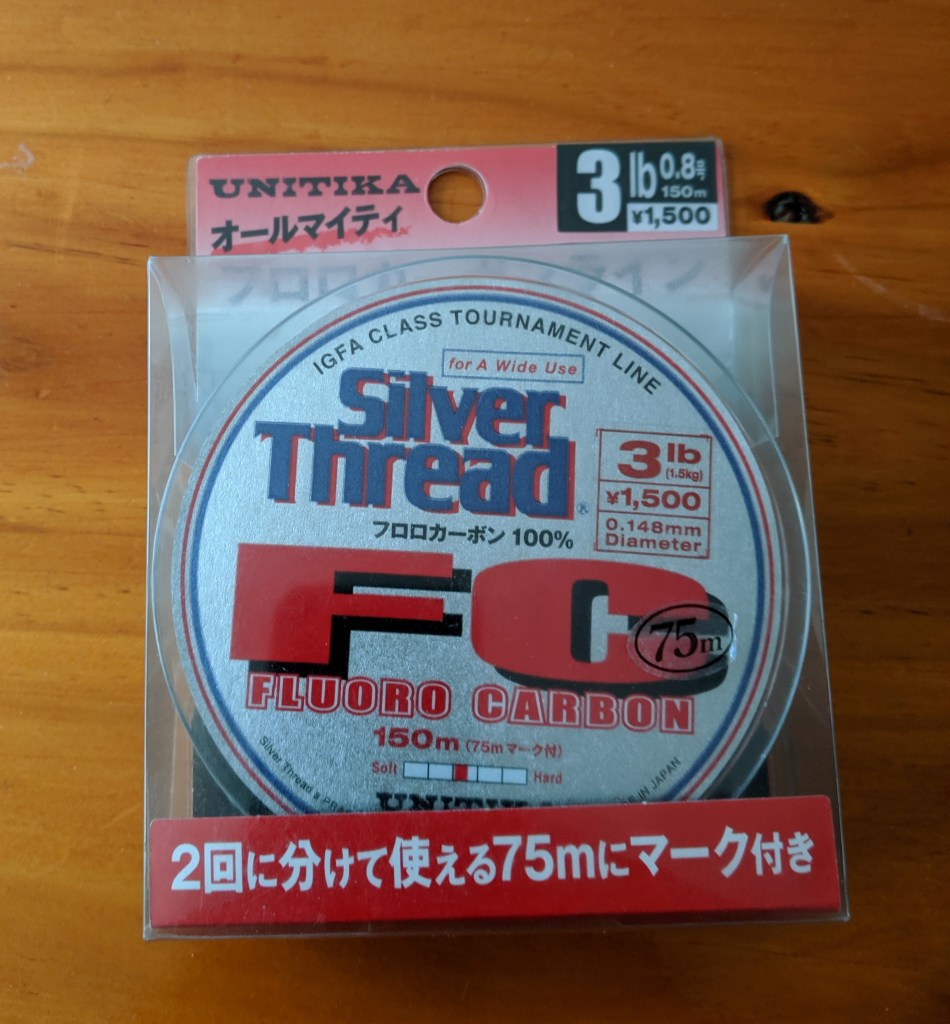
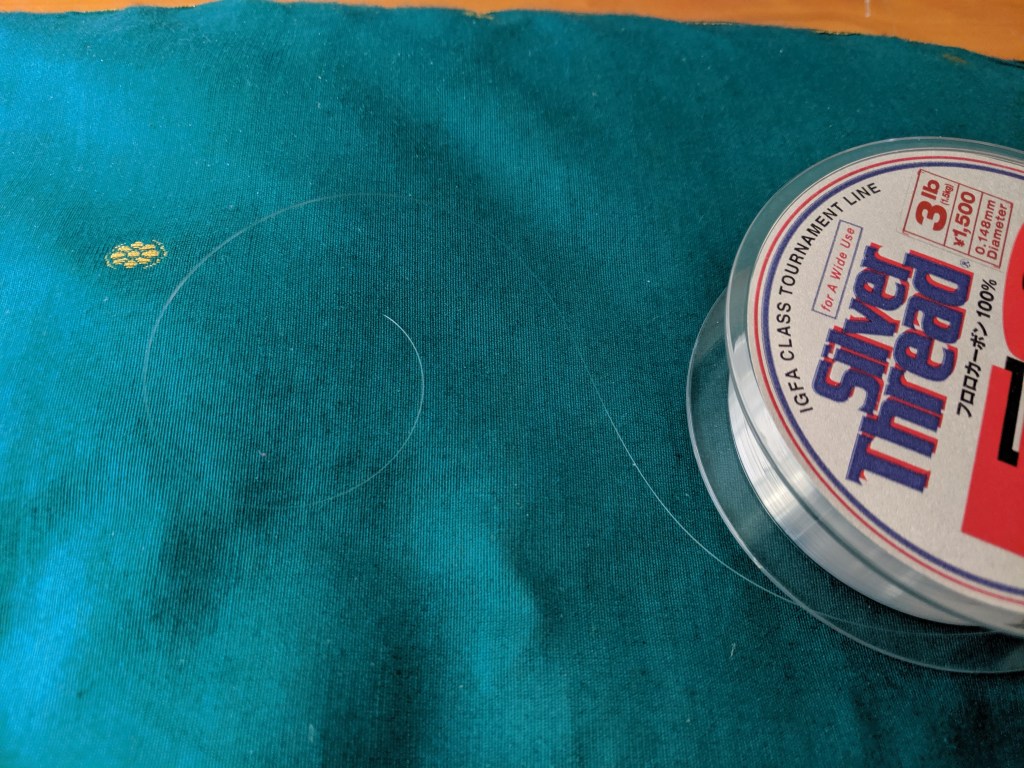
Packaging of the fishing line I used for joining the snowflakes
This is how fine and clear the fishing line is – best used for fishing in super clear water!

The line was a lot more flexible than I thought it would be, based upon what my boyfriend was initially saying about the line. Also, because of how fine it is and that it’s so clear, on the snowflakes, I can’t see where I’ve stitched with it!

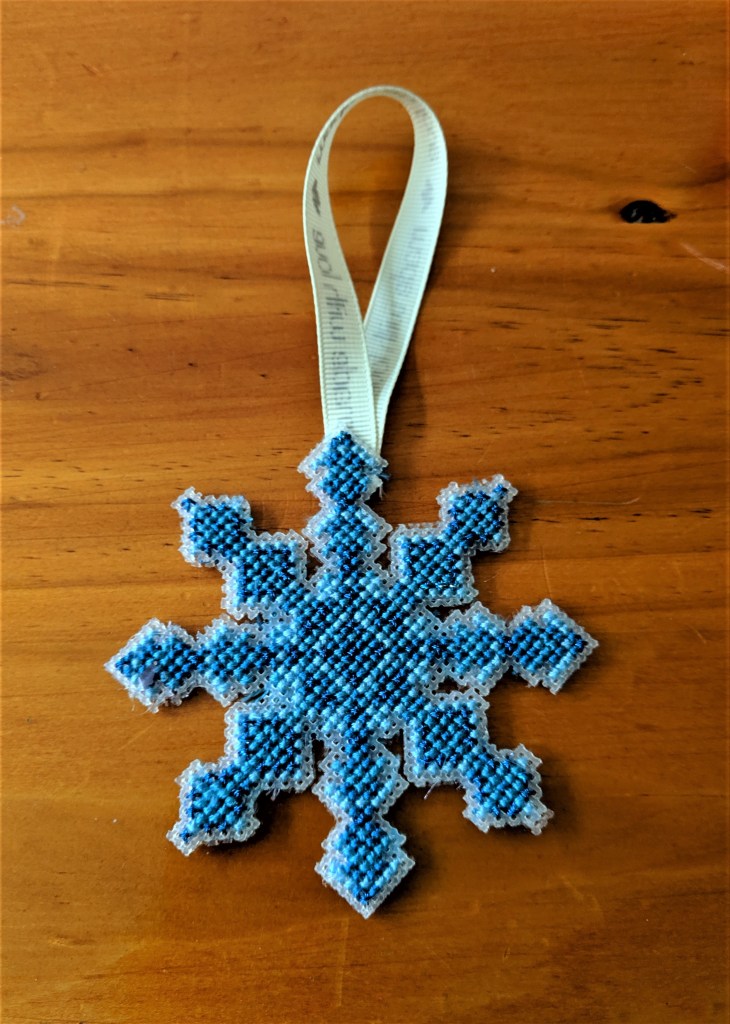
Blue side of the snowflake – can you see where I’ve used the clear fishing line?
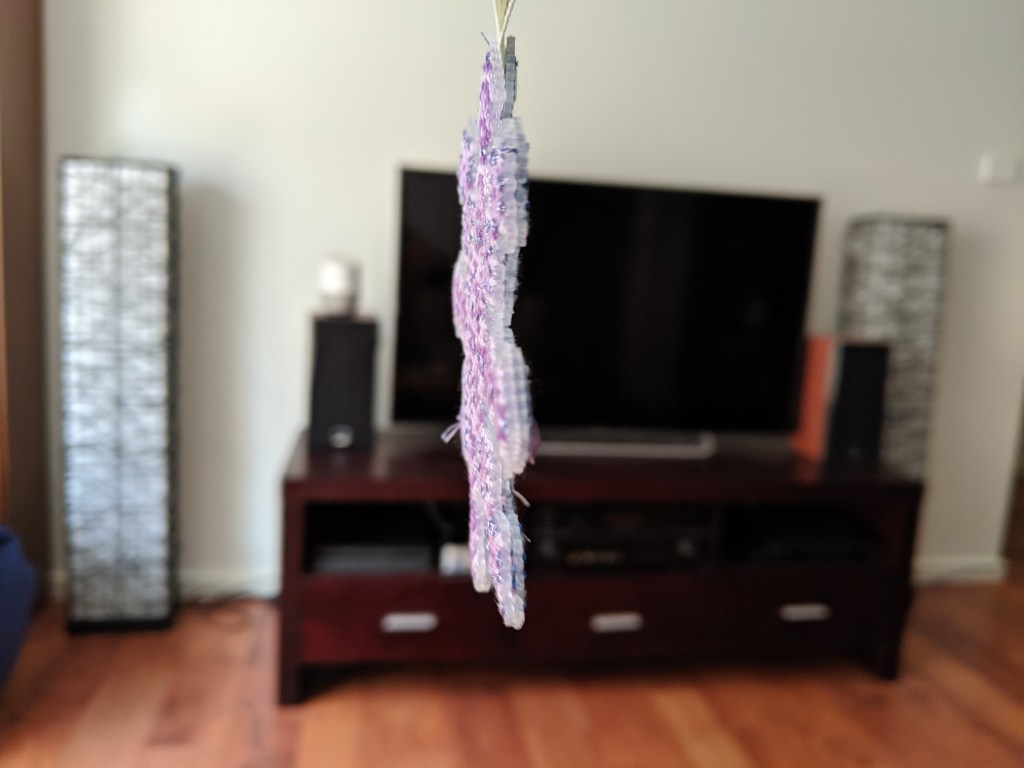
Side view of the snowflake
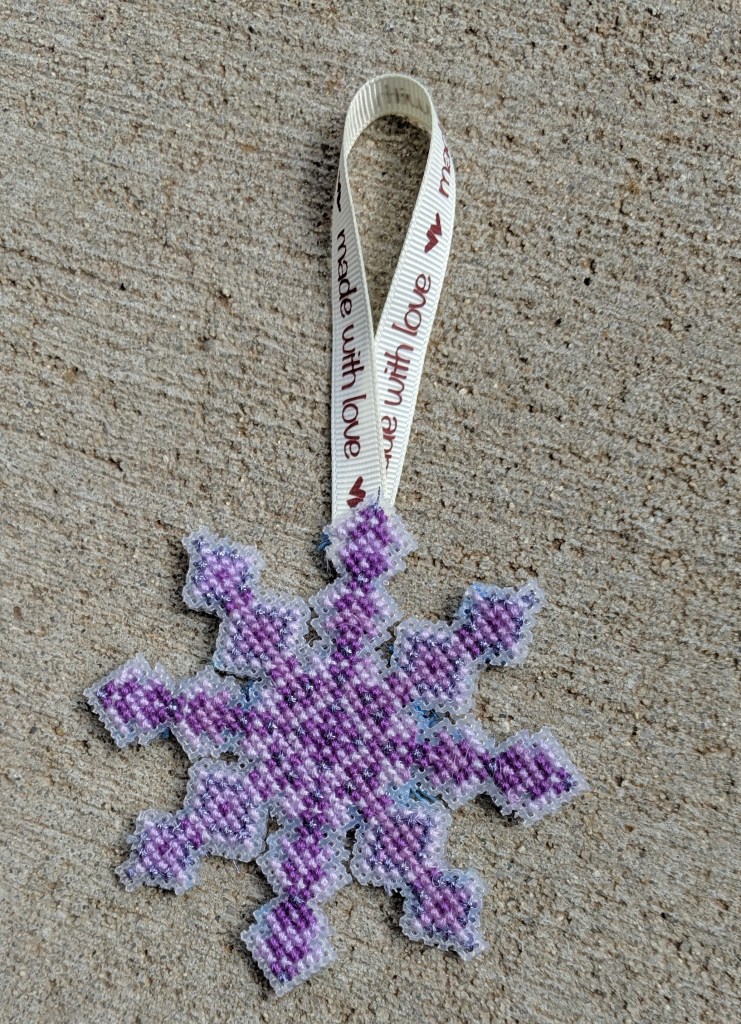
Purple Snowflake

Stitching with the fishing line gave me a new appreciation of stitching with metallic threads and similar threads that can be difficult. They’ve got nothing on fishing line! I appreciate that fishing line is just that – it’s not meant to be stitched with. I can also appreciate how easy it is to get tangled and knotted whilst being used as fishing line and getting snagged. For the majority of last night when I was joining the snowflakes together I was internally cursing and swearing like a sailor because it was knotting up and getting caught on the rough edges of the snowflakes. Then there was the additional challenge of re-threading the needle with the line. Oh. My. Gosh. The line is clear and curling up and not wanting to play nice. It took a large bundle of my patience and stubborn perseverance (this line was not going to beat me!) to get it done before I went to bed.

But it’s done and I love the result of my first attempt at stitching on plastic canvas and using clear fishing line. I don’t know if I would use fishing line again. I would probably use some pretty, decorative paper to line the back of the snowflake so that people wouldn’t see the back or ensure the ornament hung in a way that people couldn’t see the back when it’s on the tree.

Fishing on the River project work in progress…

For the last few days – since completing the snowflakes – I’ve been working on the ‘Fishing on the River’ project whilst trying to hold off on starting any new Christmas related projects. It’s been progressing a lot better since I photocopied the pattern so that I could have a working copy. I found that trying to just eye-ball the pattern and not mark where I’ve stitched doesn’t work very well. I found myself getting a little muddled with where I have or haven’t stitched – especially when it came to stitching the half stitches.

Fishing on the River project – Cross Stitch Gold – Issue 87 – year unknown

My aim at the moment it is to stitch it for my boyfriend for his birthday or Christmas. Whether I get it done by this birthday/Christmas or next year, is debatable at the moment because there are just so many projects I want to work on at the moment!

Projects I’m itching to start…

While I’ve been working on the fishing project, I’ve been really keen to start on ‘The Candy Express’, ’12 Days of Christmas’ and ‘Santa’s Coming!’ from the Ultimate CrossStitch Christmas Volume 19 2018.

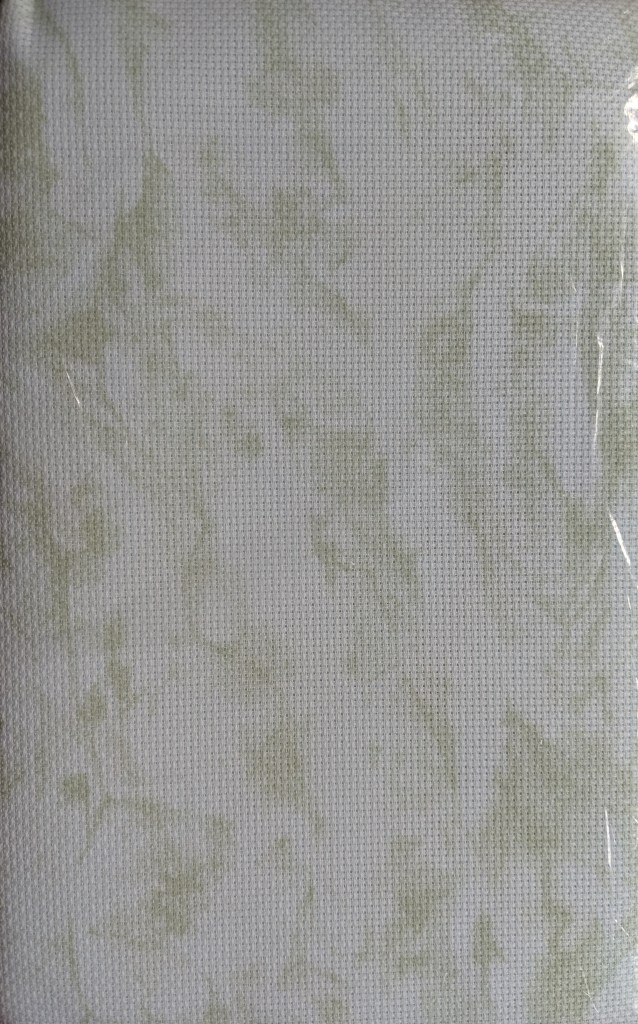
At the moment I’m thinking that I’ll stitch ‘The Candy Express’ and ‘Santa’s Coming!’ on the marble green fabric (see below) – even though the pattern calls for ‘Santa’s Coming!’ to be stitched on 14-count white Aida and ‘The Candy Express’ to be stitched on 28-count Sky High evenweave.

Green marble fabric

At the moment I have my nephew in mind for these two projects. He’ll be turning 5 very soon and I’m uncertain at the moment about how much he may appreciate the projects. However, if I stitch some more Christmas ornaments, he may enjoy putting them on the tree – especially if he knows that they are his special ones!

Running Update…

I’ve been very, very quiet on this front because I haven’t really done much for what feels like a long time. Yesterday (21 September 2019) I did some interval running for 3km and it was good to get out and about again.

On 10th November 2019 I’ll be participating in the 5km leg of Canberra Times Fun Run with the aim of getting as close as I can to the 30 minute mark. I’m a bit worried about whether or not I’ll be able to reach that time because of how unfit I’m feeling with running. The good thing though, is that I’m participating in my local gym’s 8 week challenge, which will help me with getting my fitness up!

Until next time, happy stitching and wish me luck with making decisions and progress on my projects!

Posted in Uncategorized

The Top 8 Things I Love About Cross-Stitch

Hi Everyone

I really love cross stitch! What helps at the moment is that I’m recovering from a cold that’s kept me mostly home bound for the best part of a week. Resulting in a bucket load of cross-stitch getting done and not much else!

So without further adieu, here are my top 8 of things I love about cross-stitch:

8. The Internet and Techie Devices

The Internet is a wonderful thing and I love having the option of accessing it through a variety of techie devices. I love that the Internet has enabled a lot of us to connect with each other via Flosstube, Facebook and other groups to form cross stitch communities and share with each other our starts, progresses and finishes. I also love being able to search for a variety of ideas on what to stitch next and any tools of the trade that may help me to finish a project or make it pop!

7. Mobility – Being able to stitch anywhere, anytime

I love being able to take my cross stitch nearly anywhere to stitch. I would love to be able to stitch on a plane if there weren’t any security issues (in Australia we’re not allow to take scissors in our hand luggage, otherwise the scissors will be confiscated. I’m also aware that there are alternate options scissors on a plane. I just don’t want to risk it as I could see my needles or other aspects of my project being confiscated and I’d then be stuffed!) or problems with elbow room.

I do however, love knowing that I can move around the house and sit wherever I want to stitch. This can be applied to any destination I’ve travelled to, once I’m off the plane or whichever mode of transport I’ve taken. I’m happy as long as I have a comfy seat, good light and full charge on my earphones and phone so that I can have some background noise.

6. Fabric

I love that there is so much variety when it comes to fabric and that the possibilities are endless. I love that we can get fabric ranging from Aida to Linen to Evenweave and that it comes in so many different colours. Below is just an example of the variety of options out there…

Fabric I purchased earlier this year from Victoria House Needlecraft

5. Threads. Skeins. Silks. Floss.

When I first started stitching, I thought that the only thread option was DMC cotton or what was supplied via the kits. Based on what I’ve seen via Flosstube, I can’t wait to try the silks and other brands that other stitchers have talked about.

Meanwhile, I love the colours available within the DMC range at least. As much as I might grumble at the time, metallic threads have their place in the world of cross-stitch! I love the texture and sparkle they bring to a project. I’m also really keen to use more of the variegated threads in a project and the life it can bring to the finished piece.

4. Seeing the project come to life

I don’t know about you, but I usually pick a pattern for a reason and when I see that project coming to life, it makes me smile because I’m creating the way that it’s been intended and it reassures me that I’m on the right track. If I’m stitching it for a family member or friend and I know they’re going to love it, that spurs me on even more, just thinking about how they’ll react when they see the finished piece.

Then there’s the special stitches, backstitch and embellishments that really make the piece. Sometimes I’ve contemplated not backstitching because of how much there is. Seeing the finished picture and how much the backstitch enhances the work I’ve put into the project makes it all worthwhile. Also, I believe that the designer wouldn’t have put the backstitch in there if they didn’t think that it wouldn’t make a difference!

3. Tools of the Trade

I love needle minders and I wish I had come across them sooner! Also, I can’t get enough of the hoops. They are a necessity for me to cross-stitch. I’ve tried stitching without a hoop and whilst the project turned out okay, it just didn’t seem right to stitch without it.

2. The variety of options. The endless possibilities

Like the patterns, I love that there are so many different options and possibilities to finish a project. Pillows, biscornus, cards, framing, banners and pin cushions to name a few! As nervous as I am to try something other than framing a project, I’m also keen to see how cool it could look!

1. Starting something new

I love the excitement of deciding on what to stitch next. I love looking through the various kits, patterns and magazines in my collection and searching the Net. I also love that there are endless possibilities to what we can stitch and what we use to create that finished piece. Currently I’m starting to think about Christmas and the possibility of cards and decorations I could make. However, we do have Halloween just around the corner and I do love my horror/thriller movies and tv shows…

What are your favourite things about cross-stitch?

Until next time, happy stitching!

Posted in Uncategorized

What’s Your Stitching Legacy?

Earlier this year my boyfriend and I had dinner with his family, and a part of the conversation got me thinking about what would happen to our cross-stitching collections once we pass. I realise this is a morbid topic, but something that I hadn’t really thought about until now.

My boyfriend’s mum had said that when his grand mother had passed away, her embroidery collection had been given to charity or passed onto members of the extended family who may have been interested. I’ve also been told that my boyfriend’s grand mother was part of the Embroiderers’ Guild ACT and was very proud this and her embroidery.

Thankfully I’m not the only one who has thought about this topic and written about it. In 2014 Little Thread Crafts (LTC) wrote a blog post about this titled Save the Stash from the Trash! LTC talks about the importance of us stitchers ensuring that we have other stitchers around us who will be able to save our collections from the trash and other places that our collections really shouldn’t end up. LTC also talks about the major finds they have come across in charity stores that they have then added to their own stash. For example, patterns, threads and other stitching equipment that are out of production and for a portion of the price in regular retail stores.

Alternatives to charity donations

Don’t leave it until it’s too late and you’re unable to see the joy that others will get out of your stash. If you already have some items in your stash that you know you’ll never stitch, why not pass it onto someone you know will enjoy it? They could be friends and family or fellow stitchers’ you are yet to meet. The point here, is to get the word out through whichever channel you’re comfortable with.

If you’re really happy with the stash you have and you aren’t ready to part with it yet, it may be worth having some formal documents in place listing what is in your collection and what you want to have happen to the collection upon your passing. It’s morbid, I know! Just don’t live in denial, thinking that you’ve got plenty of time to worry about it later.

Our legacy is more than just our stash

When I’m stitching, I feel calm and peaceful. All other thoughts (most of the time) leave my mind and I’m able to properly focus on the task at hand. Partly because my projects will punish me later if I’ve been too tired or distracted! The other part is, when I’m not stitching, I’ve usually got a few other things going on/happening at once. For example, as I’m writing this post, I’m listening to some really nice instrumental music whilst checking the time to see if it’s too early for my boyfriend to be home yet (it’s his first day back at work after a nice, relaxing week away!), and wondering whether or not I should get up and turn on the heating and questioning whether cold or not. All the while trying not to be too distracted by the sore muscles in my neck from sitting on the couch doing cross stitch and watching tv at a slight angle. Which leads me to wonder if I can get away with re-arranging the lounge room so that I don’t get a sore neck. All the while ensuring that it benefits my boyfriend as well, when we’re able to chill out together again once I’ve recovered from my cold! Which leads me to question whether I really should be trying to rearrange the lounge room when I’m sick.

I appreciate that from a reader’s perspective, the previous paragraph is very much a ramble. It’s also a perfect example of why I need to stitch and do other things to get such thoughts under better management!

Telling our story. Sharing our legacy.

Aside from some a wide range of projects completed, partly completed and barely started ones, how many people will know how much time was put into those projects? Unless there are people around me to see me working on the projects or I’m remembering to document the amount of hours that go into them, no one is going to know. This is the true point of it being more than just the stash!

We need to document in whichever way is comfortable and easy for us, the amount of time we put into our projects. Why we started working on them then stopped at a certain point. Why purchased the patterns/kits in the first place. Which projects we found easy and which ones were challenging and why. Why we framed one project and turned another one into pillow or wall hanging or card.

Thankfully the Internet and social media has made all of this a lot easier to do. Just by posting a picture and a few sentences (or a video) about our works in progress, finishes, questions and challenges, we’re documenting what’s happening. We’re sharing our stitching legacy!

Related articles and sites

Posted in Uncategorized

How much money is your cross stitch worth?

Have you ever tried to place a monetary value on your time?

When you’re purchasing a cross stitch kit or individual supplies for your project, you know what you’re paying for. You’re paying for the pattern, fabric, threads, needle, needle minder, scissors and any other tool to help you complete the project. You may also know how long it will take you to complete the project. But since you’re doing the project for the love of stitching, the thought of putting a monetary value on the time it will take you may seem daunting or preposterous. I mean, who’s going to spend hundreds, if not thousands of dollars on a beautiful cross stitch picture, right?

Pricing Schedules and Formulas

Many of the pricing schedules and formulas promoted on the Net for arts and crafts are assuming that you’re going to be making jewellery, painting, sculpting, card making etc. The level of complexity and time taken to produce the end product will vary – many of which can rival the time taken to completely finish a cross stitch project (framing/finishing options included). This is what you need to determine when you are deciding on which pricing schedule or formula to use. Other questions you could consider include – How complex and intricate is your project? How many different colours are you going to use? How large is the project?

I really like the article by Dave Nevue who talks about pricing art and the different formulas that can be used. One of the most common and popular ones is shown below:

Cost of Materials + Hourly Rate x time taken to complete project = cost of project + GST = Sale Price Using one of my projects as an example, this formula would look like:

Materials:

  • 148 DMC colours x $1.50 per colour = $222
  • $15 worth of 14 count Aida fabric
  • Total cost of materials = $237

The formula:

$237 (cost of materials) + $41.49 (my hourly rate) x 225 (the hours taken to complete the project) = $9,687 +10% = $10,655.70

You will see that with this formula, I’ve not included any costings for framing or any other type of finish. I’ve intentionally left out the cost of framing or other types of finishes because I don’t know who’s going to buy it and where they live. Also, at this point in time, I don’t know if I will sell it online or in-person.

Determining your hourly rate

What are your expenses? How much money do you need to ensure you can comfortably live and not be stressed by money? If you are already have a steady income and you are happy with that income, crunch the numbers to find out if that is a feasible amount to be charging when you’re pricing your craft. If you’re not sure or you think that your prices are too high or too low, talk to an accountant.

An alternate pricing option

Rather than assigning an hourly rate, some cross-stitch forums have suggested assigning 1 to 5 cents per stitch, and calculating the cost based upon how many stitches there are in the project. For example, the Heaven and Earth project I’m working on at the moment (pictured below), is 400 stitches wide by 509 stitches wide.

Cover page for the current cross-stitch project I'm working on. Pattern name is Moon Lit Waters. Designed by Michele Sayetta and artwork by Julie Fain. The image has the sillouette of a female fairy in front of the moon, hovering above the water. The water below her has a rippled reflection of her. The picture has a lot of dark colours around the edges, with lighter shades throughout the middle.
Current project I’m working on.

Using the pricing schedule suggested in some cross-stitch forums and basing it upon the Moon Lit Waters project, the formula would look like this:

(400 x 509) x $0.05 = $10,180

This is also assuming that I have already been supplied with the materials I need for the project. If we factored in the price of the pattern and materials, the price would be getting closer to $15,000.

Insuring your cross-stitch

This can be a great way to determine what your cross stitch is valued as and may be an alternate way to determining how much money your cross stitch is worth. Imperial Needlework Appraisal for example, can appraise your cross stitch and provide you with a valuation certificate.

Do your research – Test the market

If all of this still seems daunting and you think the price you’re asking for your art is too high or too low, test the market. Do some searches on the Internet. Talk to people in the industry.

Etsy, Ebay and Gumtree are just three of the places you can go to, to see what prices people are selling their projects for. This can also give you an idea of where your projects sit within the market. For example, the more complex the project, the higher the amount of money you could ask for.

It may also be worth checking to see how long the items have been sitting on the market for and getting in contact with the sellers to find out what their most popular products have been. This may help you with determining the future trends and themes.

Understand your customer

Who are you stitching for? Who is your ideal customer? Why are you stitching for them? What do they want?

Answering these questions can help you with determining the monetary value of your cross stitch and what you end up stitching. For example, you may really enjoy stitching cards for various seasons and events. They can be as simple or complex as you want the designs to be and people appreciate a thoughtful, handmade card.

Alternatively, you may have the passion, drive, patience and ability to stitch beautifully large pieces that are complex in design and are worth the time and effort that has been put into them. There’s a market for that too. The challenge is finding the right buyer.

Marketing – Promote yourself. Tell a good story.

This is applicable to all of your projects – especially your higher priced ones! Your customers will need and want to connect with the project you are selling. More importantly, if they can find a connection with you and understand why you are doing what you do, it will enable your customers to appreciate the work you have done and the price you have placed on the product.

Consider the following questions in association with a project you’re working on – why did you choose to stitch this project? What do you love about it? Did you experience any challenges whilst stitching it? Was there something happening in your life that had an impact on the project? Is there a special meaning behind the project?

Sharing your story with your customers can help them with wanting to purchase your projects. The Artlandish website for example, provides an explanation on the stories behind Aboriginal art and why certain symbols, designs and colours are used to convey their messages.

You are worth it!

If I’m struggling for motivation to get something done, I remind myself of the following quotes (I don’t know who said them. But I have seen these words quite a lot on the Internet):

Related posts and articles

Posted in Uncategorized

A Crafty Special Library – Do we need one?

Hi Everyone,

When you first hear the word ‘library’ , do you think of architectural master pieces, places that are cosy and warm, a community hub or places of torture (because you really didn’t like school or study)?

In this digital age, what if we had a library dedicated to all things crafty? I’ve been mulling around with this idea and question for a little while now. If it is possible, how would it work? If not, why? Alternatively, do we really need one? Before I go any further though and ask a lot more questions, I need to specify what a special library is, so that we’re all on the same page!

A special library focuses on a specific subject such as law, town planning and design, architecture, medical science, astronomy etc. and that library provides services that are specific to that subject. Also, the library can be part of an organisation such as a hospital or law firm or government department. Or it can be a stand alone library, relying upon community and government support. For example, employees at a hospital that has a library, can access it to aid their diagnosis of a patient or increase their knowledge and awareness of improvements and changes in their fields through the consuming of sources provided by their library. Additionally, some special libraries are open to the general public.

For the most part, special libraries work much like any other library with regards to the services and variety of formats the information you need and want. For example, you can borrow various items from the library for a set time period and you will be required to return the item by the due date. Or if it’s a digital item, your access to that item expires on a set date. You can also request information from other libraries if your library doesn’t have the item you want/need. Additionally, the staff can assist you with your information gathering requirements by assisting with your searches or conducting the searches upon your behalf.

Special library questions

So, with these things in mind, I have a lot of questions about how a special library would work for all things crafty:

  • Would there be physical locations in community spaces to enable people to catch up and do stitch ‘n’ bitch, learn new crafty techniques, monthly stitch-a-longs etc?
  • How would the collections be developed? E.g. donations, purchases.
  • Who would run it? E.g. volunteers or paid employees or both or another variation?
  • How would copyright issues be taken care of?
  • Would people be able to make acquisition recommendations?
  • How would culling/weeding the collection be handled?
  • Would patrons be able to purchase the culled items or would they be donated to places like the National Library of Australia?
  • Could there be a need for branches around the world that are regional specific or country specific?
  • If yes, how would inter-library-loans work – especially if copyright comes into play?
  • How could social media help?
  • Do we use the Dewey Decimal System or the Library of Congress way of organising the collections?
  • How would it be funded?
  • Is it necessary for it to be funded?
  • Could community grants help in any way?
  • Does it even have to be called a library? If not, what would it be called instead?
  • How would it be marketed/promoted?

Have I missed anything? What questions do you have?

Why would a crafty library not work?

  • Copyright over various jurisdictions?
  • Other legal issues I’m not aware of.
  • Issues with over-due fees and currency differences between countries?
  • Time zones?
  • Miscommunication due to language barriers and slang? E.g. Needle minders aka needle nannies, floss aka skeins aka threads etc.
  • Funding could be an issue.
  • Long-term there could be issues with employee turn-over.
  • Lack of interest or support from communities?
  • Cost of insurance covering public liability?
  • Work, Health and Safety issues relating to glues, hot objects, sharp objects, choking hazards (to name a few) – which could be covered by placing age restrictions on who can do what?
  • Upfront and ongoing costs associated with security, temperature control, location, accessibility, fit-outs, maintenance and equipment purchases to name a few?

Do any crafty special libraries exist already?

I’ve conducted some searches online to see if there’s anything out there and I’ve had very limited success. The search terms I used were:

  • Embroidery Library – which brought up a website with the same name. Which turns out to be an online shop, rather than a library in the traditional sense.
  • Craft Special Library – which brought up sites for various libraries who have or are conducting a variety of craft programs for children as part of their school holiday programs.
  • Cross Stitch Library – This search term brought up The Antique Pattern Library and my heart skipped a beat when I clicked on this site! The way this website is setup is what I’ve had in mind for how a special crafty library would look.

Does it have to be a crafty library in the traditional sense?

As I’ve been drafting and preparing this post, one of the key things that has been sitting in the back of my mind, is that all of us have our own versions of a crafty library – we just happen to call it our collections or our stashes! Additionally, we have a variety of different ways of organising our collections and many stitcher’s have shared with us, their ways of organising their collections. Below is just a sample of how:

YouTube clip by Ardith Deisgn published on 6 September 2018
YouTube clip by Harvey’s Corner published on 20 March 2015
YouTube clip by Stitching Mae published on 3 July 2014
YouTube clip by The Evergreen Needle published on 3 February 2016

I am however, stumped on how would we share our collections in terms of the patterns and kits that we no longer want or need? Would it be in the form of gifting them them to those who want them? What about the patterns and kits we have already stitched, that others really want to stitch, but the patterns are out of print and are no longer commercially available? Could a monthly catch-up work and we do a stash trade or swap? E.g. I’ll give you that pattern if you give me that fabric or I’m missing a particular floss colour and I’ll give you a lesson on something for that floss colour.

Final thoughts – Lots of questions. Not many answers.

Thank you for bearing with me for this post. I know I’ve asked a lot of questions with very few answers. I’ve also just scratched the surface for how all of this could work if it were considered to be possible and practical. A one-stop-shop could be a cool way of bringing people together like general libraries do. I appreciate that we are already connecting via social media and sharing our stories and passions and to some extent we are organised in the way that we go about it. I’m just curious about whether there is a revamp needed or a different way of pooling our resources. So I am very interested in what you think about all of this and I will greatly appreciate any comments you can provide.

Until next time, happy stitching!