Posted in WIP's and Plans

Cross stitch Progress and Plans for 2020

Hi Everyone

It’s been a while since I’ve done a stitchy update and I’ve made a tonne of progress since I’ve last posted an update. Some of the things that have significantly helped is in September 2019 I had some planned time off work and I ended up getting sick during those holidays. In hindsight, I believe that it was my body’s way of saying that I’d been under too much stress for so long that now I have the time to relax, my body was going to make sure I relaxed! It also meant that I was able to get a lot of stitching done and binge watch a huge amount of Gossip Girl, Netflix and Flosstube! Then in early to mid December 2019, I got sick for a few days because I’ve finally relaxed into my new job (it was around the three month mark of being in the new job that I got sick) and I got even more stitching done. With all of this stitching I was able to do – let alone years – I’ve given myself RSI (Repetitive Strain Injury) – self diagnosed – in my right hand. Specifically the knuckle for my index finger that connects to my palm and some of the muscles around my wrist, palm and muscles for my middle finger.

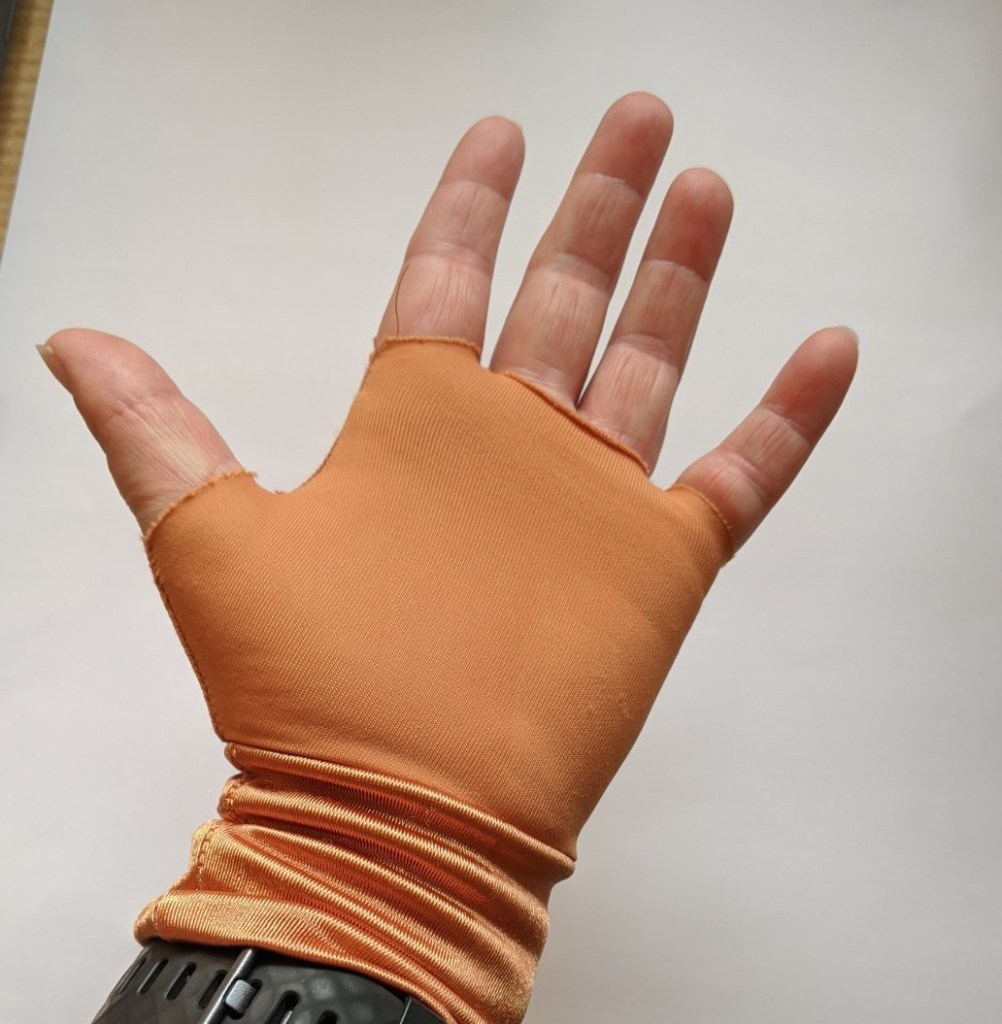
The slight positive is that I purchased a number of months ago, some fingerless support gloves (see images below) that are intended for embroidery and similar work. I purchased the gloves from the Australian website Thread and Needle. If you’re in the market for some support gloves, I highly recommend them! I’ve started using them a lot more and they’re really helping at the moment. I will need to go and see a doctor or physiotherapist about it though, because I don’t want it to get worse.

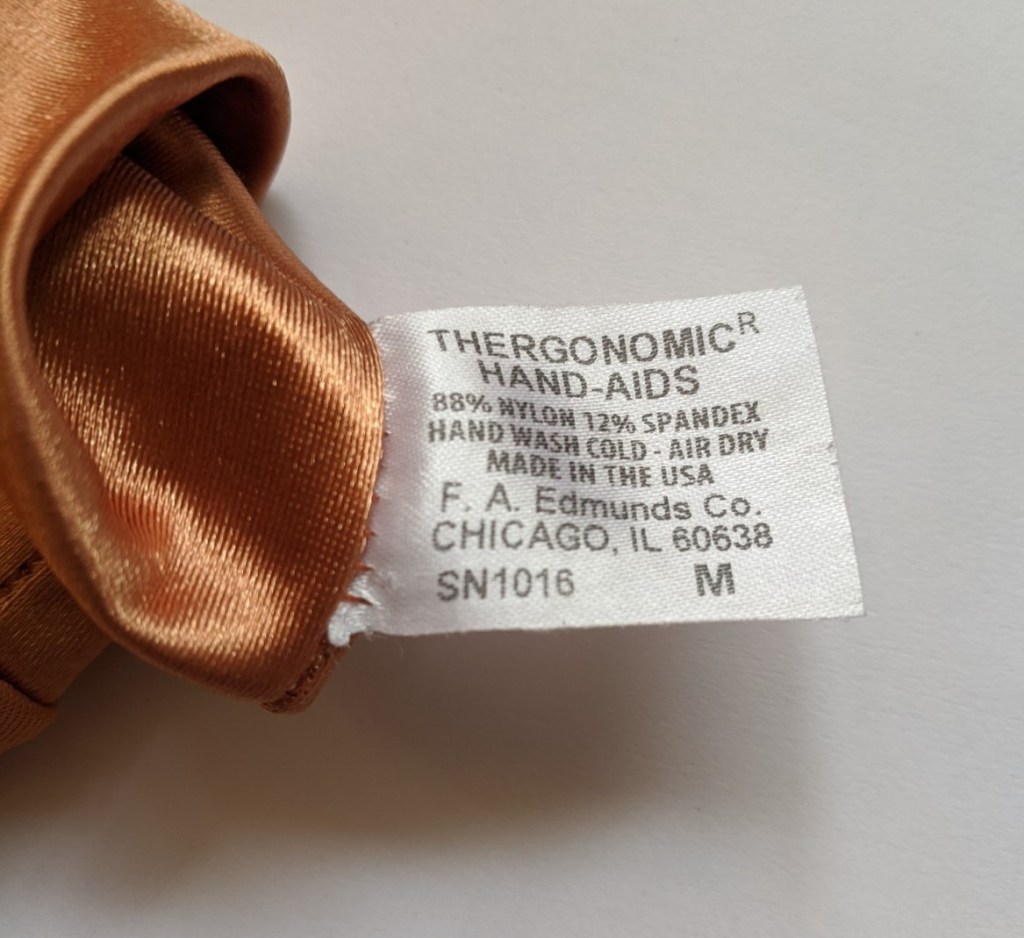
Support Gloves – Medium size
Label for support gloves – Thergonomic Hand-Aids – medium size
Support glove worn on my left hand, palm down – there is a large hole to fit my third and fourth fingers comfortably in the same hole.
Support glove left hand, palm up

As you may have seen, I have pretty small hands. I’m about 151cm to 155cm tall – depending on the time of day I’m measured. In my opinion, my hands – fingers especially – are chubby, so I find the medium size to be really good. Additionally, they are light weight and I’ve found that it doesn’t matter which hand I put the gloves on, because I can flip them around and as long as my thumbs go through the designated hole, I’m okay! The cuffs are super supportive and I’ve found that I can stitch for a lot longer with the gloves now that my right hand becomes fatigued quicker than my left hand.

The other thing I’m surprised by with these gloves is how quickly I’ve become use to stitching with them! I’ve stitched a little bit without them and my right hand has been fine, but I’ve felt a bit naked without the gloves.

WIP’s

Moon Lit Waters Project

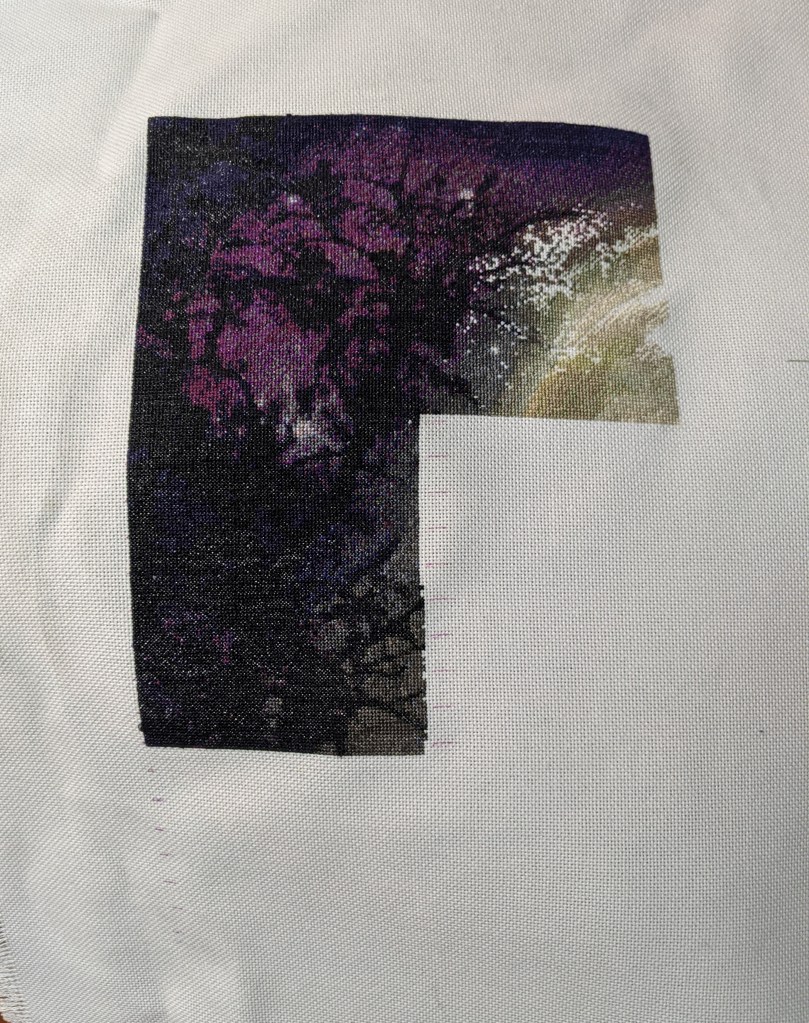
The increasing annoyance with this is I’ve got my mojo back for stitching the Moon Lit Waters (Heaven and Earth Design) project. It requires a finer needle to stitch the project because I’m stitching it on 25 count fabric. The good thing is that I have it in a hoop that’s being held in a stand.
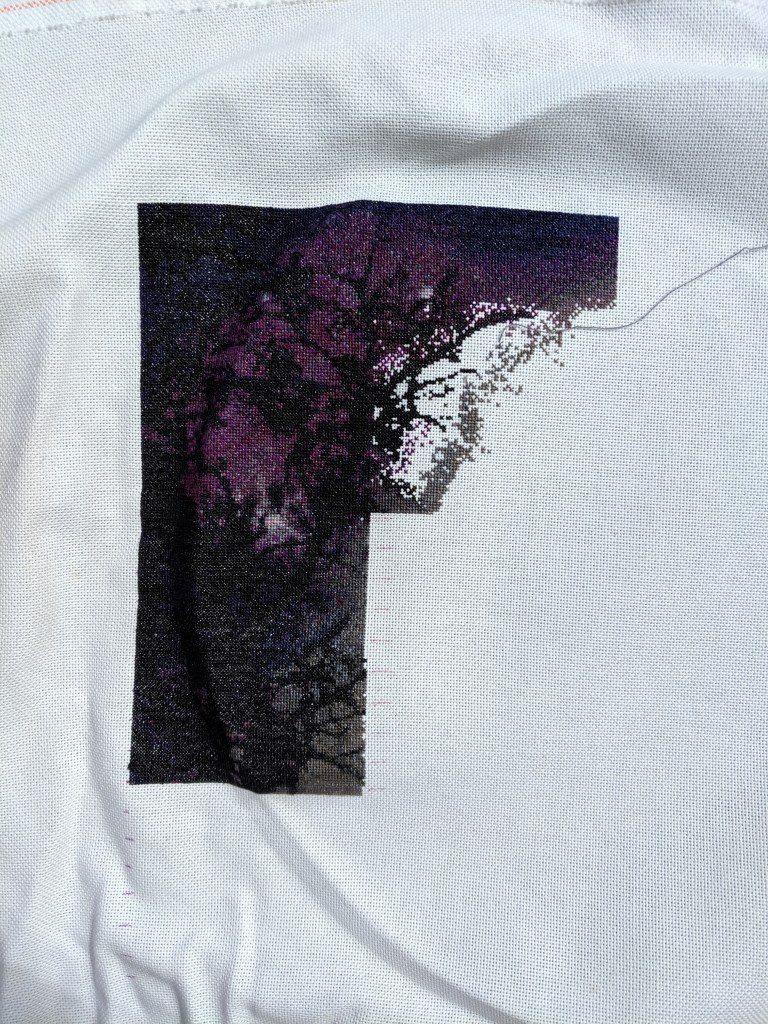
Moonlit Waters – Progress as of 22 September 2019
Moon Lit Waters – Progress as of 11 January 2020
Cover image for Moon Lit Waters project.

Based on the cover image, I have started on the edge of the moon and I have a bucket load more to do! What I’m excited about is what the future pages of the pattern look like. There’s a little bit of confetti, but mostly solid blocks and I’m feeling really positive about making more progress through the year.

Gundaroo Mini Mushrooms – my own design

Before I got my mojo back for Moon Lit Waters, I was going great guns on the Gundaroo Mini Mushrooms. This is my own design that I’ve converted into a cross stitch pattern from a photo I took.

Gundaroo Mini Mushrooms – Copyright Kristen Gawronski – Photo converted to cross stitch pattern

The last time I wrote about this project was back on 24th June 2019 and below was the progress I had made…

Progress of Gundaroo Mini Mushrooms as of 24 June 2019
Progress of Gundraoo Mini Mushroom as of 11 January 2020

Since then, I’ve finished the first page and I’ve moved to the left and I’m about half way through the second page. Looking at it from a distance and especially looking at it through the lens of a camera, I’m really happy with how it’s coming out. Sometimes when I’m working on it, I start doubting myself and the decisions I’ve made with the picture and pattern. I’m mostly doubting myself about the size of the photo when I imported it to the PC Stitch 11 and the measurements I’ve entered into the system to enable it to develop the pattern. I’ve looked at other pictures that people are working on that are photos that’ve been converted to cross stitch and the cross stitch project looks awesome!

Four Seasons Kittens

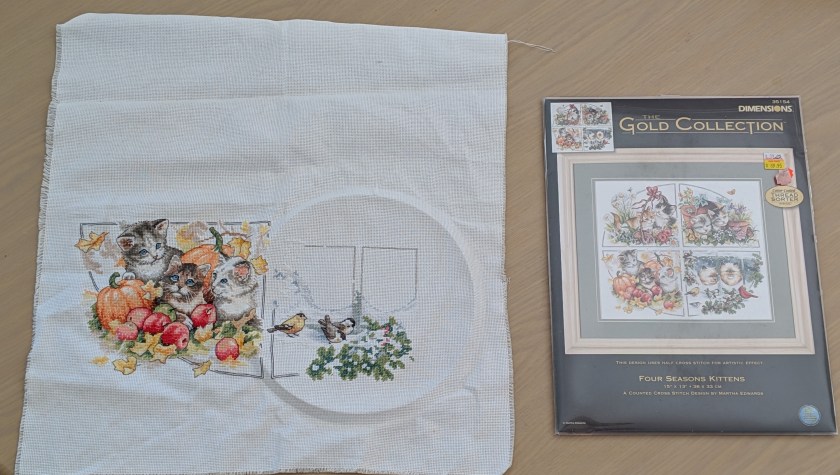
I’ve made a little bit more progress with the winter kittens. They’re my go-to if I need a break from the HAED or my own design. The last time I’d written about these kittens was back on 25th October, 2019 and below was the progress I had made then. By memory I may have talked about some of the fudging I needed to do. If I didn’t mention it, I had to get a bit creative with the top left corner of the winter kittens.

Four Seasons Kittens by The Gold Collection, Dimensions – Progress as of 25 October 2019
A lot more of the kittens has been filled in. Their eyes and facial features are a bit more obvious. The background of the kittens has been filled in and some of the fauna to the right of the kittens has been stitched.
Four Seasons Kittens by The Gold Collection, Dimensions – Progress as of 11 January 2020
Four Season Kittens by The Gold Collection, Dimensions – Progress as of March 2019 on the left and what the completed picture should look like on the right.

Plans for 2020

Becoming a uni student…again

The first half of this year at least is going to be super busy for me and I don’t think I’ll be getting much stitching done. I’m going back to uni – this time I’m enrolled at the University of Canberra (Uni of Canberra) to do a Graduate Certificate in Creative and Cultural Futures, commencing 10th February. The difference for me this time is that I’ll be attending lectures and tutorials instead of doing the majority of it online. Two years ago I graduated from Charles Sturt University with a Bachelor of Information Studies with a specialisation in Records and Archives. It took me 6 years of part-time study and working full-time to complete it and it was well worth the experience. I valued the flexibility studying online gave me. What I hadn’t realised, was how much I missed being in the class room until I decided to enrol in a course at the Uni of Canberra. I’m hoping that the Certificate will provide me with an introduction to working with cultural organisations and what it is to deal with cultural heritage information and artefacts. Something I hope will compliment my degree and who knows what it may lead to!

Work

The other thing that will be busy will be work. I’m contracted until mid to late September and by October-ish my workplace is due to move from its current office to a new location, roughly 1km away. My aim is to try and improve my self promotion at work and let people know that I am there to help them and what I can help them with. My fear factor is people leaving it too late to be organised for the move or them making some avoidable decisions if they had consulted me. One of my biggest difficulties is self-promotion. I know I have the skills. I’m just super scared of putting myself out there, for fear of failure and criticism.

Fitness and running

My goal for this year is to run 5km in 30 minutes. A few years ago I got really close to that time and I want to beat it. But in order to do so, I need to stop using the poor air quality conditions as an excuse and use the treadmill at the gym until things get better. For the last two to three months (at least), Canberra has been inundated with smoke and dust due to the bush fires to the East of us and the drought that has been surrounding us.

This morning (Sunday, 12 January 2020) was the first time in what feels like a very long time, I went for an interval run outside. Probably not one of the smartest things I’ve done considering the air quality this morning was rated as being unhealthy. My run covered just over 5km in the space of 44 minutes give or take. By the end of it my eyes felt raw and I had a bit of a headache from the smoke. When I did run though, it felt good. So when the smoke and dust clears, I am really looking forward to more running outside.

To keep myself motivated, I have entered into the 5.3km leg of the Canberra Times Marathon Festival, to be held in early April. This year the course has changed and the event is sponsored by a different company. I’m really looking forward to the different course. It’s quite similar to the course I’ve run many times when I worked in the suburb of Parkes and would run around Lake Burley Griffin during my lunch break or parts of it after work. It’s a beautiful spot and I’m really hoping that I don’t get injured between now and then!

Travel

When the air is clearer and the roads are safer, I can’t wait to get to the South Coast – specifically Malua Bay and the surrounding region. It’s my second home (like many Canberran’s) and when I first get down there, I may spend half my time in tears and being a ball of emotion because I’ll be able to properly see what the residents and tourists went through. I want to help the businesses there as much as I can by purchasing their goods and services whenever possible. I want to help the area get back on its feet and see the beautiful bushland regenerate.

Stitching

Stitching wise, I’ll still be plugging along on the same projects. My aim is to get as much stitching done before I start uni because I don’t know how much time I’ll be able to make for it when assignments and exams are due. I will be really happy if I could get the Gundaroo Mini Mushrooms fully finished this year so that I can enter it into the Canberra Royal Show for 2021. I’ll also be really happy if I could get about a quarter of the way through Moon Lit Waters by the end of the year. Any other finishes that happen this year will be gravy!

I want to use February as my motivation for finishes. Considering the complexity of the Gundaroo Mini Mushrooms and Moon Lit Waters, my aim is to get a page finish for both projects and hopefully a start on a new page.

March madness may see me having a break from the main projects and stitching a small, like a card or something along those lines. Though the madness may also be preparing for the fun run I’ve got early April and uni assignments/exams and a public holiday in there somewhere!

April however, may bring some holidays for Easter and ANZAC Day and hopefully a trip to Malua Bay and some crafty purchases.

I am curious about Stitch’May’nia this year and what that might bring for me. Life may get in the way too much, but if last year on Flosstube is anything to go by, I think it could be fun to be part of!

By June/July if all goes well, I should be finished with uni and then I’ll be able to be stitching mad again and life will be good!

Posted in Uncategorized

Cross Stitch Therapy – what if disaster strikes?

Hi Everyone

In February 2019, I lightly touched on cross stitch as therapy and the potential it has for having a positive impact on mental health. I’m reflecting on this post as some natural disasters that have happened in Australia over the last few months, let alone the last few years.

As 2019 came to a close and we commence the year 2020, some of the south coast towns and villages in New South Wales have been catastrophically impacted by bush fires and drought. Many people have lost their homes and businesses because of the bush fires. Thousands have fled to beaches and evacuation centres because the main roads have been cut off by the fires.

At the moment it’s too early to say how much damage has been done by the fires. I am like hundreds of Canberrans who flock to the south coast town of Batemans Bay and surrounding region for holidays and weekends away. The devastation that has happened down there is felt by all of us because we have either experienced it for ourselves or our empathy has been kicked into overdrive because the south coast is like our second home. Batemans Bay and nearby villages that have been hit by the fires – to the point where as of last night (31 December 2019), electricity and telecommunications are down and may be down and out for a week or more. At the time of writing this post, many areas are isolated because of the fires themselves or the safety risk of trees and branches falling and perished wildlife. Images that have been shared on social media and the news show walls of flames and smoke. Some people have had enough warning to grab some supplies and things they need. Others have just had moments to grab and go. Even if power and telecommunications hadn’t been cut by the fires, telecommunications at the coast isn’t always great because of the terrain and quality of services some of the providers are able to supply.

One of the devastating things about these fires is that no one knows how long it will take before these fires are put out and people can try to start re-building. I’ve heard whispers that significant rainfall may not come until autumn – sometime in March, April or May. Additionally, it’s been so dry in so many areas of Australia for so long that there’s a huge amount of fuel in the national parks that buffer / line the south east coast of Australia. Which means that these fires could continue to burn for several weeks more. With the flow on effect of continued drops in tourism – which the majority of these coastal towns and villages rely upon to survive. There are also hindrances to air quality and a significant depletion to wildlife numbers to name a few.

As of Sunday 5th January 2020, Canberra will have had it’s worst air quality day on record. This morning we woke up to a light orange glow and smoke covered skies. Canberra has fires burning to the East, South and West and some to the North East. Regardless of which direction the wind blows, we are going to be impacted by the smoke. Many areas of Canberra have become evacuation centres for people who have fled the fires at the south coast and surrounding region or are travelling back home from these fire affected areas.

How can cross stitch therapy help?

Stash Donations

On some of the social media feeds and internet pages, I’ve seen people encouraging others to donate their parts of their cross stitch stashes to areas who can accept them and pass them on when they can.

For example, the X Stitchers Helping Hands Aus & NZ is a private Facebook group, but is easy enough to join as long as you are able to answer simple questions required of the group. My understanding is that any Canberra based and surrounding region based stitchers and crafters out there who are wanting to destash, they can drop their donations off to the Crafty Frog in Kambah. I am hopeful that there are similar locations around Australia and New Zealand who are able to have similar drop-off locations!

Tourism – how far would you go for your stash?

The Internet has made life easier for many of us to make a few clicks and we’ve just spent (in my case at least), $50 to $100 on patterns and materials. When I can, I try to buy within Australia. Websites such as OzStitch, the Threaded Needle and The Fox Collection.

For a retail kick, I’ve travelled a few hours north of Canberra, to Mittagong or a couple of hours south to Mogo (a village that has just been wiped out by the bush fires). I want to travel further a field to see and experience other locations. My boyfriend and I have talked lightly about doing some more road trips – especially along the south coast of New South Wales and making our way to Melbourne and eventually along the Great Ocean Road. We’ve also talked about heading over to Tasmania and driving ourselves around there. Additionally, I’ve never been to Perth or Darwin and we’ve only just scratched the surface of visiting Queensland.

A distraction from reality, when there’s nothing else to be done

I don’t know about you, but I need to keep my hands busy if I’m ‘chilling out’ in front of the television. It makes me feel like I’m still being productive, even though I’m sitting on my bum for potentially hours on end. For anyone who is a stitcher or crafter, you will know what I mean! That said, I can’t begin to imagine what people are experiencing at the evacuation centres. If I was at an evacuation centre, at some point in time, I’d be needing to distract myself from what’s happening because there’s nothing I would otherwise be able to do. Talking about the circumstances and events would help a little bit, knowing that others have experienced something similar. It may however, get to the point where it would only serve as a reminder of what has been lost and serve as a reminder to myself to be thankful that I escaped with my life.

Priorities of what to pack should evacuation be required

My boyfriend is very practical. I’m at the other end of the scale because he’s so practical. This came to light when we were talking recently about what to pack and have ready should we need to grab and go. We have an emergency tub of basic essentials that is 90% complete. I have some clothes packed and things that can’t be replaced. Then I started thinking about my craft room and how much of it I could practically pack and how much of it I could leave behind. Photos and camera gear to me is an obvious choice to take with me. What I’m trying to figure out is the practicality of how to pack my patterns, kits, books, stash, WIP’s, FO’s, FFO’s and gear in case of an emergency that may not happen now, but sometime into the future? My entire collection is spread across 6 rooms out of 10. I’m well aware that there area special tubs and suitcase style items I could use. The problem I have is where to put the tubs and stuff when I’m not using it? As much as it annoys my boyfriend at times, I’m pretty happy with the setup I have. I like knowing that I can move my projects around from room to room, depending on what’s happening. I have a filing cabinet I use for most of my kits, fabric and patterns. I also like having a craft room that I can use as a partial study. The part that could be streamlined is where I do my stitching. I watch a lot of television – specifically YouTube, Netflix and and Amazon Prime. It’s my way of burying my head in the sand for a period of time and escaping from the real world for a little while. But I digress…

Using something along the lines of a spreadsheet or My Cross Stitch Tracker (or something similar) may help to organise my stash and have a clear idea of what I have should anything be lost, let alone what I might want to take with me should the time come. My challenge with this is remembering to keep (whichever method I choose) it updated.

Please be safe everyone and hopefully we’ll have some more happy stitching next time!

Related posts

Posted in How To, Tips and Tricks

How Do You Teach Someone to Cross Stitch? Part 5 – The Final Touches

Hi Everyone

This is the last post of the series and looking at the date (in Australia, it’s Sunday 29th December, 2019), the last post for this year!

We’ve come a fair way in this series. We’ve considered who our student is and what their learning styles and abilities are, and some of the tools of the trade that may help them with starting out in cross stitch and hopefully enjoying it! We’ve had a quick look at some of the different patterns that are out there, with the strong recommendation of starting your learner out on a kit before embarking on chart and kitting things up themselves. Let alone embarking on a project that has a fabric count size 20 or over!

With these things in mind, we now need to have a chat with our learner about how they want to finish their project and the potential for back-stitch, beads, French Knots and what should be done with it when we’re done.

Back-stitch – is it overrated or a necessary evil?

Over the years I have definitely complained about doing back-stitch on many of my projects. Sometimes it’s because there’s so much of it and it’s felt like I’ve been working on the project for a really long time. Other times it’s because I’m just really keen to get moving onto a different project and I’m procrastinating the inevitable. That said, I know that really, back-stitch isn’t really all that hard. Tedious at times yes, but not hard. It also makes the world of different to a project and makes things stand out in a way that other stitching wouldn’t be able to do – that I’m aware of. If anyone does know of another stitch similar to back-stitch that can be used in cross stitch, I challenge you to show me!

Reading the pattern however, for doing back-stitch on a project – that may be another reason why I grumble about it. Because the pattern will remind me where I’ve fudged things on the project and when I go to try and follow where the back-stitch needs to be, I get annoyed at myself all over again. To help you understand why this is, the two clips below by Peacock and Fig, explain how back-stitch works in cross stitch projects:

“Backstitch tutorial for embroidery and cross stitch” by Peacock and Fig – uploaded to YouTube on 14 November 2015
“Intermediate backstitch techniques: handling long runs of backstitch” by Peacock and Fig – uploaded to YouTube on 31 October 2017

For some of the projects I’ve worked on that have had long runs or long lines of back-stitch, I’ve carried my thread from point A to point B without any stops in-between. This could cover a number of centimetres and I’ve then gone back and put some small anchors along the line to secure the thread. I’ve found this to have a bit more of a cleaner view rather than stitching the individual stitches and it saves a bit of time. You may need to help your student with starting and finishing the back-stitch to ensure the stitches stay put.

French Knots or Beads

This is something you and your student will need to have a chat about, regarding whether or not your student wants to give them a go. Personally, it’s taken me a very long time to get the hang of doing French Knots and I have used beads instead of the knots. An example of how this can look is shown below:

“Angel Bear with Candle” – design by Joan Elliott (C)2006 – stitched by Kristen Gawronski (The XStitching Runner)

The additional tip I can provide you and your learner with if either of you choose to use beads, is the smaller the bead, the fiddlier they are going to be to use in the project and you’re going to need to use a thinner needle than what was used to stitch the project. The image below shows the needle I use for beading. Unfortunately I’ve lost the packaging that the needles came in, so I’m unable to let you know the details of the brand and needle size. What I do like about these needles is that they are a little longer and thinner than the regular embroidery needle and I’m able to get a little Mill Hill Seed Bead on the end of the needle. Which helps a lot when I’m trying to pick a bead out from the packaging and adding it to the project, like the ‘Angel Bear with Candle’. I like to grow my fingernails a bit and I find it difficult to pick out just one of the little beads out of the packaging because of my nails!

Needles I use for beading. Brand and needle size unknown.

Additionally, I use one strand of cotton that’s the same colour (or as close as possible) as the bead I’m attaching to the project. My logic for doing this is to make it as seamless as possible and the centre of the bead is sometimes so small that it can only handle one or two strands at the most.

Washing your final project

Have you ever taken a project out of a stand, hoop or frame and found that your hands weren’t as clean as you thought they were – even though you thought you were diligent about washing them before working on the project? Don’t worry. Accidents happen. Even with the best of intentions!

Washing a project after it’s been finished is a personal preference for many people. If I’ve been working on light coloured fabric, I prefer to wash my projects to be absolutely sure I’ve not left any grubby marks on it. My logic behind this is I want the project to last for as long as possible. By removing any contaminates from the fabric, it puts my mind at ease knowing that I’ve done what I could to remove anything that could increase the deterioration of the fabric or threads.

It’s important to note that whenever I’ve washed my projects, I’ve hand washed them in the basin with some warm water and hand soap. Nothing fancy. I’ve rinsed the project in cool to warm water and gently wrung the project out and laid it out flat on an old, clean tea towel. I’ve usually left it overnight and then used an iron to smooth it all out. I’ll usually iron the back side of the project to ensure the iron doesn’t catch on any of the back-stitch or cause any problems with the French Knots or beads.

However, this is a personal preference and you will need to have a chat with your student about what they want to do about washing their finished project. Aside from potential marks from dirty hands or accidental spillages, another deciding factor will be what your student wants to do with the finished project. Do they want to frame it? Make a card? Turn it into a pin cushion? No decisions have to be made straight away. There are a lot of options out there regarding the way a cross stitch project can be fully finished. In the related posts section at the end of this post, is a link to an earlier post I wrote on what finishing options there are, if you or your student choose not to frame.

End of a series, but not goodbye…

It’s been fun and interesting writing this series. I hadn’t anticipated parts of it being so difficult to write – mostly the parts about doing the actual stitching! I’ve likened it to teaching someone to drive. Whilst the two activities are very different, it’s the fact that both activities are so hands on, that at times it can be easier to just jump straight in and make adjustments as you go!

Thank you for bearing with me throughout this series. I hope that you have picked up on some different things that help you and your student. I’ve certainly learnt a bit about different learning styles and going through my stash has reminded me how much I have and how much I want to stitch!

So until next time, happy stitching!

Related posts:

Posted in How To, Tips and Tricks

How do you teach someone to cross stitch? Part 4 – Patterns, Projects and Stitching

Hi Everyone

We’re now getting to the fun part of teaching someone to cross stitch! Well, fun in my opinion anyways! In this part of the series we’re going to take a look at pattern choices, starting a cross stitch project and the different ways to do cross stitch.

I’ve always loved the prospect of starting something new and seeing something new come out of a blank canvas. I love the different options available to us regarding fabric, patterns and the tools of the trade. It may be part of why it takes me a while to fully finish a project, because there are so many options out there and I want to stitch them all! But I digress…

Choosing a pattern or a kit

By now, I hope that you and your student have gotten to know each other and you know what their interests abilities are, which will enable both of you to pick out a pattern that will suit them and keep them interested long enough to finish it.

For someone who is completely new to cross stitch, it would be best for them to start with a kit, because the majority of what they need will be in the kit – i.e. fabric, threads, a needle and most importantly, the pattern. The question is…which one when there’s so much to choose from?

Patterns and kits for kids

When kids are concerned, the simplest pattern design with a few different colours is probably the best one to go with. Because it has at best, 3 to 4 different symbols on a chart they need to worry about and the simple design means that the chart should be easy enough for them to read.

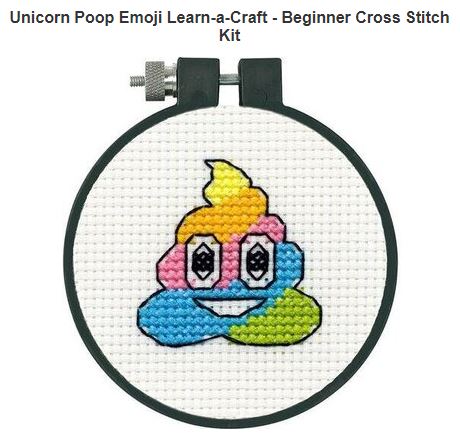
Examples of simple patterns and kits for kids include the following:

Image from the website 123Stitch.com – Designed by Dimensions

According to the 123Stitch.com website, this Unicorn Poop Emoji kit comes with everything, including 11 count Aida, the black hoop we see in the picture and all of the things needed to complete the project. This particular kit I think ticks alot of the boxes for kids these days because it’s poop! Also, in Australia at the moment, the unicorn theme has been strong and emojis seem to be here to stay, so why not embrace them?!

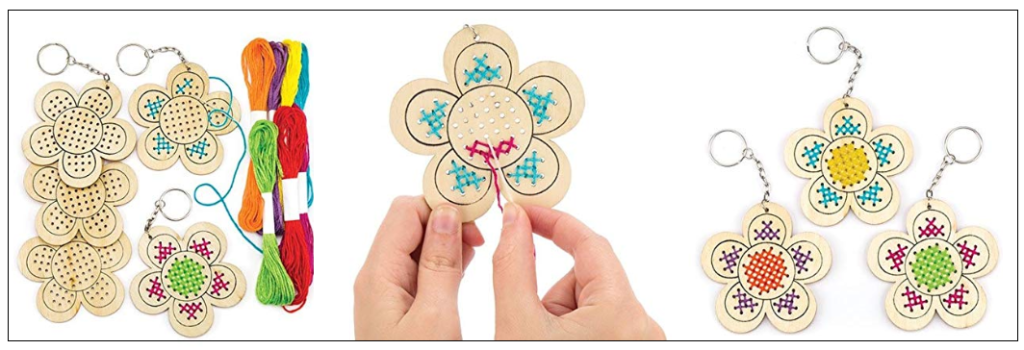
Baker Ross Wooden Flower Cross Stitch Keyring Kits for Beginners (Pack of 5) Embroidery For Kids – images from the Amazon UK site

These particular kits are from the UK Amazon site and they could be a fantastic way of introducing kids to cross stitch and embroidery. With these kits, there’s no pattern they have to follow. The holes are already drilled into the wood. All the kids need to do is decide what colours they want to use where because the kit comes with the threads and needle.

Scrolling through the Net…

Another idea is to jump onto the Net and have a scroll through some different websites that may spark some inspiration. The website OzStitch.com.au for example, has a couple of pages dedicated to kits that can be stitched by kids. Meanwhile, The Fox Collection has some pages on kids crafts and mini kits that could be of interest.

Patterns and kits for teenagers and adults

If your student is a bit older, then you have a bit more wriggle room for options in design. This is a lot to do with the complexity in the designs and your student’s potential ability to more patience and time to sit down and work on the project. It also means that your older student may be able to cope with a larger count size – e.g. 14, 16 or 18 count.

Personally, I’ve found the Country Threads patterns and kits by Fiona Jude to be absolutely awesome. The patterns are easy to read and they are comfortable size to work on. Meaning, it took me an average of three months to complete one of Country Threads patterns and that’s all the while working full time and in many circumstances, studying online part-time as well. The other thing that attracts me to the Country Threads designs is that there’s little to no backstitch and it’s a mix of full cross stitch and half stitch (aka tent stitch) and some patterns may require some French Knots.

Subversive cross stitch

This is something that may be of interest for teenagers and adults who may be more into quotes or words rather than images. The main challenges in this case, will be deciding on which font to use, how much swearing there is and which quote or word fits best with your student! Because the Internet and the stitching community has fully embraced subversive cross stitch and it doesn’t look like slowing down any time soon!

On a related note to the swearing, even if there isn’t any swearing in actual pattern, there may be a bit of swearing as the stitching commences because of the number of times that you or your student stabs themselves with the needle, the amount of un-picking that may happen and figuring out where you or they are on the pattern!

If you and you’re student still aren’t sure on what to stitch because nothing’s really jumped out at them, another idea is that your student could try designing their own pattern. All you and your student need is some graph paper and some colour pencils and some creativity and imagination to bring it to life!

A kit has been chosen…Now what?

Hemming the edges of the fabric*. Washing the fabric and threads*. Finding the middle of the fabric. Sorting or organising the threads*. Getting the rest of your supplies together. Understanding the pattern.

*These things are optional and may suit the preferences of you or your student. Personally, I’ve been really lucky with the threads I’ve used from kits and purchased individually either online or instore. When I have washed my project after completion, none of my threads have run and adversely affected the project. I have read in different forums that for some people, their threads have run and had a negative impact on their projects. Additionally, in some kits, the threads may not be as organised as you or your student need them to be.

Finding the centre of your fabric

The main times I bring out my iron and ironing board is to do something with cross stitch! When I’m finding the centre of my fabric, I prefer to iron out my fabric so that it’s as flat as possible because of the way it’s initially been folded and stored in my collection. By doing this, I know that I’ll be able to easily fold up my fabric in half and then half again, then run the iron over it while it’s folded up, so that I can cleanly see the centre.

The clip below by Stitcherista shows you what I mean…

‘Cross Stitch 101 – Finding the center of your fabric’ by Stitcherista – uploaded to Youtube on 9 October 2018

Additionally, if your student wants to use a hoop while stitching, the clip below by Spot Colours, will show them how to find the centre of their fabric and how to put it into the hoop…

‘Cross Stitch – How to Find the Center and Hoop’ by Spot Colours – Uploaded to YouTube on 22 June 2017

Hoops, Qsnaps and Frames

It’s important to note that depending on the size of the project your student is working on, that the size of the hoop, qsnap or frame will have a large impact on how well the fabric fits. For example, the smaller the size of the fabric, the smaller the tool you use to keep the tension. This may also depend on personal preference and what your student is able to use.

Personally, I have always used hoops of various sizes and I’ve recently started using a stand to hold the hoop.

Understanding the pattern

The first time your student sees the cross stitch pattern, it may look really confusing to them. Thankfully, some patterns have colours on them to make it easier to see the different areas they need to stitch with the different threads. However, if it’s a black and white pattern with a series of symbols, helping your student understand that each symbol represents a different colour in the key will be crucial. The YouTube clip below by Love Crafts shows people in a really easy and simple way how to understand and read a pattern, to enable them to start stitching:

‘How to read a cross stitch pattern for beginners’ by Love Crafts – uploaded to YouTube on 14 October 2019

Tip – Drawing the symbols from the pattern on the thread sorter

One of the things that may help – regardless of your student’s age – is to go through the key and draw the symbols on the thread sorter (if the kit came with one). I’ve found this to be really useful for some of the Dimensions kits I’ve worked on due to the way the chart and key have been written up.

Symbols I have hand drawn on the card sorter that came with a kit

Starting to stitch…

The earlier clip by Love Crafts shows people one of the ways that they can start stitching a pattern. What you will need to show your student is what they will need to do with their thread so that it doesn’t accidentally come straight through the hole of the fabric.

Floss, cotton and strands

You and your student will find that the majority of patterns and projects will require it to be stitched with two strands of cotton (aka floss). To help put things into perspective, the image below shows that the floss can be split into 6 individual threads or grouped into 3 lots of 2.

Image shows that floss can be grouped into three lots of 2 strands.

The Loop Start Method

This relates to the way the amount of strands you or your student has pulled out of the cotton and the way it has been threaded into the needle. For the loop method to be most effective, you or your student will need to pull out just one strand and then fold it in half, so that ends meet up evenly. The clip below by Mr X Stitch explains the loop method really well:

‘Start your cross stitch with the Loop Technique’ by Mr X Stitch – uploaded to YouTube on 18 July 2018

Personally, I love the loop method if I’m using two strands on a project. It makes the back of the project a lot neater and I find it to be a fantastic anchor for the first few stitches. The caveat with using this method though is that it’s only useful if I need to use two strands of floss.

Finishing off your crosses and changing colours

You may need to help your student with the first time they go to finish off their crosses in accordance with the pattern or because they’ve run out of enough thread on their needle. The aim is to fully finish the cross and then flip the project over so that you’re looking at the back of the project. Then have the needle move between the fabric and some of the crosses that have just been stitched. I’ve found this to be a very neat way of finishing the crosses and it helps to secure them. To put this into perspective, the clip below by Rainbowlune, shows us how to just this:

“How to Finish a Thread – Cross Stitch” by Rainbowlune – uploaded to YouTube on 23 February 2013

Meanwhile, changing colours is reasonably easy in cross stitch. The difficulty sometimes is deciding which colour to do next or threading the needle – depending on the size of the eye of the needle! The way that your student would start off and finish on a new colour is very much the same as they would with any other colour.

Which way to stitch – left to right, up and down, right to left, cross country or parking

If you’ve been stitching for a while, you’ll hopefully know what I mean by this heading! When you’re chatting with your student, you will be able to work with them to find out what is most comfortable for them and what the pattern allows you to do too.

Stitching left to right and right to left (aka horizontal cross stitch)

This predomenantly means that the first half of the stitches will be done left to right – just like when we’re writing something. Once we’ve reached the designated number of stitches, we then complete the crosses by stitching right to left.

Meanwhile, the stitching right to left is when you start the first half of the crosses by moving right to left and then completing the crosses by moving left to right.

To help put this into perspective, the clip below by Peacock and Fig help to put these words into motion by showing you the English and Danish methods of cross stitch (aka left to right/right to left or one cross at a time):

“Cross Stitch Techniques: English method and Danish method of cross stitch” by Peacock and Fig – posted to YouTube on 4 April 2017

Stitching up and down (aka vertical cross stitch)

This way of stitching may depend a little bit on the pattern your student may be working on. Personally, I’ve found it easiest to stitch the full cross before I move above or below the first cross. To help explain what I’m talking about, check out the clip below:

“Full Cross Stitch Vertical” by MonkeySee.com – posted on YouTube on 8 August 2008

Cross Country and Parking

The good thing with cross country cross stitch is that we don’t need to leave our chairs to do this. The main exertion with this method is keeping track of where you are on the pattern!

The aim of cross country cross stitch is to stitch as much as possible of the pattern with the one colour and where possible, using the same strand without the stopping and starting. This can make the picture look a bit pixelated or scattered. Below is an image on how cross country stitching looks on a project:

Example of cross country stitching

Meanwhile, the parking method means that your student may prefer to read the pattern line by line, like they are reading a book, and stitch each symbol on that line. This will mean a lot of threading the needle with different colours as the pattern requires it. The benefit of using the parking method is that the thread will be ready when your student next reaches the corresponding symbol on the pattern.

To help put this into perspective, the clip below will show you and your student what cross country stitching and parking looks like on a project and which methods may be most effective on which projects.

“Cross Country vs Blocks with Parking” by Pam’s Crafty Corner – uploaded to YouTube on 18 January 2017

Deep breath… you’ve finished your project, now what?

This post was surprisingly challenging to put together, which is something I had never expected! I think a lot of it has to do with cross stitch being so much of a hands-on activity, that to just write about how to do cross stitch doesn’t do the activity justice! Which is why I think that there are so many more videos out there on how to cross stitch than there are written posts.
My next post in this series will hopefully be a little shorter. In the next post of this series we’ll be looking at the finishing touches of your student’s project, which may include back-stitching, the inclusion of some beads or special stitches. There may also be questions about whether it’s worth washing the project before your student then completely finishes it.

Thank you for sticking with me during this post and the series so far!

Until next time, happy stitching!

Related resources:

Posted in Uncategorized

How do you teach someone to Cross Stitch? Part 3 – Tools of the trade

Hi Everyone

Following last week’s post on learning styles and learning disabilities, this week we’ll be taking a closer look at some of the different tools of the trade that may assist people with different abilities.

While you’re getting to know your student and you’re both trying to figure out what works and what doesn’t, it’s really important to check with your student regarding any health ailments they may have or restrictions they have on their movement or if they are left handed or right handed. This is regardless of whether your student has any obvious or hidden disabilities, because you don’t want to aggravate any existing injuries or ailments such as Carpal Tunnel Syndrome, arthritis or any skeletal or muscular injuries or defects. Alternatively, you or your student may have experienced or suffered from a medical trauma such as a stroke, diabetes or epilepsy. This conversation may be awkward or uncomfortable to have with your student, but it’s an important one to have because it will help you and your student set achievable goals during the sessions you have, such as the length of time spent stitching. It will also help both of you to figure out what tools of the trade will help .

Tools of the trade

Scissors, needles, fabric, threads, really good light and a pattern are the basics of what we all need. Personal preferences and our comfort and abilities kick in when we start looking at:

  • Hoops
  • Q-snaps
  • Stands
  • No hoops or Q-snaps
  • Fabric colour and count size
  • Needle size
  • Needle Minders
  • Brand of thread (e.g. DMC, Anchor, silks)
  • Where our lighting comes from (e.g. natural sunlight, LED over-the-top lighting, regular light bulbs)
  • Needle threaders
  • Type of scissors
  • Magnifiers or glasses with lights attached to them
  • Unpickers
  • Thimbles

Janet M Perry for example, wrote a post titled ‘Stitching Aids for Stitchers with Strokes‘ on 16 April 2016. Janet writes from experience because in her post, she states that she has MS (Multiple Sclerosis) and for 5 years she had been misdiagnosed as having had a stroke, until she had her second attack. She also acknowledges that in one of her classes, she had been asked about some of the aids available for people who have had a stroke which formed the basis of her post.

Automatic Needle Threaders

One of the things Janet talked about in her post, was an automatic needle threader that is made by a company called Clover. I never realised or thought of such a tool existing! But it makes sense and I’m really happy that this tool is out on the market because there’s a pretty strong chance that I might need it one day or someone I teach may need it.

Automatic Needle Threader made by the company Clover – image and description found on the Amazon website as of 2 December 2019

Scissors

When we’re talking about craft related scissors we have a really nice variety to choose from to cater for people who may left handed or right handed and various strength levels and mobility in either hand. Many of the smaller craft scissors on the market now (we can use for cutting our threads) have been designed for left or right handed people.

One of the things that Janet suggests in her post, is the use of shears for people who may have difficulties with using regular scissors.

Hoops, Q-Snaps and Stands

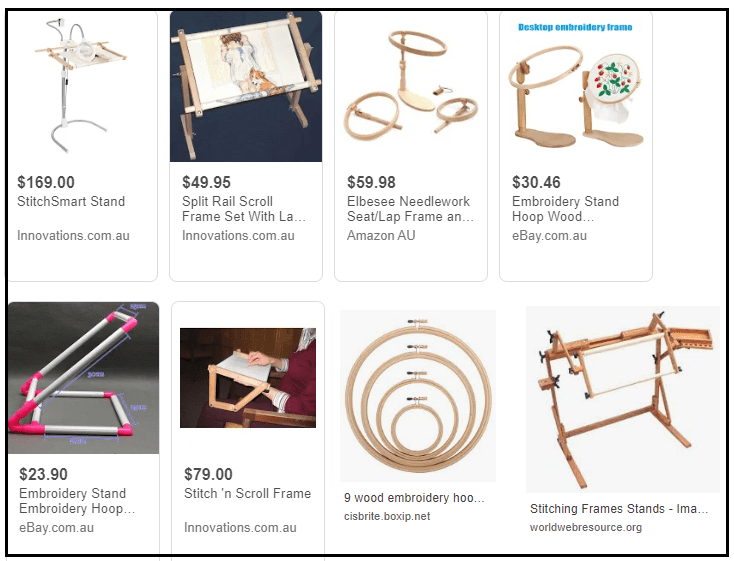
As crafters, I feel like we can be spoilt for choice. We can choose to use hoops, q-snaps, stands or nothing at all to help keep the tension in our fabric. Additionally, if we choose to use a stand or frame, it can take the weight off our hands while stitching.

Images of various hoops and stands from a Google Image search – as of 8 December 2019

Depending on the ability of your student and their preferences, a frame or hoop may make it easier for them to learn how to cross stitch and potentially for longer periods of time.

Personally, I use the Stitch Smart Stand that you can see in the top left corner of the above image. My stand doesn’t have the magnifier or pattern holder attached to it, but I have the option to add them if I want and can use a variety of sized hoops with it. To access the back of the project to finish off a thread or commence stitching with a new thread, all I need to do is turn the hoop to the left or right and I can see what’s happening. Using this stand takes the weight off my left hand (that I use to hold the project) and I can just use my right hand for the needle and thread. I still use my left hand to lightly hold the project and give the project the extra bit of support.

Additionally, regardless of whether I’m using the stand or not, I definitely use a hoop for all of my projects. I find that the tension for the project is a lot better than when I’m stitching without one. I have stitched one project without a hoop and I felt naked without it!

Magnifiers, lights or glasses

When you can clearly see what you’re doing, it can make the task you’re doing so much easier and hopefully a lot more enjoyable! When it comes to embroidery glasses and magnifiers, there are a number of options on the market which include:

  • the 5 Lens Loupe LED Light Headband Magnifier Glass LED Magnifying Glasses that can be worn like regular glasses and they have a light embedded in the bridge of the glasses and enables you to light up your work. The 5 lenses means that you’re able to adjust the strength of the lenses to suit your eye sight.
  • Giant Large Hands Free Magnifying Glass with light LED which is a rectangle magnifier on a stand that you can use if you’re sitting at a table or on the couch and your work can go under the magnifier. Alternatively, (based upon the images on the internet) the magnifier can hang from your neck.
  • If you choose to use a stand to hold your work, some models enable you to have magnifiers and lights attached to them.
  • Magnifiers that lay over the top of the paper pattern (if you choose to have a paper version or copy) to help you clearly see the symbols and see where you’re up to.

Gloves or wrist supports

Cross stitching for extended periods of time (e.g. hours at a time) and over the course of many years, many of us may become susceptible to ailments such as RSI (repetitive strain /stress injury) and arthritis. Internet searches have shown that there are numerous types of compression finger-less gloves available to provide support to provide support to hands and wrists.

Project Bags

Your student is going to need to put their project somewhere when there not working on it, and be able to easily pick it up and go if you’re meeting somewhere to do a stitch ‘n’ bitch session! The bag can be anything that makes it easy for them to store their stash, ranging from a backpack with many pockets through to a calico bag that may have been used to purchase their new crafty items.

However, if they want something really special, an internet search on project bags for cross stitch will bring up an enormous amount of options such as:

A very tiny sample of cross stitch project bags available on Etsy by various talented people – image taken on 8 December 2019

Alternatively, you and your student may want to try your hand at making a project bag yourself and thankfully, there are many videos on YouTube that can help you with that!

Make your won project bag by Making Life Count – Posted on 2 January 2017

Storage Options

Thankfully there are a lot of different options when it comes to the way we can store our collections – especially depending on whether the projects are actively being worked on or not. The way in which your student chooses to store and manage their floss (aka, cotton, silks or skeins) can make it easier or harder for them to know which colours they need for different parts of the pattern. Additionally, depending on their preference, it may make it easier for them to ensure their strands don’t get tangled. For example, will it be easier for them to be put onto bobbins, remain as they are, be stored in boxes and tins or hanging from hoops?

How to organise embroidery floss and wind on floss to bobbins – YouTube clip by Peacock and Fig – uploaded on 25 October 2015

Technology or paper

Similar to the lighting and magnifying of patterns and projects, your student may have a preference for seeing the pattern on an IT device or on paper and how they mark off the areas they’ve stitched will be impacted by the IT device or paper.

There are a number of apps available to enable people to view and use patterns on their IT devices. I’ve not used any of them before, so the information listed below is based upon searches from the internet:

  • GoodReader – available on Apple only
  • ezPDF reader – available for Android and Apple
How to use the GoodReader app for cross stitch (on ipad) – by Carolyn Mazzeo – uploaded to YouTube on 3 January 2015
EzPDF Cross Stitch how to highlight and remove highlight by Leeleered – uploaded to Youtube on 16 September 2018
My Favourite Cross Stitch and Diamond Painting Apps and why they’re useful by Crafty Lisa – uploaded to Youtube on 21 September 2018

Alternatively, your student may prefer the feel of pencil and paper, photocopying and enlarging the pattern can make life a lot easier if the symbols are quite small or there are a lot of them on the one page.

It’s important to note that there will be limitations around the number of copies you can make – especially for paper based patterns. Additionally, not all patterns are available digitally. Which means that some extra steps will need to be taken to digitise the patterns to enable them to work with whichever app you or your student chooses to use (if using an IT device).

Parting note…

If you’re teaching someone who has never done any form of sewing or embroidery, it may be worth taking a trip to your local craft store so that your student can get a feel for what is right for them.

Meanwhile, next time in Part 4 of this series, we’ll take a look at pattern choices, starting a cross stitch project and the different ways to do cross stitch.

Until next time, happy stitching!

Related Links

Posted in Uncategorized

How do you teach someone to cross stitch? Part 2 – Learning styles and abilities

Hi Everyone

The way we learn is unique to us and when we find someone who can explain things or show us things in a way that clicks for us, makes them a very special person! It can also say a lot about the teacher. Their ability to ask the right questions, observe your body language and properly hear what you are telling them, to then adjust their way of communicating with you. Resulting in you feeling supported and (hopefully) confident in your abilities to have successfully learnt the intended lesson or perform a specific task.

Learning styles

There are many different ways in which we learn. Sometimes it depends on what we’re that will determine the best way in which we can put it into practice. Sometimes it depends on how our teacher presents the material to us that we need to learn that can make the world of difference. The YouTube clip below shows how this can be true for both sides of the coin via the use of scenes from popular or famous movies through the decades…

‘Learning Styles’ – uploaded to YouTube on 10 November 2010 – shows the main learning styles via popular movies.

In support of the above YouTube clip, the website Learning-styles-online.com (viewed on 29 July 2018) suggests that there are 7 different ways in which people prefer to learn.

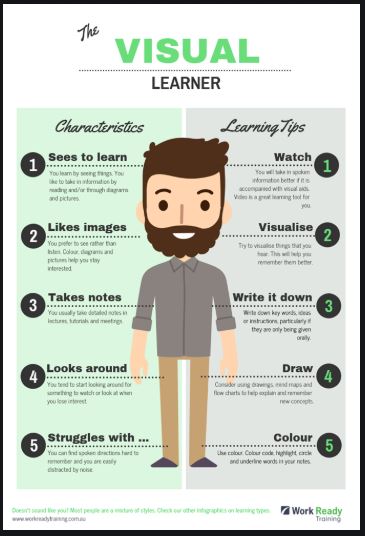
Visual learning means that you or your student prefers to use pictures/ diagrams and videos that assist you with understanding how to do something. Additionally, you or your student may find it easier to have someone sit with you and show you how to thread the needle and make the crosses on the fabric – regardless of which fabric it is. Furthermore, you or your student may find the use of colours and patterns to assist with the learning of a new task. Click here for further information.

Image from the Work Ready Training website – originally posted on 18 September 2018

Logical learning means that you or your student uses logic, reasoning and systems, to understand how and why cross-stitch works to then put it into practice. From a teaching perspective, explaining why we do cross stitch may assist your student with understanding the logic of cross stitch. This may also relate to the pattern they choose to stitch. Click here for further information.

Verbal learning means that you or your student finds it easier to listen to someone talk or reading a set of instructions (words only). Learning-styles-online.com suggests that you or your student read the instructions to yourself out-loud. By doing so in a dramatic and varied way, it may make the instructions sound more interesting and you or your student may pick up on the keywords that will assist with achieving the desired outcome. Click here for further information.

Physical or tactile learning means that you or your student needs to get your hands dirty to learn. Learning-styles-online.com uses the example of pulling apart an engine and putting it back together without the assistance of instructions to learn how the engine works. From a cross stitch perspective, you and your student can sit together and go through the motions of cross stitch. Click here for further information.

Image from the Work Ready Training website – originally posted on 2 October 2018

Aural learning is about the use of sounds and music to enable you or your student to connect to what you’re learning, because it enables you (or your student) to visualise the way something moves or the actions you need to take to complete a movement. Alternatively, the music in the background can assist with triggering memories the next time the sounds or music are heard, resulting in your or your student being able to remember the process of cross stitch until it becomes second nature. Click here for further information.

Social learning means that you or your student enjoys studying in group environments or being around other people whilst learning, because it enables you to bounce ideas off others and increase your understanding of the topic at hand. Which is where stitch ‘n’ bitch sessions can be a perfect way for your or your student/s to learn cross stitch, because you’re able to bounce off each other and share different tips and tricks you’ve learnt along the way and see how others stitch as well. Click here for further information.

Social learning image from the ATD website article on ‘how to be a catalyst for social learning’

Solitary or one-on-one learning means that you or your student finds it easier to learn on your own because there are less distractions. Which also means that stitching at home in silence (or softened background noises) may be your preference or your student’s preference. Click here for further information.

What about learning disabilities?

This is a little different to the learning styles that we have just looked at and learning disabilities can have a major impact on the way in which you teach someone to cross stitch. In the YouTube clip below titled ‘Common Learning Disabilities’, Dr Audrey Huebner from the Mayo Clinic, briefly talks about the common learning disabilities and what they mean.

‘Common Learning Disabilities’ by Dr Audrey Huebner from the Mayo Clinic – uploaded on 14 April 2017

It’s important that we talk about learning disabilities because it will (hopefully) help you and your student be more comfortable around each other and both of you will be able to communicate in a way that works for both of you. On a personal note, I always have and always will struggle with maths and doing some calculations in my head. At times when I’m doing cross stitch, I’ll joke about how I need to go back to school and learn how to count because I’ve stitched either too many or not enough crosses. I’ll also joke about how I need to get my eyes checked because as I get tireder as the day progresses, I make more mistakes. The eye sight thing and making mistakes can happen to anyone and everyone. However, I absolutely acknowledge that people who have legitimate eye sight problems will need some extra help with the way they see a cross stitch pattern and fabric – just a hint for what the next post will be about!

If you are teaching someone with a learning disability, the following clip by the CreativeMentalist may help you with providing praise and feedback to your student. Additionally, your student may find comfort and reassurance in hearing and seeing what she has to say.

‘8 Things kids with learning disabilities need to hear’ by CreativeMentalist – uploaded on 2 January 2015

Another clip that may be of interest and use for you as a teacher is ‘Students with Disabilities: Special Education Categories’ by Teachings in Education. The presenter briefly goes through the 14 different categories by defining what they are and provides some tips on what teachers can do to help their students learn a task or concept.

‘Students with Disabilities: Special Education Categories’ by Teachings in Education – Uploaded to YouTube on 7 April 2018

I hope that this post has given you some food for thought and that you consider some of the different ways in which may approach the way you do your cross stitch. In part 3, we’ll take a look at physical abilities and disabilities and some tools of the trade that may help you and your students.

Until next time, happy stitching!

Related links:

Posted in How To, Tips and Tricks, Uncategorized

How do you teach someone to cross stitch? Part 1 – Who is your student?

Hi Everyone

Have you ever been approached by family, friends, friends of friends or colleagues and asked if you could teach them how to cross stitch?

I’ve been contemplating this question for some time now and wondered what the best approach would be. Many years ago I would have just jumped straight into it with whomever my student would be. Not really considering their preferred learning style, choice of pattern and materials, their age and abilities, let alone my teaching style!

This series is going to cover all of these things and more in case you are approached and asked to teach someone to cross stitch. So without further adieu…

Why age matters

How old we are and our life experiences can make the world of difference in how we learn new things and sometimes, how long it takes us to learn those new things.

For example, the blog post by the TEFL Academy (posted on 16 January 2017) titled ‘6 Differences between teaching adults and young learners’ talks about the importance of using different approaches based upon the age of your student. Based upon the blog post by the TEFL Academy, you will need to consider the following things if you are teaching adults or children and adolescents:

Adults Children and teenagers
Are autonomous and independent and prefer to work things out for themselves, with minimal direction. You will need to be in charge and provide the young learner with clear instructions on what they need to do with their needle and thread and fabric.
You may find that you and your adult learner can spend a lot more time on the cross stitch project due to extended attention spans. Your young learner may have a genuine interest in cross stitch, but will need a bit of variety to keep them interested. This is where the choice of pattern is crucial. Starting off on a small picture that the young learner is interested in will make the difference.
Keeping things fun is still important for your adult learner. This is where stitch ‘n’ bitch sessions may be more applicable. Having a relaxed environment where there is minimal pressure may help your learner with being anxious about learning something new. Keep it as fun as possible for your young learner – especially for your very young learners. Their key interest is play and having fun. How you do that is up to you!
Finding the motivation for why your person wants to cross stitch is important. It’s just like you needing to find the motivation to stitch a project. This may be closely linked with keeping it fun and having a design or project that they really want to stitch. Finding the motivation for why your person wants to cross stitch is important. It’s just like you needing to find the motivation to stitch a project. This may be closely linked with keeping it fun and having a design or project that they really want to stitch.
Depending on the type of relationship you have with your adult learner, having some ground rules may still be necessary to ensure you both are on the same page. Each person is different. Use your judgement on this one.   Discipline. How you approach this may vary from person to person. For example, setting up some ground rules may help for some people. The challenge will be following through on the consequences should any of those ground rules be broken. E.g. running with scissors, poking others with needles and scissors = no stitching for x amount of time.
Life experience will play a very large part with your adult learner and it can have an enormous impact on their motivation for wanting to learn how to do cross stitch. It will be worth having a chat with your learner to find out why they want to learn cross stitch. Also, you may find that you learn something from your learner while you’re teaching them! The TEFL Academy recognises the enthusiasm and curiosity that young people bring to learning. It will be worth keeping this in mind and trying to enhance their enthusiasm and curiosity while teaching them cross stitch. For example, linking story telling with cross stitch may be one way of keeping it fun and piquing their curiosity!

What about gender?

In this day and age, gender shouldn’t matter – anyone can do cross stitch – what does matter, is the way gender can influence the way you teach your student and how your student learns.

If your student considers themselves to be male, they may initially feel embarrassed about learning how to cross stitch, even though they have a strong interest in it. All because cross stitch and embroidery has historically have been considered something women and girls have done – even though some of the most famous fashion designers are men – e.g. Karl Largerfeld, Hugo Boss, Pierre Cardin, Giorgio Armani and Tommy Hilfiger to name a few. To put this into context, the flosstube video below is the first one from Shaun/ Sean who has wanted to do cross stitch for a long time, but has felt embarrassed and fearful about taking it up, because of the perceptions around who does cross stitch.

Flosstube clip by Sean/Shaun – uploaded to YouTube on 30 January 2019

So what I’m trying to say here is that some of your male students may need some extra praise and encouragement to help them feel comfortable with doing cross stitch. The patterns they stitch may help a lot too. The same may be for your female students and other students who are part of the LGBTQI community who are really interested in cross stitch, but feel uncomfortable about taking up the craft because of some old perceptions about our craft.

So what do you think so far? Have you already taught someone to cross stitch? Has their age and gender had an impact on how you have taught them?

Until next time, happy stitching!

Posted in Uncategorized

Creative Flair – when it’s in your genes, there’s no escaping!

Hi Everyone

As I’m writing this post, I’ve just gotten back from spending some awesome time with my sister and her family. Yesterday (26 October) my nephew turned 5 and today was a great time to catch up with my nephew, my sister and her family and celebrate 5 years of my nephew being with us!

One of the really cool things with spending time with my nephew, is that he’s really into art and being crafty! At the moment he’s really into water colour painting and drawing and experimenting with colours. This area of art isn’t my strong point, so I found it really fun to experiment with my nephew and have fun working with kid logic. For example, we had fun figuring out what would happen if we mixed a dark blue with bright yellow and how much of each colour we used to make the final colour. We also found that the paint brush would be very thirsty for some colours and not so much for other colours.

As I’m reflecting on today, many things are coming to mind. I’m remember what it was like to have that kid wonder of ‘what if’ and not worrying about the result, because we don’t know what it will be and therefore we have no expectations. When I was in late primary school, we had the friendship bracelets.

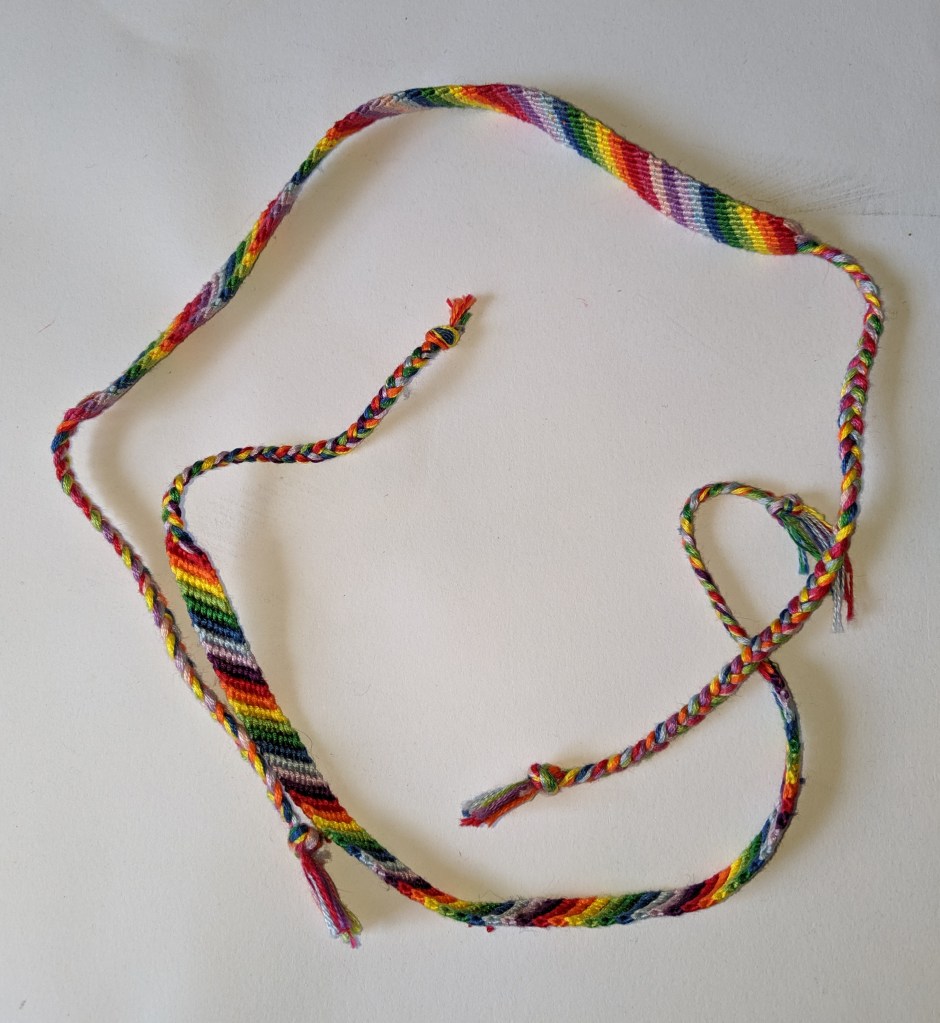
It became so much of a craze that I remember making a number of them and selling them at school for about $0.50c (50 cents) to about $1 to $2 depending on the complexity of the design. I remember spending many nights in front of the t.v. with one end of the bracelet pinned to my pant leg or the bean bag and I’d be madly tying the knots in preparation for the next day. Below are a couple of the bracelets I’ve held onto. They’re quite simple in comparison with some of the others I’ve made and sold.

Rainbow friendship bracelets. Diagonal design going from left to right. This image shows a close up of the design to show the darker and lighter reds, blues, greens and an orange and yellow and darker and lighter purple and pink.
Rainbow Friendship Bracelet made out of DMC cotton
This overhead shot shows two friendship bracelets that show the front and back of the bracelets. Both are rainbow diagonal going from left to right.
Overhead view of the rainbow friendship bracelets

It’s also important to note that with the selling of these bracelets, I had a limited market because I went to a small country school. When I graduated, there were a total of 74 students in the entire school and 8 people in my year. So my market was pretty small and there was someone else making the bracelets as well. Mine were better though!

In high school I was very much into writing and wanted to do something with that. I did a fair bit of cooking and craft classes to get my creative fix and did a bit of cross stitch at home. It was also at high school that I was introduced to quilting and photography. It was pretty cool developing the film in photography and learning how the whole process worked. I also knew early on that with photography, that if I had to do portraiture and tell people how to pose in photos, that I didn’t want to take it any further. I really don’t like telling people what to do and how to look to get a particular result. There’s also the pressure of getting the picture taken in a quick and short period of time and to that’s too much pressure.

I digress! I can’t help but wonder what things my nephew will be interested in and how everyone in his life can help to influence him in a positive way. I’m curious about whether he’ll stick with painting or progress onto other forms like pastels, charcoal and pencils. Or move onto mediums like pottery, origami, woodwork, metalwork and photography.

The really cool thing has been seeing that the creative flair remaining strong in my immediate and extended family. My grandparents on both sides of my family were creative with their photography, knitting, painting, gardening and music. I remember my grand father on Dad’s side, bringing out the piano accordion or mandolin on Christmas Eve and would play us some tunes. Sometimes he would sing as well. There was a few times there where he had tried to teach some of my cousins and I how to play the mandolin . My fingers were too small at the time and they haven’t grown much since!

Many of my aunts are creative with their painting and gardening and one of my uncles has taught himself to play the guitar. One of my cousins is/has been in a number of different bands and has performed on stage with his band. Another cousin of mine is creative with her hairdressing and make-up artistry. Meanwhile, my sister and her fiance are creative in their own rights with their talents in music (drums and possibly guitar), pottery, drawing and photography.

So my nephew has no escape from this strong creative flair and I can’t wait to see what comes of it!

Posted in Uncategorized

Halloween Cross Stitch – Admiring from a distance

Hi Everyone

As an Aussie, Halloween has never been a big part of my life. I love horror and thriller movies, tv shows and novels. I’m facinated by ghost stories and urban legends. All of which has sometimes caused me to be a little scared a times, when I’ve needed to drive home late at night, the fog’s starting to roll in and I think to myself that this would be a great start to a ‘Supernatural’ episode!

Meanwhile, over the last few months when I’ve been watching Flosstube, a lot of Halloween themed cross stitch has caught my – especially some of the designs that the Sunshine Stitchers have shown as part of their WIP’s and finishes. In their latest episode (shown below), checkout the framed Halloween projects in the background.

Sunshine Stitchers – Episode #50 – 29 September 2019

Another flosstuber who’s caught my eye for Halloween things is Javagirlstitches – episode 15:

The awesome thing with flosstube is that everyone who shows us the projects they’re working on, also talks about where they got their patterns from and fabrics. I love this because I’ve started doing some searches on the Internet and it’s going to get me into a world of pain soon. All because I’ll want to buy all of the things and then want to stitch all of the things when they arrive in the mail and I’ve already got enough on the go! Or have I?!

The patterns that have caught my eye include (but not limited to):

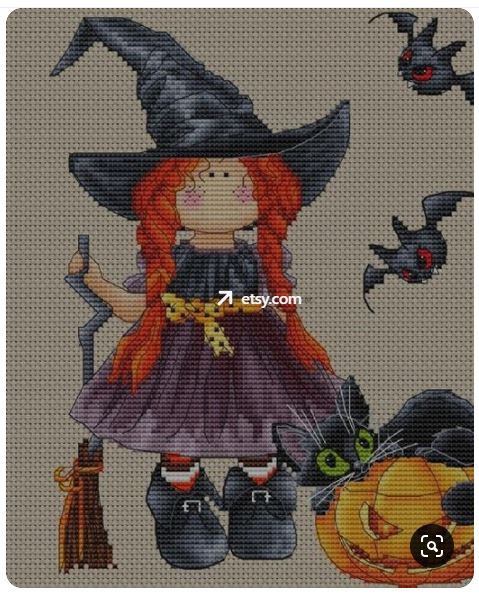
The Cottage Needle’s petite cross stitch of ‘The Classical Sorceress Witch’ (loosely translated from the French title on The Cottage Needle’s etsy store. Les PETiTES CROiX De LUCIE Le Sorciere Classical Witch):

The Cottage Needle’s ‘Classic Sorceress Witch’ – image captured from Pinterest – pattern available from The Cottage Needle’s etsy site.

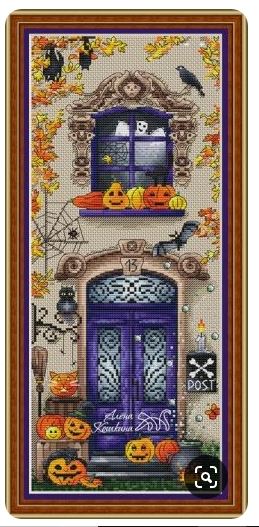
‘Halloween Balcony’ cross stitch pattern by Alena Koshkina, which is available from the Mybobbin Crafts Online store:

Image from Pinterest

I love the colours that Alena has chosen for this pattern and the colour of fabric just makes everything pop!

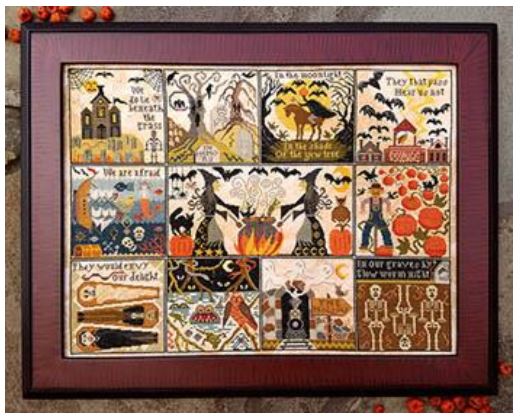
“Halloween at Hawk Run Hollow” by Carriage House Samplings, which is available from the Everything Cross Stitch website:

Image from the Everything Cross Stitch website.

“Halloween Night” by Alena Koshkina which is also available from the Mybobbin Crafts Online store:

Image from the Mybobbins Crafts Online Store

‘Sleepy Hollow’ by Glendon Place and it’s available from Sandra’s Stitch Stash. I saw this pattern as part of Gary’s (from the Sunshine Stitchers) WIP parade. He’s done a fantastic job on it!

Image from Sandra’s Stitch Stash

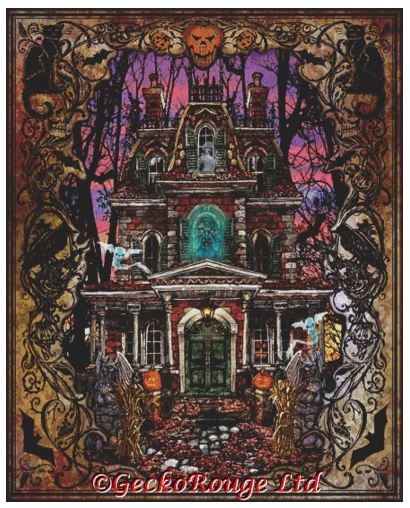
Last, but not least is ‘Fright Night’ by Lewis T Johnson and sold by Geko Rouge. My jaw dropped and my eyes widened when I saw this one! Just wow! The detail!

Image from Geko Rouge website

The awesome thing with all of this, is that this is just a sample – a tiny sample – of what’s out there! As I was scrolling through Pinterest and the different website I visited to put this post together, I came across more and more images and projects that I wanted to add to the list to share with you, let alone add to my collection!

Honourable mentions should go to Heaven and Earth Designs, 123Stitch and Hands On Designs. All three websites have some amazing Halloween themed pieces to work on.

Until next time, happy stitching!

Posted in Uncategorized

Cross Stitch, Footy Finals and Blogging

Hi Everyone

It’s been a big week. I’ve successfully completed my first full week at my new job, finished my second week of three days at the gym and I’m exhausted. I’ve been really tired and slept through the majority of the night, but my quality of sleep hasn’t been great. I know that a lot of it’s to do with not drinking enough water, I’ve been taking on bucket loads of information and my muscles are sore (a good sore though!).

In the lead up to this weekend, conversations and news items on the tv have grabbed my attention about footy finals and I’ve been mulling over in my mind, what I want to write about this week for this blog post – both of which I’ll talk about a little later.

Cross Stitch

For all of this week I’ve been able to get some cross stitch done and I’ve managed to stick to one project! I’m still working on the fishing project and I really should have taken a progress shot last week, so that you could see how much more I’ve done. However, the picture below shows what I have been able to do over the last few months – most of which has been done over the last few weeks…

‘Fishing on the River’ / ‘Out Fishing’ – Designed by Collette Bispham – my progress so far

The strands of floss you see to the left and right of the WIP are for when I get to the next stages of the pattern. Also, in an earlier post, I had called this pattern ‘Fishing on the River’. I had used this name based upon sub-heading the Cross Stitch Gold magazine had used. Meanwhile, I’ve found that it’s been called ‘Out Fishing’ on the pages of the actual pattern and its details. As a result of this, I’m gong to call this project the fishing project just to keep it simple. Also, it’s the only fishing project I’m working on at the moment.

The other important thing to note with this project, is that I’ve chosen to use a brown Aida, rather than the recommended cream Aida. It is still 14 count though. I decided to use the brown Aida because I had the right amount for the pattern and enough excess for framing (or whatever I choose to do for the finish). Also, I thought that it would give the project an interesting finish because of the brown border the finished project has.

Now that I’ve taken the fishing project out of the hoop and ironed it to show you the progress, I’m itching to start a new project or move onto an existing project. I’m still umming and arrring about a new Christmas project. A lot of this is due to the patterns and fabric for the projects are in my stitching corner (I’m currently residing in my lounge room on the chase part of the couch), and I can see them every time I sit down to work on the fishing project or any other one I choose to work on. What’s holding me back at the moment, is figuring out which threads I use – DMC or Anchor threads. The patterns have listings for both brands and I have no doubt that I have all of the called for threads. Two things that are holding me back on starting a new project are:

  1. It’s another new project. I have so many other projects at the moment. Do I really need another one? Also, if I do start a new project, which one should I start? Should it be a small, easy one that I can finish in about a week and finish as a card? Or should it be one that will take a few months (at least) to finish?
  2. Where and how am I going to store the project if start a new one? Many of the YouTube clips I’ve watched over recent months have talked about and shown us their project bag collections and new additions to that collection. I don’t have anything like that at the moment and I’m starting to think that I need to have some. I do have a couple of Lincraft bags I use as travel bags for my WIPs and I’m currently using them for existing projects that I’m actively working on.

I’m also leaning towards going back to my mini mushroom project.

Mini Mushroom WIP – image taken back around the end of June 2019

I’ve stitched a lot more since the above image was taken. I’ve really enjoyed seeing it come to life so far because it’s one of my own designs and like any project, I love seeing it come to life.

Additionally, I had a reminder come up on my IT devices about finishing and sending off a finished project to the framer’s, to then enter it in the 2020 Sydney Royal Easter Show. I haven’t finished my intended project for this show, but the reminders about the framing, reminded me of the plan/s I have for my stitching and what I want to achieve with it. I will achieve and complete those plans. It will just be on a slightly different timeline to what I had initially intended for them!

Footy Finals

It’s also the AFL (Australian Football League) Grand Final this weekend and NRL (National Rugby League) semi-final. I’m not a regular follower of the NRL, but I’m mentioning it now because the Canberra Raiders have made it to the Grand Final – 25 years in the making! So for the next 7 days at least, there are going to be a whole heap of local businesses getting behind the team with Raiders paraphernalia, green decorations and green food. It would be so good if the Raiders won because it’s been so long between drinks and if I had to support an NRL team, why not my home team?!

Meanwhile, today (Saturday 28 September 2019) is the AFL Grand Final and it’s going to be HUGE! We have Richmond Tigers versus the Greater Western Sydney (GWS) Giants. The Tigers have been part of the AFL for over 100 years whilst the Giants have only been around for 8 years and this is their first grand final. The Tigers have a number of flags under their belt – most recently, a couple of years ago. So, I’m really hoping that Giants win because they’re such a young team.

Update – The Tigers won. Their experience meant that they completely thrashed the Giants – 114 to 25. That said, it was a history making game in so many ways. What I hadn’t realised until the commentators said it, 100 years ago, the Tigers were in their first grand final, now 100 years later, the Giants were in their first grand final.

Blogging Mojo

I feel like I’m loosing my blogging mojo. Or at least, I think I need to re-adjust the direction I move with my blog. This may assist with me practising what I’m preaching with regards to promoting cross stitch and the designers who are having such a huge influence on the direction that cross stitch is going.

Alternatively, I’m thinking that I could have posts a lot like everyone else’s, and have weekly or monthly updates and have WIP (work in progress) parades, finishes, full finishes (e.g. framed, cards etc.) and starts. The challenge I’m working through with this, is the fear I have of being over-looked or my posts being considered ‘yawn-fests’ because I’m talking about very similar things to everyone else. The slight positive is that I’ll be stitching things a little different to everyone else!

Your help is needed

Any feedback you can provide on what you want to see and read about cross stitch would be great! Do you want to know about what others are doing? What I’m stitching?

Until next time, happy stitching!